
电针和艾灸改善了葡聚糖硫酸钠诱导的结肠炎小鼠的焦虑行为。
Electroacupuncture and Moxibustion Improved Anxiety Behavior in DSS-Induced Colitis Mice.
作者信息
Wei Daneng, Zhao Na, Xie Lushuang, Huang Biao, Zhuang Zhiqi, Tang Yong, Yu Shuguang, Wu Qiaofeng
机构信息
Acupuncture and Tuina School, Chengdu University of Traditional Chinese Medicine, Chengdu, Sichuan 610075, China.
Pharmacy School, Chengdu University of Traditional Chinese Medicine, Chengdu, Sichuan 610075, China.
出版信息
Gastroenterol Res Pract. 2019 Feb 7;2019:2345890. doi: 10.1155/2019/2345890. eCollection 2019.
BACKGROUND AND AIMS
Psychological disorders are prevalent in patients with inflammatory bowel disease, but the underlying mechanisms remain unknown. The aim of this study was to study whether electroacupuncture (EA) and moxibustion (MB) can improve anxiety behavior in DSS-induced colitis mice and to investigate whether this effect is related to hypothalamic-pituitary-adrenocortical (HPA) axis.
METHODS
The colitis model was established by drinking 2.5% dextran sodium sulfate (DSS). DSS-induced colitis mice were treated by EA or MB. Disease activity index (DAI) was scored; intestinal morphological and pathological structure was observed; anxiety behavior was tested by the elevated plus maze and open field. The concentration of corticotropin-releasing hormone (CRH) and cortisol (CORT) in serum was measured by enzyme-linked immunosorbent assay (ELISA). The protein expression of CRH in the colon and hypothalamus was detected by Western blot (WB).
RESULTS
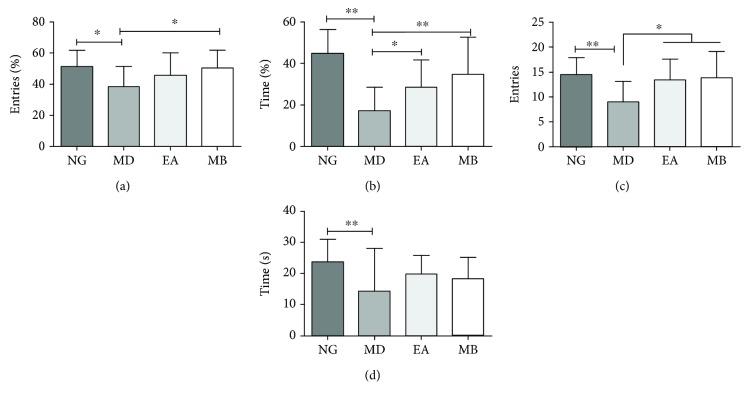
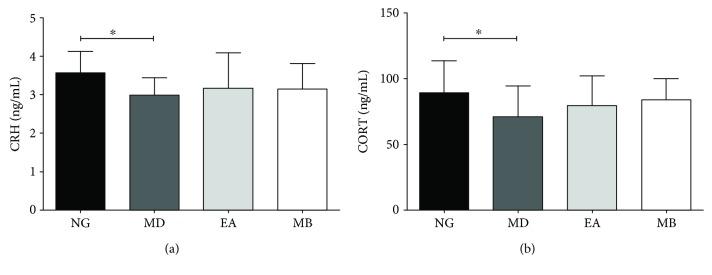
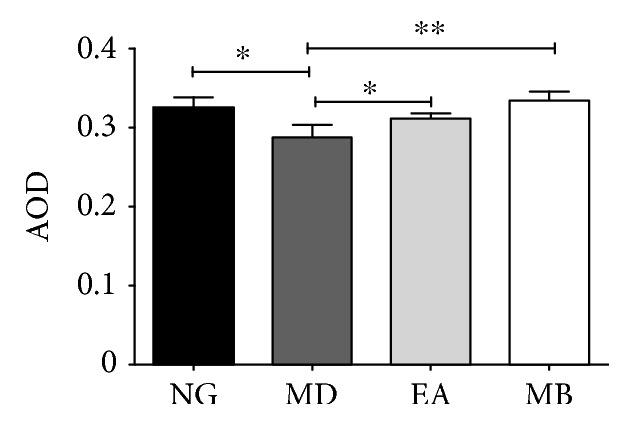
Both EA and MB treatments can improvethe morphology of their distal colonic mucosal epithelia, as well as the disease activity index. Meanwhile, anxiety behavior in colitis mice was improved slightly after EA and MB treatment. In addition, the levels of CRH and CORT in the serum were slightly improved after EA and MB treatment. These effects are further supported by WB results. The expression of CRH in the colon and hypothalamus was increased significantly after treatment, compared with the model group.
CONCLUSION
EA and MB were able to regulate the concentration of CRH in serum and protein expression in the peripheral and central at different levels and promote the recovery of the HPA axis that may be the basis for EA and MB to improve colonic pathology and alleviate anxiety behavior in DSS-induced colitis.
背景与目的
心理障碍在炎症性肠病患者中普遍存在,但其潜在机制尚不清楚。本研究旨在探讨电针(EA)和艾灸(MB)是否能改善葡聚糖硫酸钠(DSS)诱导的结肠炎小鼠的焦虑行为,并研究这种作用是否与下丘脑 - 垂体 - 肾上腺皮质(HPA)轴有关。
方法
通过饮用2.5%的葡聚糖硫酸钠(DSS)建立结肠炎模型。对DSS诱导的结肠炎小鼠进行EA或MB治疗。对疾病活动指数(DAI)进行评分;观察肠道形态和病理结构;通过高架十字迷宫和旷场试验测试焦虑行为。采用酶联免疫吸附测定(ELISA)法检测血清中促肾上腺皮质激素释放激素(CRH)和皮质醇(CORT)的浓度。通过蛋白质免疫印迹法(WB)检测结肠和下丘脑中CRH的蛋白表达。
结果
EA和MB治疗均能改善其远端结肠黏膜上皮的形态以及疾病活动指数。同时,EA和MB治疗后,结肠炎小鼠的焦虑行为略有改善。此外,EA和MB治疗后血清中CRH和CORT的水平略有改善。WB结果进一步支持了这些作用。与模型组相比,治疗后结肠和下丘脑中CRH的表达显著增加。
结论
EA和MB能够在不同水平调节血清中CRH的浓度以及外周和中枢的蛋白表达,并促进HPA轴的恢复,这可能是EA和MB改善DSS诱导的结肠炎结肠病理和缓解焦虑行为的基础。




 Zotero 插件