
MicroRNA-596 在胃癌中作为一种肿瘤抑制因子发挥作用,其表达受启动子去甲基化的上调。
MicroRNA-596 acts as a tumor suppressor in gastric cancer and is upregulated by promotor demethylation.
机构信息
Department of Gastroenterological Surgery, the Fourth Affiliated Hospital of China Medical University, Shenyang 110032, Liaoning Province, China.
出版信息
World J Gastroenterol. 2019 Mar 14;25(10):1224-1237. doi: 10.3748/wjg.v25.i10.1224.
BACKGROUND
In the present study, we investigated a suppressive role of microRNA-596 (miR-596) in gastric cancer (GC). Moreover, the downregulation of miR-596 in GC cell lines was associated with an increase of miR-596 promoter methylation. We also established that miR-596 controls the expression of peroxiredoxin 1 (PRDX1), which has never been reported before, suggesting that this interaction could play an important role in GC progression.
AIM
To study the potential role and possible regulatory mechanism of miR-596 in GC.
METHODS
The expression levels of miR-596 and PRDX1 in gastric cancer tissues and cell lines were detected by quantitative real-time PCR (qRT-PCR). Western blot and luciferase reporter assay were used to detect the effect of miR-596 on PRDX1 expression. Then, the proliferation, metastasis, and invasion of GC cell lines transfected with miR-596 mimics were analyzed, respectively, by Cell Counting Kit-8 proliferation assay, wound healing assay, and transwell invasion assay. Meanwhile, the methylation status of the promoter CpG islands of miR-596 in GC cell lines was detected by methylation-specific PCR (MSP).
RESULTS
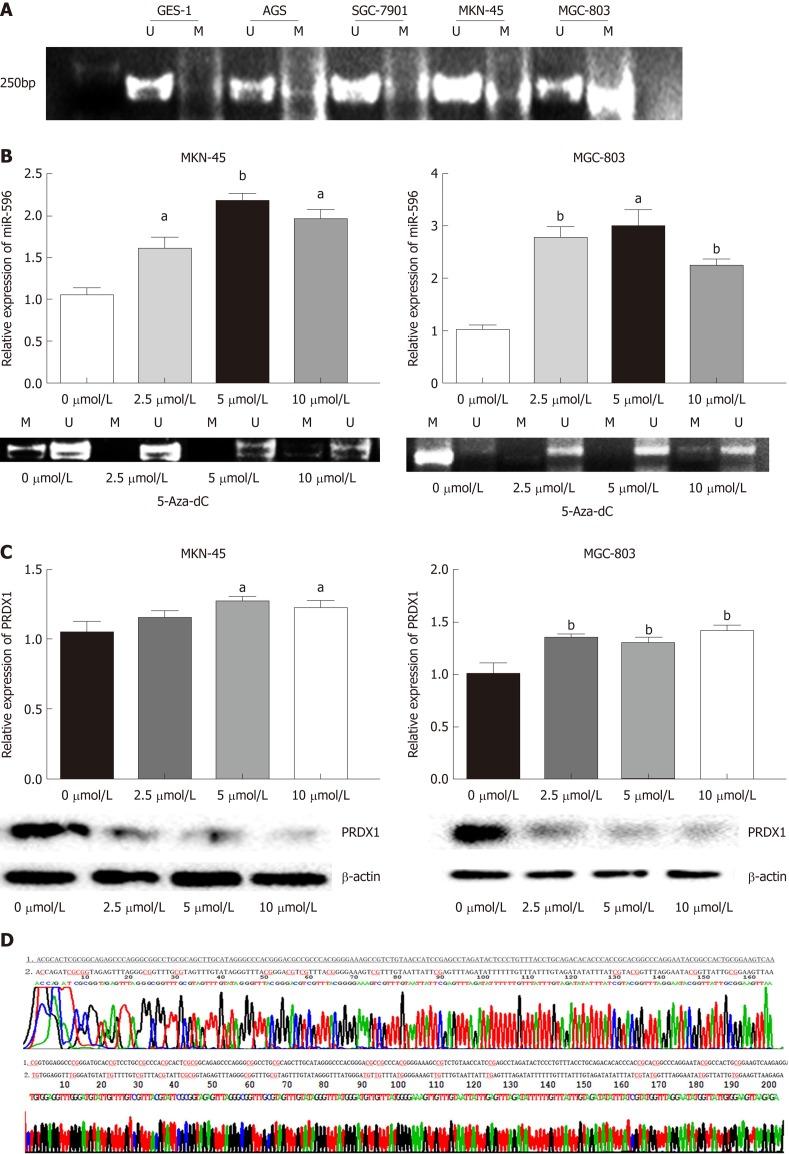
Expression of miR-596 was decreased and PRDX1 was upregulated in GC tissues and cell lines. Overexpression of miR-596 decreased the expression of PRDX1 and luciferase reporter assays detected the direct binding of miR-596 to the 3'-untranslated region (UTR) of PRDX1 transcripts. Furthermore, we found that overexpression of miR-596 remarkably suppressed cell proliferation, migration, and invasion in GC cells. We further analyzed miR-596 promoter methylation by MSP and qRT-PCR, and found the downregulation of miR-596 was associated with promoter methylation status in GC cell lines. Moreover, DNA demethylation and reactivation of miR-596 after treatment with 5-Aza-2'-deoxycytidine inhibited the proliferative ability of GC cells.
CONCLUSION
MiR-596 has a tumor suppressive role in GC and is downregulated partly due to promoter hypermethylation. Furthermore, PRDX1 is one of the putative target genes of miR-596.
背景
在本研究中,我们研究了 microRNA-596(miR-596)在胃癌(GC)中的抑制作用。此外,GC 细胞系中 miR-596 的下调与 miR-596 启动子甲基化的增加有关。我们还证实,miR-596 控制过氧化物还原酶 1(PRDX1)的表达,这是以前从未报道过的,表明这种相互作用可能在 GC 进展中发挥重要作用。
目的
研究 miR-596 在 GC 中的潜在作用和可能的调节机制。
方法
通过实时定量 PCR(qRT-PCR)检测胃癌组织和细胞系中 miR-596 和 PRDX1 的表达水平。Western blot 和荧光素酶报告基因检测用于检测 miR-596 对 PRDX1 表达的影响。然后,通过细胞计数试剂盒-8 增殖试验、划痕愈合试验和 Transwell 侵袭试验分别分析转染 miR-596 模拟物的 GC 细胞系的增殖、转移和侵袭能力。同时,通过甲基化特异性 PCR(MSP)检测 GC 细胞系中 miR-596 启动子 CpG 岛的甲基化状态。
结果
miR-596 在 GC 组织和细胞系中的表达降低,PRDX1 上调。miR-596 的过表达降低了 PRDX1 的表达,荧光素酶报告基因检测检测到 miR-596 与 PRDX1 转录物的 3'-非翻译区(UTR)的直接结合。此外,我们发现 miR-596 的过表达显著抑制 GC 细胞的增殖、迁移和侵袭。我们通过 MSP 和 qRT-PCR 进一步分析 miR-596 启动子甲基化,发现 GC 细胞系中 miR-596 的下调与启动子甲基化状态有关。此外,5-Aza-2'-脱氧胞苷处理后 miR-596 的去甲基化和再激活抑制了 GC 细胞的增殖能力。
结论
miR-596 在 GC 中具有肿瘤抑制作用,部分原因是启动子过度甲基化。此外,PRDX1 是 miR-596 的一个假定靶基因。


 Zotero 插件