
新生儿和婴儿用化妆品:产品成分中的半抗原。
Cosmetics for neonates and infants: haptens in products' composition.
作者信息
Dumycz Karolina, Kunkiel Katarzyna, Feleszko Wojciech
机构信息
Department of Pediatric Pneumology and Allergy, The Medical University of Warsaw, Żwirki i Wigury 63A, 02-091 Warsaw, Poland.
出版信息
Clin Transl Allergy. 2019 Mar 8;9:15. doi: 10.1186/s13601-019-0257-8. eCollection 2019.
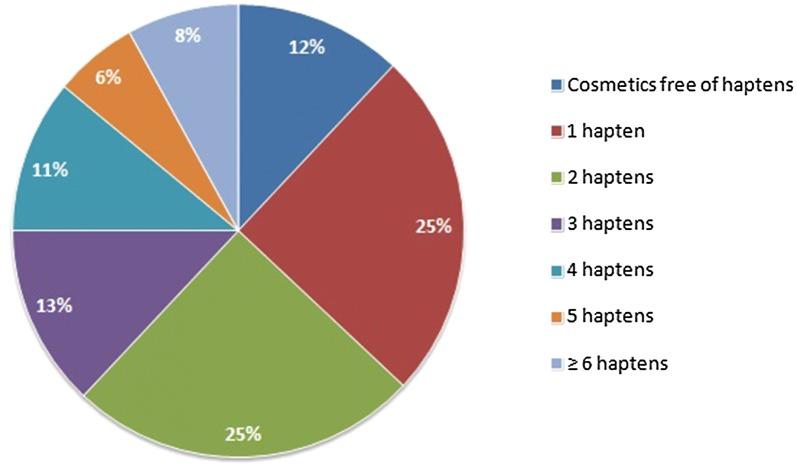
Cosmetics and skin care products for neonates and infants are considered as ''hypoallergenic'', "tested" or ''safe''. Nevertheless, the prevalence of haptens in these products is a matter of concern, since allergic contact dermatitis in children is gaining an importance. We aimed to assess the prevalence of haptens in cosmetics designed for children younger than 1 year. To identify haptens, the components of the cosmetics listed on packaging were compared with substances from European baseline series, Cosmetics series and Fragrance series. Survey comprised 212 cosmetics among which 186 (87.7%) contained at least one hapten from reference lists. Altogether there were 41 different haptens found in cosmetics. Number of sensitizers per product ranged between 1-12 and, each product contained 2.51 haptens on average. The most abundant sensitizers were cocamidopropyl betaine, tocopherol, propylene glycol, fragrances, lanolin. Majority of products for children were labeled as hypoallergenic/dermatologically tested/safe for children etc. from which 85% contained haptens. This survey highlights the extent of presence of haptens in cosmetics for children under the first year of age.
用于新生儿和婴儿的化妆品及护肤品被认为是“低过敏性的”、“经过测试的”或“安全的”。然而,这些产品中半抗原的流行情况令人担忧,因为儿童过敏性接触性皮炎正变得越来越重要。我们旨在评估针对1岁以下儿童设计的化妆品中半抗原的流行情况。为了识别半抗原,将包装上列出的化妆品成分与欧洲基线系列、化妆品系列和香料系列中的物质进行了比较。调查包括212种化妆品,其中186种(87.7%)含有参考列表中的至少一种半抗原。化妆品中共发现41种不同的半抗原。每个产品中致敏剂的数量在1至12种之间,每个产品平均含有2.51种半抗原。最常见的致敏剂是椰油酰胺丙基甜菜碱、生育酚、丙二醇、香料、羊毛脂。大多数儿童产品被标注为低过敏性/经过皮肤测试/对儿童安全等,其中85%含有半抗原。这项调查突出了一岁以下儿童化妆品中半抗原的存在程度。
 Zotero 插件