
六氟环氧丙烷二聚酸(GenX)经口妊娠期暴露对 Sprague-Dawley 大鼠母体、胎儿和产后的不良影响。
Adverse Maternal, Fetal, and Postnatal Effects of Hexafluoropropylene Oxide Dimer Acid (GenX) from Oral Gestational Exposure in Sprague-Dawley Rats.
机构信息
1 Toxicity Assessment Division, National Health and Environmental Effects Research Laboratory, Office of Research and Development (ORD), U.S. Environmental Protection Agency (U.S. EPA) , Research Triangle Park, North Carolina, USA.
2 Exposure Methods and Measurements Division, National Exposure Research Laboratory, ORD, U.S. EPA , Research Triangle Park, North Carolina, USA.
出版信息
Environ Health Perspect. 2019 Mar;127(3):37008. doi: 10.1289/EHP4372.
BACKGROUND
Hexafluoropropylene oxide dimer acid [(HFPO-DA), GenX] is a member of the per- and polyfluoroalkyl substances (PFAS) chemical class, and elevated levels of HFPO-DA have been detected in surface water, air, and treated drinking water in the United States and Europe.
OBJECTIVES
We aimed to characterize the potential maternal and postnatal toxicities of oral HFPO-DA in rats during sexual differentiation. Given that some PFAS activate peroxisome proliferator-activated receptors (PPARs), we sought to assess whether HFPO-DA affects androgen-dependent development or interferes with estrogen, androgen, or glucocorticoid receptor activity.
METHODS
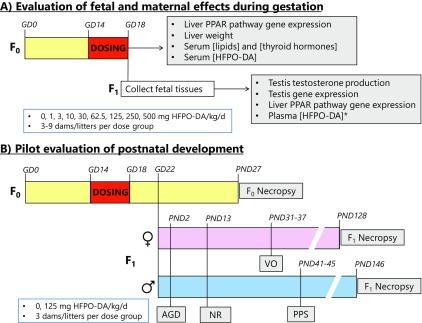
Steroid receptor activity was assessed with a suite of in vitro transactivation assays, and Sprague-Dawley rats were used to assess maternal, fetal, and postnatal effects of HFPO-DA exposure. Dams were dosed daily via oral gavage during male reproductive development (gestation days 14-18). We evaluated fetal testes, maternal and fetal livers, maternal serum clinical chemistry, and reproductive development of F1 animals.
RESULTS
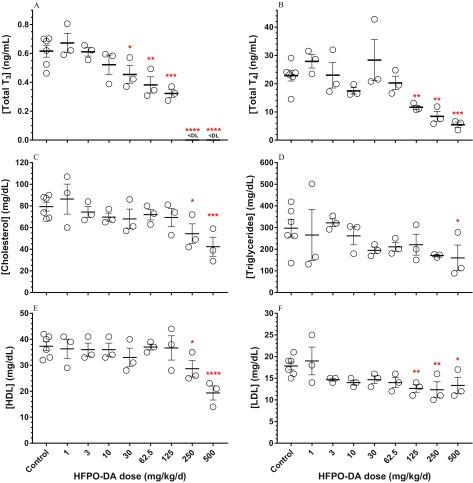
HFPO-DA exposure resulted in negligible in vitro receptor activity and did not impact testosterone production or expression of genes key to male reproductive development in the fetal testis; however, in vivo exposure during gestation resulted in higher maternal liver weights ([Formula: see text]), lower maternal serum thyroid hormone and lipid profiles ([Formula: see text]), and up-regulated gene expression related to PPAR signaling pathways in maternal and fetal livers ([Formula: see text]). Further, the pilot postnatal study indicated lower female body weight and lower weights of male reproductive tissues in F1 animals.
CONCLUSIONS
HFPO-DA exposure produced multiple effects that were similar to prior toxicity evaluations on PFAS, such as perfluorooctane sulfonate (PFOS) and perfluorooctanoic acid (PFOA), but seen as the result of higher oral doses. The mean dam serum concentration from the lowest dose group was 4-fold greater than the maximum serum concentration detected in a worker in an HFPO-DA manufacturing facility. Research is needed to examine the mechanisms and downstream events linked to the adverse effects of PFAS as are mixture-based studies evaluating multiple PFAS. https://doi.org/10.1289/EHP4372.
背景
六氟环氧丙烷二聚酸[(HFPO-DA),GenX]是全氟和多氟烷基物质(PFAS)化学物质类别的成员,在美国和欧洲,地表水、空气和处理过的饮用水中都检测到了高水平的 HFPO-DA。
目的
我们旨在研究在性分化过程中口服 HFPO-DA 对大鼠潜在的母体和产后毒性。鉴于某些 PFAS 会激活过氧化物酶体增殖物激活受体(PPARs),我们试图评估 HFPO-DA 是否会影响雄激素依赖性发育或干扰雌激素、雄激素或糖皮质激素受体活性。
方法
采用一系列体外转录激活测定法评估甾体受体活性,并使用 Sprague-Dawley 大鼠评估 HFPO-DA 暴露对母体、胎儿和产后的影响。在雄性生殖发育期间(妊娠第 14-18 天),通过口服灌胃每天对母体进行给药。我们评估了胎儿睾丸、母体和胎儿肝脏、母体血清临床化学以及 F1 动物的生殖发育。
结果
HFPO-DA 暴露导致的体外受体活性可忽略不计,并且不会影响胎儿睾丸中的睾酮产生或与雄性生殖发育相关的基因表达;然而,在妊娠期间的体内暴露会导致母体肝脏重量增加([Formula: see text])、母体血清甲状腺激素和脂质谱降低([Formula: see text])以及母体和胎儿肝脏中与 PPAR 信号通路相关的基因表达上调([Formula: see text])。此外,初步的产后研究表明,F1 动物的雌性体重较低,雄性生殖组织重量较低。
结论
HFPO-DA 暴露产生了多种与之前对 PFAS(如全氟辛烷磺酸(PFOS)和全氟辛酸(PFOA))的毒性评估相似的影响,但这些影响是由更高的口服剂量引起的。最低剂量组母鼠血清浓度的平均值是在 HFPO-DA 制造设施工作的工人中检测到的最高血清浓度的 4 倍。需要研究来检查与 PFAS 不良影响相关的机制和下游事件,以及评估多种 PFAS 的基于混合物的研究。https://doi.org/10.1289/EHP4372。





 Zotero 插件