
Group 3 ILCs:和平守护者还是麻烦制造者?你的直觉告诉你什么!
Group 3 ILCs: Peacekeepers or Troublemakers? What's Your Gut Telling You?!
机构信息
Kennedy Institute of Rheumatology, University of Oxford, Oxford, United Kingdom.
Department of Inflammation Biology, Centre for Inflammation and Cancer Immunology, King's College London, London, United Kingdom.
出版信息
Front Immunol. 2019 Apr 5;10:676. doi: 10.3389/fimmu.2019.00676. eCollection 2019.
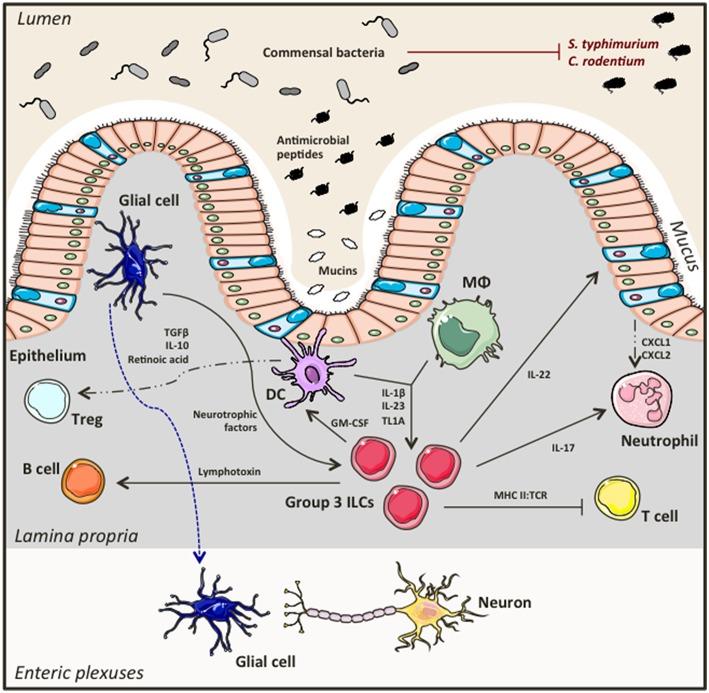
A complex network of interactions exists between the microbiome, the epithelium, and immune cells that reside along the walls of the gastrointestinal tract. The intestinal immune system has been assigned with the difficult task of discriminating between commensal, harmless bacteria, and invading pathogens that translocate across the epithelial monolayer. Importantly, it is trained to maintain tolerance against commensals, and initiate protective immune responses against pathogens to secure intestinal homeostasis. Breakdown of this fine balance between the host and its intestinal microbiota can lead to intestinal inflammation and subsequently to development of inflammatory bowel disease (IBD). A decade since their discovery, innate lymphoid cells (ILCs) are now recognized as important regulators of intestinal homeostasis. ILC3s have emerged as a critical subset in the gut. They are the most phenotypically diverse ILC population and interact directly with numerous different cell types (haematopoietic and non-haematopoeitic), as well as interface with the bacterial flora. In addition to their contribution to intestinal pathogen immunity, they also mitigate against tissue damage occurring following acute injury, by facilitating tissue repair and regeneration, a key function in the maintenance of intestinal homeostasis. However, in chronic inflammation the tables are turned and ILC3s may acquire a pro-inflammatory phenotype in the gut. Chronic ILC activation can lead to persistent inflammation contributing to IBD and/or colorectal cancer. In this review, we discuss current knowledge of group 3 ILCs and their contributions to intestinal homeostasis and disease leading to novel therapeutic targets and clinical approaches that may inform novel treatment strategies for immune-mediated disorders, including IBD.
肠道微生物群、上皮细胞和免疫细胞之间存在着复杂的相互作用网络,这些细胞存在于胃肠道壁上。肠道免疫系统面临着艰巨的任务,需要区分共生的、无害的细菌和穿过上皮细胞单层转移的入侵病原体。重要的是,它被训练成对共生菌保持耐受,并对病原体发起保护性免疫反应,以确保肠道内环境稳定。宿主与其肠道微生物群之间的这种微妙平衡的打破可导致肠道炎症,并随后导致炎症性肠病(IBD)的发生。自发现以来的十年间,先天淋巴细胞(ILC)现在被认为是肠道内环境稳定的重要调节者。ILC3 已成为肠道中的一个关键亚群。它们是表型最多样化的 ILC 群体,直接与众多不同的细胞类型(造血细胞和非造血细胞)相互作用,并且与细菌菌群相互作用。除了对肠道病原体免疫的贡献外,它们还通过促进组织修复和再生,减轻急性损伤后发生的组织损伤,这是维持肠道内环境稳定的关键功能。然而,在慢性炎症中,情况发生了变化,ILC3 可能在肠道中获得促炎表型。慢性 ILC 激活可导致持续性炎症,导致 IBD 和/或结直肠癌。在这篇综述中,我们讨论了 ILC3 的当前知识及其对肠道内环境稳定和疾病的贡献,为免疫介导的疾病提供了新的治疗靶点和临床方法,包括 IBD。


 Zotero 插件