
同种异体造血干细胞移植后清除急性髓系白血病微小残留病的自然杀伤细胞免疫治疗。
Natural Killer Immunotherapy for Minimal Residual Disease Eradication Following Allogeneic Hematopoietic Stem Cell Transplantation in Acute Myeloid Leukemia.
机构信息
Division of Hematology, Department of Medicine, Showa University School of Medicine, Tokyo 142-8555, Japan.
出版信息
Int J Mol Sci. 2019 Apr 26;20(9):2057. doi: 10.3390/ijms20092057.
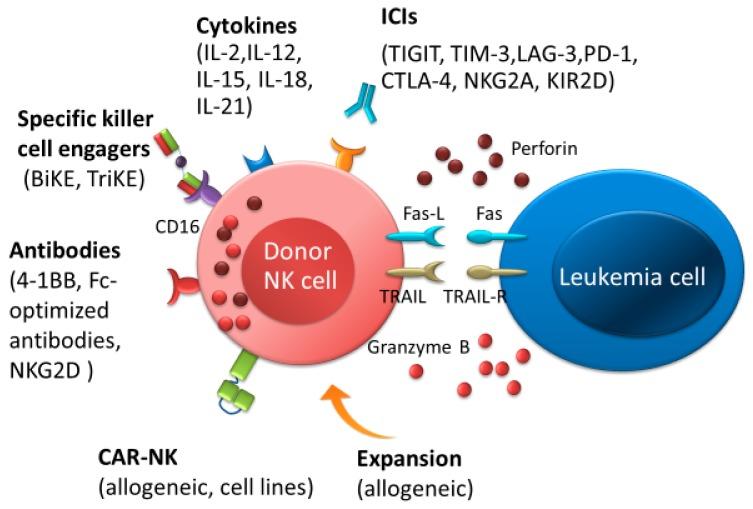
The most common cause of death in patients with acute myeloid leukemia (AML) who receive allogeneic hematopoietic stem cell transplantation (allo-HSCT) is AML relapse. Therefore, additive therapies post allo-HSCT have significant potential to prevent relapse. Natural killer (NK)-cell-based immunotherapies can be incorporated into the therapeutic armamentarium for the eradication of AML cells post allo-HSCT. In recent studies, NK cell-based immunotherapies, the use of adoptive NK cells, NK cells in combination with cytokines, immune checkpoint inhibitors, bispecific and trispecific killer cell engagers, and chimeric antigen receptor-engineered NK cells have all shown antitumor activity in AML patients. In this review, we will discuss the current strategies with these NK cell-based immunotherapies as possible therapies to cure AML patients post allo-HSCT. Additionally, we will discuss various means of immune escape in order to further understand the mechanism of NK cell-based immunotherapies against AML.
在接受异基因造血干细胞移植(allo-HSCT)的急性髓系白血病(AML)患者中,最常见的死亡原因是 AML 复发。因此,allo-HSCT 后附加治疗具有显著预防复发的潜力。基于自然杀伤(NK)细胞的免疫疗法可以纳入治疗方案,以清除 allo-HSCT 后 AML 细胞。在最近的研究中,NK 细胞为基础的免疫疗法,过继性 NK 细胞的使用,NK 细胞与细胞因子联合使用,免疫检查点抑制剂,双特异性和三特异性杀伤细胞衔接子,以及嵌合抗原受体工程化 NK 细胞,在 AML 患者中均显示出抗肿瘤活性。在这篇综述中,我们将讨论目前使用这些基于 NK 细胞的免疫疗法的策略,作为治愈 allo-HSCT 后 AML 患者的可能疗法。此外,我们还将讨论各种免疫逃逸的方式,以便进一步了解 NK 细胞为基础的免疫疗法对抗 AML 的机制。


 Zotero 插件