
颅内动脉瘤破裂会引起全身反应,涉及特定基因亚型的表达。
Systemic response to rupture of intracranial aneurysms involves expression of specific gene isoforms.
机构信息
Department of Molecular Neuropharmacology, Institute of Pharmacology, Polish Academy of Sciences, ul. Smetna 12, 31-343, Kraków, Poland.
Department of Neurosurgery and Neurotraumatology, Faculty of Medicine, Jagiellonian University Medical College, ul. Botaniczna 3, 31-503, Kraków, Poland.
出版信息
J Transl Med. 2019 May 2;17(1):141. doi: 10.1186/s12967-019-1891-6.
BACKGROUND
Rupture of an intracranial aneurysm (IA) causes a systemic response that involves an immune/inflammatory reaction. Our previous study revealed a downregulation of genes related to T lymphocytes and an upregulation of genes related to monocytes and neutrophils after IA rupture. It remains unknown whether that resulted from alterations in transcription or cell count. We sought to characterize the systemic response to IA rupture through analysis of transcript expression profiles in peripheral blood cells. We also investigated effects of IA rupture on the composition of mononuclear cells in peripheral blood.
METHODS
We included 19 patients in the acute phase of IA rupture (RAA, first 72 h), 20 patients in the chronic phase (RAC, 3-15 months), and 20 controls. Using deep transcriptome sequencing, we analyzed the expression of protein-coding and noncoding RNAs. Expression levels, transcript biotypes, alternative splicing and other features of the regulated transcripts were studied. A functional analysis was performed to determine overrepresented ontological groups among gene expression profiles. Flow cytometry was used to analyze alterations in the level of mononuclear leukocyte subpopulations.
RESULTS
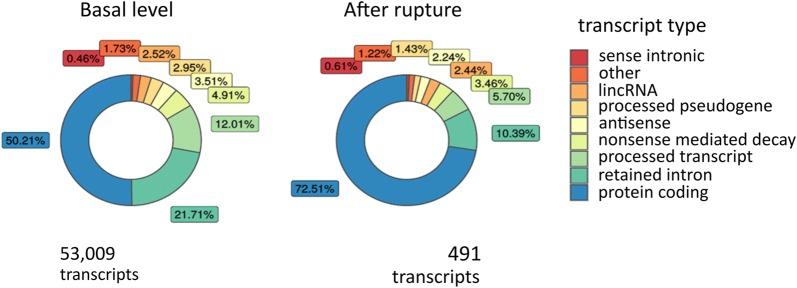
Comparing RAA and controls, we identified 491 differentially expressed transcripts (303 were downregulated, and 188 were upregulated in RAA). The results indicate that the molecular changes in response to IA rupture occur at the level of individual transcripts. Functional analysis revealed that the most impacted biological processes are related to regulation of lymphocyte activation and toll-like receptor signaling pathway. Differences between RAC and controls were less prominent. Analysis of leukocyte subsets revealed a significantly decreased number of CD4+ lymphocytes and increase of classical and intermediate monocytes in RAA patients compared to controls.
CONCLUSIONS
IA rupture in the acute phase strongly influences the transcription profiles of peripheral blood cells as well as the composition of mononuclear cells. A specific pattern of gene expression alteration was found, suggesting a depression of lymphocyte response and enhancement of monocyte activity.
背景
颅内动脉瘤(IA)破裂会引起全身性反应,涉及免疫/炎症反应。我们之前的研究表明,IA 破裂后,与 T 淋巴细胞相关的基因下调,与单核细胞和中性粒细胞相关的基因上调。目前尚不清楚这是转录或细胞计数的改变所致。我们试图通过分析外周血细胞中的转录表达谱来描述 IA 破裂后的全身性反应。我们还研究了 IA 破裂对外周血单核细胞组成的影响。
方法
我们纳入了 19 例 IA 破裂急性期患者(RAA,破裂后 72 小时内),20 例 IA 破裂慢性期患者(RAC,3-15 个月)和 20 例对照者。使用深度转录组测序,我们分析了蛋白质编码和非编码 RNA 的表达。研究了受调控转录本的表达水平、转录本生物型、选择性剪接和其他特征。进行了功能分析,以确定基因表达谱中过度表达的本体论组。采用流式细胞术分析单核白细胞亚群水平的变化。
结果
与对照组相比,RAA 组有 491 个差异表达的转录本(303 个下调,188 个上调)。结果表明,IA 破裂后分子变化发生在单个转录本水平。功能分析表明,受影响最严重的生物学过程与淋巴细胞激活和 Toll 样受体信号通路的调节有关。RAC 组与对照组之间的差异不明显。白细胞亚群分析显示,与对照组相比,RAA 患者的 CD4+淋巴细胞数量明显减少,经典和中间单核细胞数量增加。
结论
IA 破裂的急性期强烈影响外周血细胞的转录谱以及单核细胞的组成。发现了一种特定的基因表达改变模式,提示淋巴细胞反应抑制和单核细胞活性增强。



 Zotero 插件