
拟杆菌门利用数千种酶组合来分解聚糖。
Bacteroidetes use thousands of enzyme combinations to break down glycans.
机构信息
Architecture et Fonction des Macromolécules Biologiques (AFMB), Centre National de la Recherche Scientifique (CNRS, UMR7257), Institut National Agronomique (INRA, USC 1408) and Aix-Marseille Université (AMU), 13288 Marseille cedex 9, Marseille, France.
Department of Biological Sciences, King Abdulaziz University, Jeddah, Saudi Arabia.
出版信息
Nat Commun. 2019 May 3;10(1):2043. doi: 10.1038/s41467-019-10068-5.
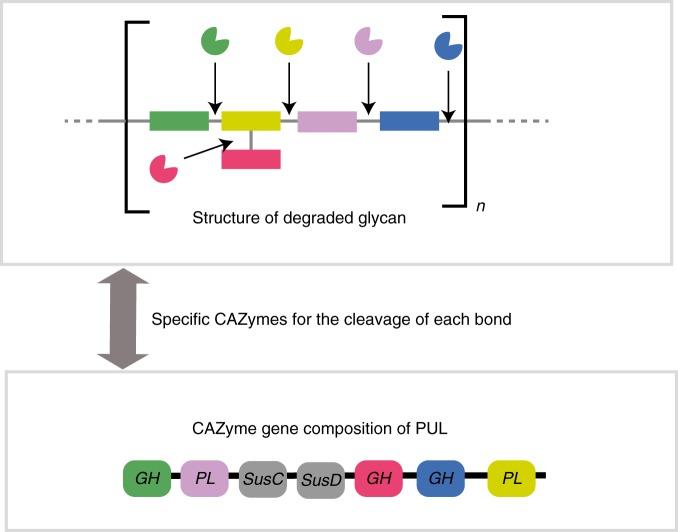
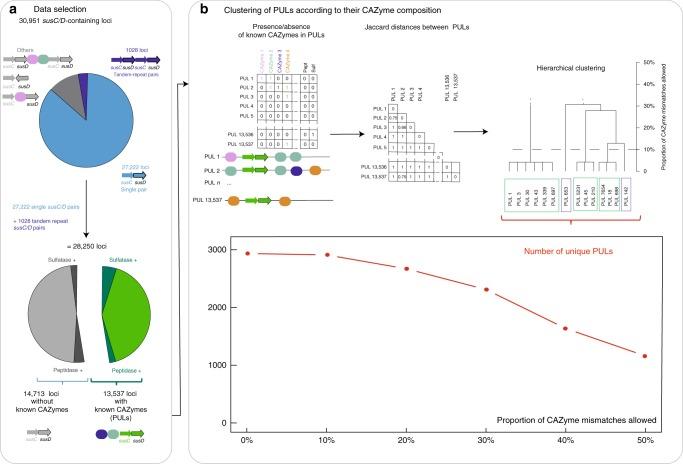
Unlike proteins, glycan chains are not directly encoded by DNA, but by the specificity of the enzymes that assemble them. Theoretical calculations have proposed an astronomical number of possible isomers (> 10 hexasaccharides) but the actual diversity of glycan structures in nature is not known. Bacteria of the Bacteroidetes phylum are considered primary degraders of polysaccharides and they are found in all ecosystems investigated. In Bacteroidetes genomes, carbohydrate-degrading enzymes (CAZymes) are arranged in gene clusters termed polysaccharide utilization loci (PULs). The depolymerization of a given complex glycan by Bacteroidetes PULs requires bespoke enzymes; conversely, the enzyme composition in PULs can provide information on the structure of the targeted glycans. Here we group the 13,537 PULs encoded by 964 Bacteroidetes genomes according to their CAZyme composition. We find that collectively Bacteroidetes have elaborated a few thousand enzyme combinations for glycan breakdown, suggesting a global estimate of diversity of glycan structures much smaller than the theoretical one.
与蛋白质不同,糖链不是由 DNA 直接编码的,而是由组装它们的酶的特异性决定的。理论计算提出了可能的异构体数量(> 10 个六糖)是天文数字,但自然界中糖链结构的实际多样性尚不清楚。拟杆菌门的细菌被认为是多糖的主要降解者,它们存在于所有被调查的生态系统中。在拟杆菌门的基因组中,碳水化合物降解酶(CAZymes)排列在基因簇中,称为多糖利用基因座(PULs)。拟杆菌 PULs 对给定的复杂糖的解聚需要定制的酶;相反,PULs 中的酶组成可以提供关于靶糖结构的信息。在这里,我们根据碳水化合物分解酶(CAZyme)的组成,将 964 个拟杆菌基因组中的 13537 个 PUL 进行分组。我们发现,拟杆菌共开发了几千种用于糖链分解的酶组合,这表明糖链结构的多样性估计远小于理论值。

 Zotero 插件