
微藻生物填料对增塑麸质新型热塑性生物复合材料的机械增强作用
Mechanical Reinforcement by Microalgal Biofiller in Novel Thermoplastic Biocompounds from Plasticized Gluten.
作者信息
Ciapponi Riccardo, Turri Stefano, Levi Marinella
机构信息
INSTM⁻National Interuniversity Consortium of Materials Science and Technology, Via G. Giusti 9, 50121 Firenze, Italy.
Department of Chemistry, Materials and Chemical Engineering "Giulio Natta", Politecnico di Milano, Piazza Leonardo da Vinci 32, 20133 Milano, Italy.
出版信息
Materials (Basel). 2019 May 7;12(9):1476. doi: 10.3390/ma12091476.
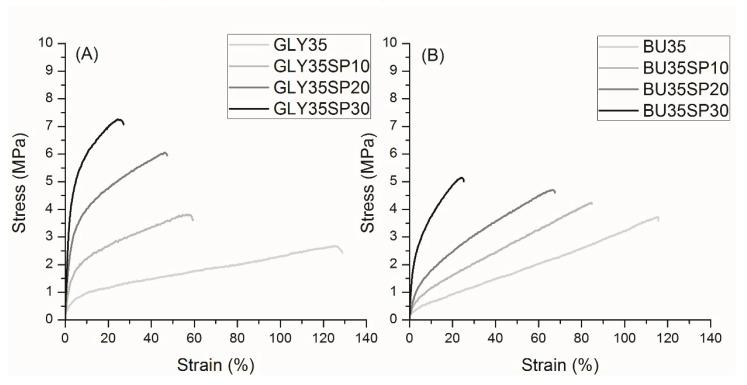
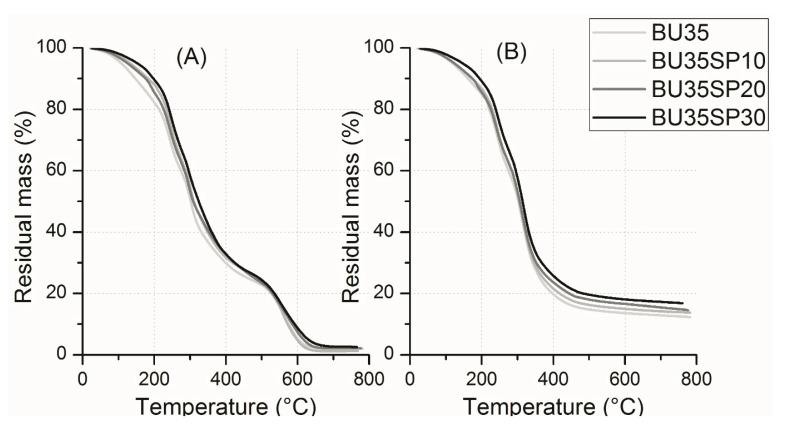
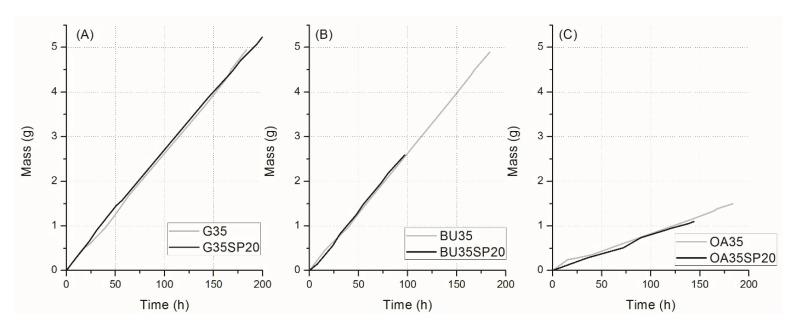
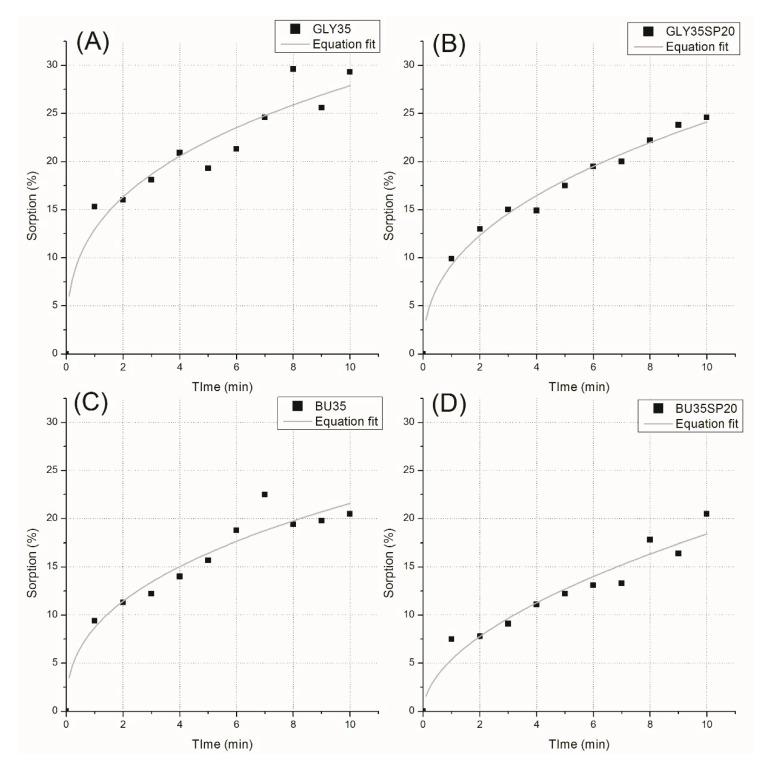
The aim of this work was to develop new bioplastic compounds from wheat gluten, biobased plasticizers (glycerol, octanoic acid and 1,4-butanediol), and microalgal biomass as a filler. The effects of the composition on tensile properties, thermal stability, and water sensitivity were investigated. Microalgal biomass was added with the selected quantities: 10, 20, and 30 per hundred parts (php). Mechanical mixing of the components, i.e., gluten, plasticizer, and microalgae, was followed by molding in a hot press. Microlgal filler improved mechanical properties of the plasticized gluten material: in samples plasticized with 1,4-butanediol, 30 php of biomass increased the tensile modulus by nearly one order of magnitude, from 36.5 MPa to 273.1 MPa, and it also increased the tensile strength from 3.3 MPa to 4.9 MPa. The introduction of microalgal biomass slightly increased the surface sensitivity against water: 30 php of biomass reduced the water contact angle from 41° to 22° in samples plasticized with glycerol, but the biomass lowered the overall water absorption kinetics for material with each plasticizer. Microalgal biomass proved therefore to be an interesting sustainable resource with which to develop materials based on gluten, in particular to increase the mechanical properties of the compounds without reducing thermal stability or water resistance.
这项工作的目的是利用小麦面筋、生物基增塑剂(甘油、辛酸和1,4 -丁二醇)以及作为填料的微藻生物质开发新型生物塑料化合物。研究了组合物对拉伸性能、热稳定性和水敏感性的影响。添加了选定数量的微藻生物质:每百份(php)10、20和30。将组分,即面筋、增塑剂和微藻进行机械混合,然后在热压机中成型。微藻填料改善了增塑面筋材料的机械性能:在用1,4 -丁二醇增塑的样品中,30 php的生物质使拉伸模量提高了近一个数量级,从36.5 MPa提高到273.1 MPa,并且还使拉伸强度从3.3 MPa提高到4.9 MPa。微藻生物质的引入略微增加了表面对水的敏感性:在用甘油增塑的样品中,30 php的生物质使水接触角从41°降低到22°,但生物质降低了每种增塑剂材料的总体吸水动力学。因此,微藻生物质被证明是一种有趣的可持续资源,可用于开发基于面筋的材料,特别是在不降低热稳定性或耐水性的情况下提高化合物的机械性能。
 Zotero 插件