
适用于中等大小蛋白质的高效立体专一性氢核磁共振谱峰归属策略
Efficient Stereospecific H NMR Assignment Strategy for Mid-Size Proteins.
作者信息
Born Alexandra, Henen Morkos A, Nichols Parker, Wang Jing, Jones David N, Vögeli Beat
机构信息
Department of Biochemistry and Molecular Genetics, University of Colorado Anschutz Medical Campus, 12801 East 17th Avenue, Aurora, CO 80045, USA;
Faculty of Pharmacy, Mansoura University, Mansoura 35516, Egypt.
出版信息
Magnetochemistry. 2018 Jun;4(2). doi: 10.3390/magnetochemistry4020025. Epub 2018 Jun 1.
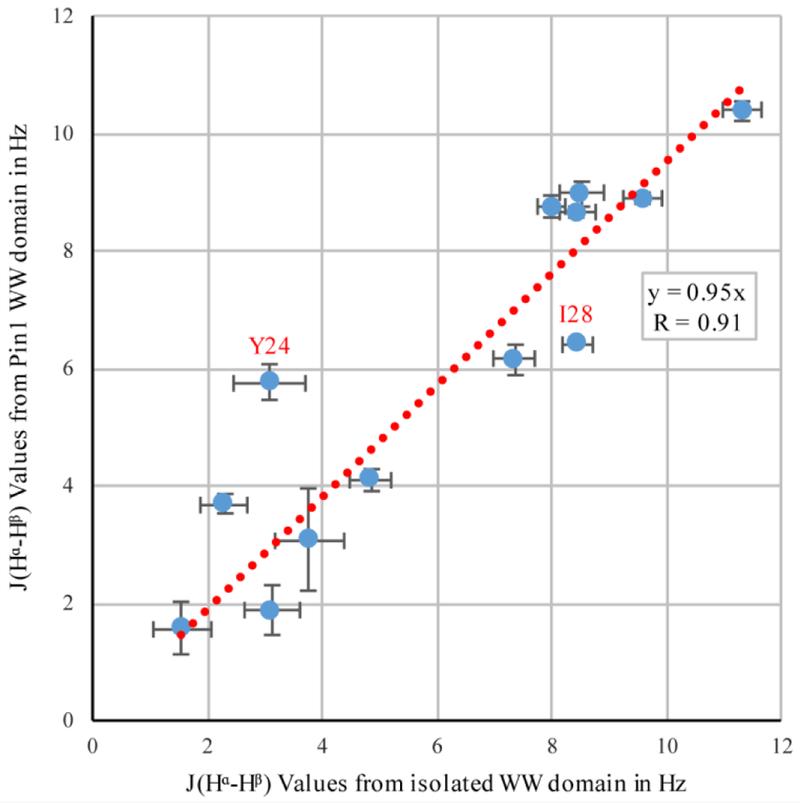
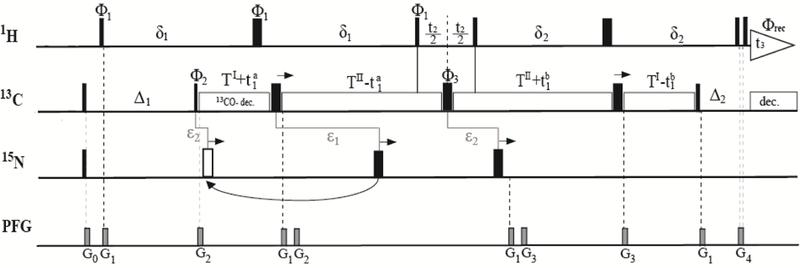
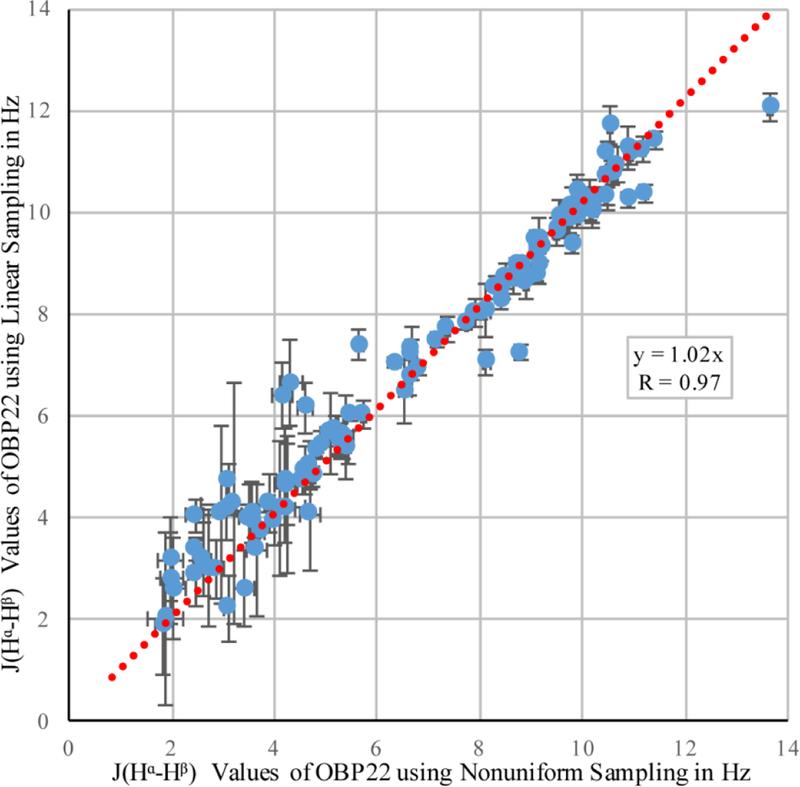
We present a strategy for stereospecific NMR assignment of H and H protons in mid-size proteins (~150 residues). For such proteins, resonance overlap in standard experiments is severe, thereby preventing unambiguous assignment of a large fraction of β-methylenes. To alleviate this limitation, assignment experiments may be run in high static fields, where higher decoupling power is required. Three-bond H-H J-couplings ( ) are critical for stereospecific assignments of β-methylene protons, and for determining rotameric χ states. Therefore, we modified a pulse sequence designed to measure accurate couplings such that probe heating was reduced, while the decoupling performance was improved. To further increase the resolution, we applied non-uniform sampling (NUS) schemes in the indirect H and C dimensions. The approach was applied to two medium-sized proteins, odorant binding protein 22 (OBP22; 14.4 kDa) and Pin1 (18.2 kDa), at 900 MHz polarizing fields. The coupling values obtained from NUS and linear sampling were extremely well correlated. However, NUS decreased the overlap of H protons, thus supplying a higher yield of extracted coupling values when compared with linear sampling. A similar effect could be achieved with linear prediction applied to the linearly sampled data prior to the Fourier transformation. Finally, we used couplings from Pin1 in combination with either conventional or exact nuclear Overhauser enhancement (eNOE) restraints to determine the stereospecific assignments of β-methylene protons. The use of eNOEs further increased the fraction of unambiguously assigned resonances when compared with procedures using conventional NOEs.
我们提出了一种用于对中等大小蛋白质(约150个残基)中的H和H质子进行立体特异性核磁共振(NMR)归属的策略。对于这类蛋白质,标准实验中的共振重叠非常严重,从而阻碍了大部分β-亚甲基的明确归属。为了缓解这一限制,可以在高静磁场中进行归属实验,在这种情况下需要更高的去耦能力。三键H-H J耦合( )对于β-亚甲基质子的立体特异性归属以及确定旋转异构体χ状态至关重要。因此,我们修改了一个旨在测量精确 耦合的脉冲序列,以便在提高去耦性能的同时减少探头加热。为了进一步提高分辨率,我们在间接H和C维度中应用了非均匀采样(NUS)方案。该方法应用于900 MHz极化场下的两种中等大小蛋白质,即气味结合蛋白22(OBP22;14.4 kDa)和Pin1(18.2 kDa)。从NUS和线性采样获得的耦合值具有极好的相关性。然而,NUS减少了H质子的重叠,因此与线性采样相比,提供了更高的提取 耦合值产率。在傅里叶变换之前对线性采样数据应用线性预测也可以实现类似的效果。最后,我们将Pin1的 耦合与传统或精确的核Overhauser增强(eNOE)约束相结合,以确定β-亚甲基质子的立体特异性归属。与使用传统NOE的程序相比,使用eNOE进一步增加了明确归属的共振比例。


 Zotero 插件