
基于整合分析的双诱导脓毒症差异表达潜在转录生物标志物的鉴定。
Identification of Potential Transcriptional Biomarkers Differently Expressed in Both - and -Induced Sepsis via Integrated Analysis.
机构信息
Department of Pathophysiology, School of Basic Medicine Science, Central South University, Changsha, China.
Sepsis Translational Medicine Key Lab of Hunan Province, China.
出版信息
Biomed Res Int. 2019 Apr 9;2019:2487921. doi: 10.1155/2019/2487921. eCollection 2019.
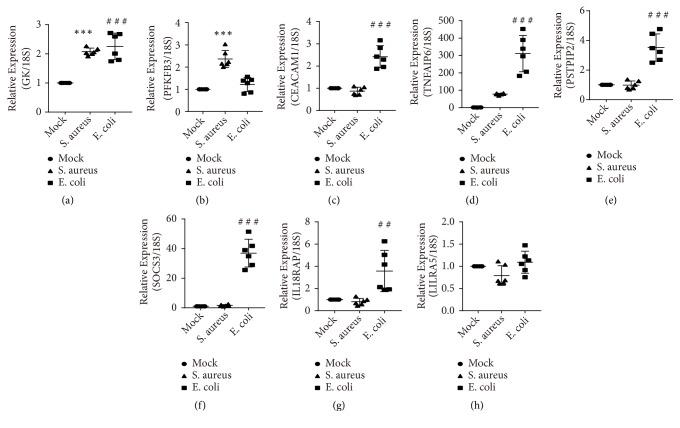
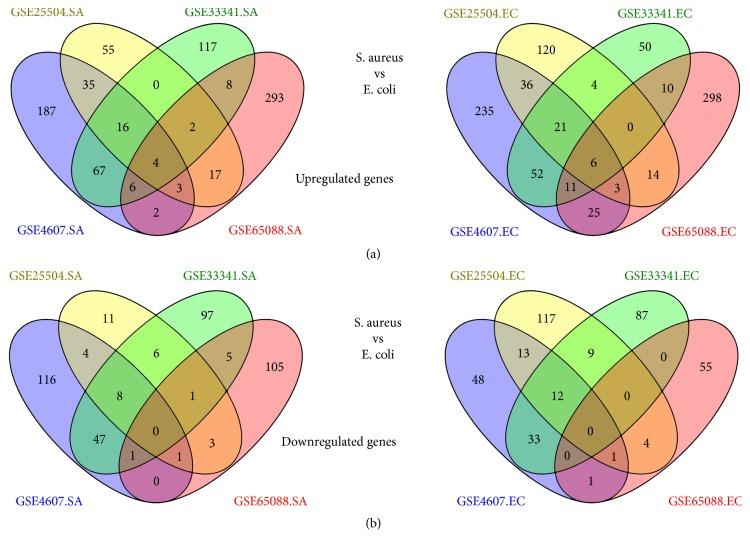
Sepsis is a critical, complex medical condition, and the major causative pathogens of sepsis are both () and (). Genome-wide studies identify differentially expressed genes for sepsis. However, the results for the identification of DEGs are inconsistent or discrepant among different studies because of heterogeneity of specimen sources, various data processing methods, or different backgrounds of the samples. To identify potential transcriptional biomarkers that are differently expressed in - and -induced sepsis, we have analyzed four microarray datasets from GEO database and integrated results with bioinformatics tools. 42 and 54 DEGs were identified in both and samples from any three different arrays, respectively. Hierarchical clustering revealed dramatic differences between control and sepsis samples. GO functional annotations suggested that DEGs in the group were mainly involved in the responses of both defense and immune regulation, but DEGs in the group were mainly related to the regulation of endopeptidase activity involved in the apoptotic signaling pathway. Although KEGG showed inflammatory bowel disease in the E. coli group, the KEGG pathway analysis showed that these DEGs were mainly involved in the tumor necrosis factor signaling pathway, fructose metabolism, and mannose metabolism in both - and -induced sepsis. Eight common genes were identified between sepsis patients with either or infection and controls in this study. All the candidate genes were further validated to be differentially expressed by an ex-vivo human blood model, and the relative expression of these genes was performed by qPCR. The qPCR results suggest that GK and PFKFB3 might contribute to the progression of -induced sepsis, and CEACAM1, TNFAIP6, PSTPIP2, SOCS3, and IL18RAP might be closely linked with -induced sepsis. These results provide new viewpoints for the pathogenesis of both sepsis and pathogen identification.
脓毒症是一种严重而复杂的医学病症,脓毒症的主要致病病原体既有革兰氏阴性菌()也有革兰氏阳性菌()。全基因组研究确定了脓毒症的差异表达基因。然而,由于标本来源的异质性、不同的数据处理方法或样本的不同背景,不同研究中差异表达基因(DEG)的鉴定结果并不一致或存在差异。为了鉴定在-和-诱导的脓毒症中差异表达的潜在转录生物标志物,我们分析了 GEO 数据库中的四个微阵列数据集,并使用生物信息学工具整合了结果。分别从三个不同的微阵列中鉴定出了在-和-样本中均存在的 42 个和 54 个差异表达基因。层次聚类显示了对照和脓毒症样本之间的显著差异。GO 功能注释表明,组中的 DEG 主要参与防御和免疫调节反应,而组中的 DEG 主要与涉及凋亡信号通路的内肽酶活性调节有关。尽管 KEGG 在大肠杆菌组中显示出溃疡性结肠炎,但 KEGG 途径分析表明,这些 DEG 主要参与肿瘤坏死因子信号通路、果糖代谢和甘露糖代谢在-和-诱导的脓毒症中。本研究在脓毒症患者中鉴定出了 8 个与感染或对照患者均存在差异的共同基因。所有候选基因均通过体外人血模型进一步验证为差异表达,并通过 qPCR 检测这些基因的相对表达量。qPCR 结果表明,GK 和 PFKFB3 可能有助于-诱导的脓毒症进展,而 CEACAM1、TNFAIP6、PSTPIP2、SOCS3 和 IL18RAP 可能与-诱导的脓毒症密切相关。这些结果为脓毒症和病原体鉴定的发病机制提供了新的观点。

 Zotero 插件