
玻璃连蛋白的拓扑结构:基于计算机辅助检测的神经母细胞瘤风险分类的补充特征。
The topology of vitronectin: A complementary feature for neuroblastoma risk classification based on computer-aided detection.
机构信息
Departamento de Biología Celular, Instituto de Biomedicina de Sevilla (IBiS), Hospital Universitario Virgen del Roció/CSIC/Universidad de Sevilla, Seville, Spain.
Biomedical Network Research Centre on Neurodegenerative Diseases (CIBERNED), Madrid, Spain.
出版信息
Int J Cancer. 2020 Jan 15;146(2):553-565. doi: 10.1002/ijc.32495. Epub 2019 Jul 8.
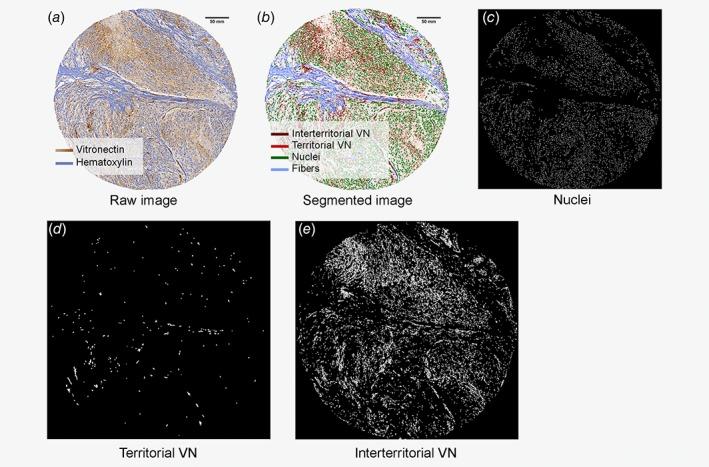
Tumors are complex networks of constantly interacting elements: tumor cells, stromal cells, immune and stem cells, blood/lympathic vessels, nerve fibers and extracellular matrix components. These elements can influence their microenvironment through mechanical and physical signals to promote tumor cell growth. To get a better understanding of tumor biology, cooperation between multidisciplinary fields is needed. Diverse mathematic computations and algorithms have been designed to find prognostic targets and enhance diagnostic assessment. In this work, we use computational digital tools to study the topology of vitronectin, a glycoprotein of the extracellular matrix. Vitronectin is linked to angiogenesis and migration, two processes closely related to tumor cell spread. Here, we investigate whether the distribution of this molecule in the tumor stroma may confer mechanical properties affecting neuroblastoma aggressiveness. Combining image analysis and graph theory, we analyze different topological features that capture the organizational cues of vitronectin in histopathological images taken from human samples. We find that the Euler number and the branching of territorial vitronectin, two topological features, could allow for a more precise pretreatment risk stratification to guide treatment strategies in neuroblastoma patients. A large amount of recently synthesized VN would create migration tracks, pinpointed by both topological features, for malignant neuroblasts, so that dramatic change in the extracellular matrix would increase tumor aggressiveness and worsen patient outcomes.
肿瘤是由不断相互作用的元素组成的复杂网络
肿瘤细胞、基质细胞、免疫细胞和干细胞、血液/淋巴血管、神经纤维和细胞外基质成分。这些元素可以通过机械和物理信号影响其微环境,从而促进肿瘤细胞生长。为了更好地了解肿瘤生物学,需要多学科领域的合作。已经设计了各种数学计算和算法来寻找预后靶点并增强诊断评估。在这项工作中,我们使用计算数字工具来研究细胞外基质糖蛋白 vitronectin 的拓扑结构。vitronectin 与血管生成和迁移有关,这两个过程与肿瘤细胞的扩散密切相关。在这里,我们研究了这种分子在肿瘤基质中的分布是否可能赋予影响神经母细胞瘤侵袭性的机械特性。我们结合图像分析和图论,分析了从人类样本中获取的组织病理学图像中捕获 vitronectin 组织线索的不同拓扑特征。我们发现,两个拓扑特征——欧拉数和区域化 vitronectin 的分支,可用于更精确的预处理风险分层,以指导神经母细胞瘤患者的治疗策略。大量最近合成的 VN 将为恶性神经母细胞瘤创建迁移轨迹,这两个拓扑特征都可以指出,因此细胞外基质的剧烈变化将增加肿瘤的侵袭性并恶化患者的预后。


 Zotero 插件