
精神共病模式和遗传相关性为注意缺陷多动障碍和自闭症谱系障碍的差异提供了新的见解。
Patterns of Psychiatric Comorbidity and Genetic Correlations Provide New Insights Into Differences Between Attention-Deficit/Hyperactivity Disorder and Autism Spectrum Disorder.
机构信息
Department of Biomedicine, University of Bergen, Bergen, Norway; Department of Global Public Health and Primary Care, University of Bergen, Bergen, Norway; K.G. Jebsen Centre for Neuropsychiatric Disorders, University of Bergen, Bergen, Norway.
Department of Biomedicine, University of Bergen, Bergen, Norway; K.G. Jebsen Centre for Neuropsychiatric Disorders, University of Bergen, Bergen, Norway; Analytic and Translational Genetics Unit, Department of Medicine, Massachusetts General Hospital and Harvard Medical School, Boston, Massachusetts; Stanley Center for Psychiatric Research, Broad Institute of MIT and Harvard, Cambridge, Massachusetts.
出版信息
Biol Psychiatry. 2019 Oct 15;86(8):587-598. doi: 10.1016/j.biopsych.2019.04.021. Epub 2019 Apr 28.
BACKGROUND
Attention-deficit/hyperactivity disorder (ADHD) and autism spectrum disorder (ASD) share common genetic factors but seem to have specific patterns of psychiatric comorbidities. There are few systematic studies on adults; therefore, we compared psychiatric comorbidities in adults with these two neurodevelopmental disorders using population-based data and analyzed their genetic correlations to evaluate underlying factors.
METHODS
Using data from Norwegian registries, we assessed patterns of psychiatric disorders in adults with ADHD (n = 38,636; 2.3%), ASD (n = 7528; 0.4%), and both diagnoses (n = 1467; 0.1%) compared with the remaining adult population (n = 1,653,575). We calculated their prevalence ratios (PRs) and differences using Poisson regression, also examining sex-specific relations. Genetic correlations (r) among ADHD, ASD, and the examined psychiatric disorders were calculated by linkage disequilibrium score regression, exploiting summary statistics from relevant genome-wide association studies.
RESULTS
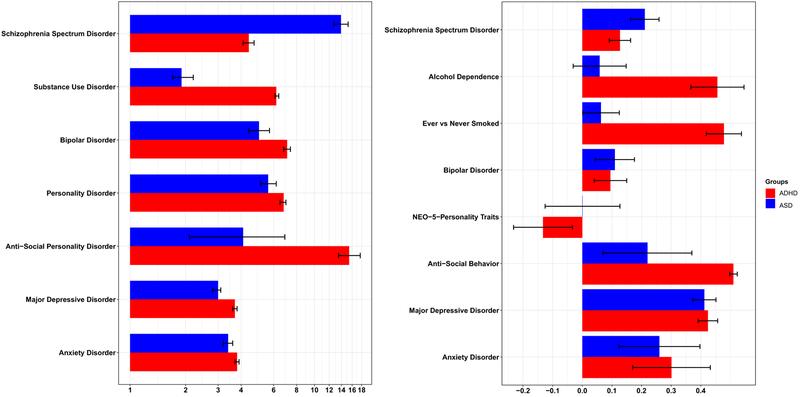
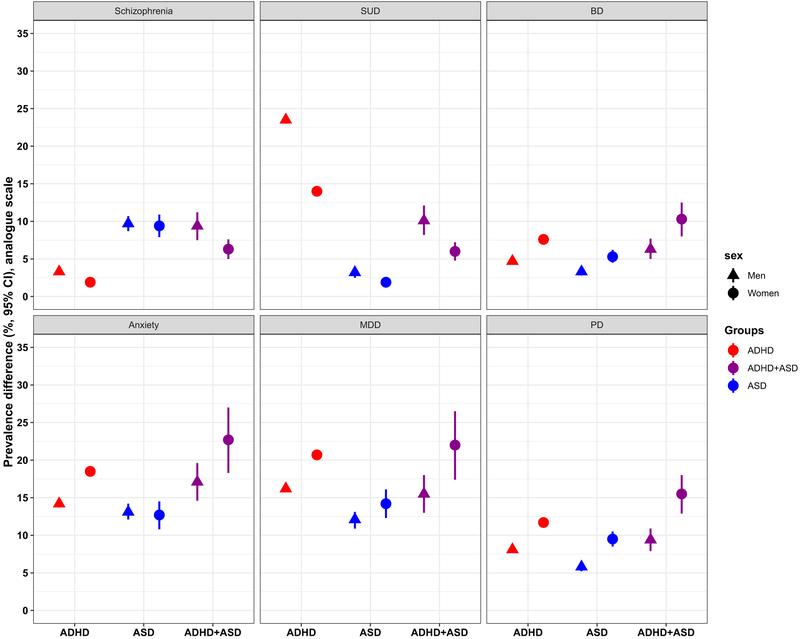
For all psychiatric comorbidities, PRs differed between ADHD and ASD. Associations were strongest in individuals with ADHD and ADHD+ASD for most comorbidities, in both men and women. The relative prevalence increase of substance use disorder was three times larger in ADHD than in ASD (PR, 6.2; 95% confidence interval [CI], 6.1-6.4; PR, 1.9; 95% CI, 1.7-2.2; p < .001); however, the opposite was true for schizophrenia (PR, 13.9; 95% CI, 12.7-15.2; PR, 4.4; 95% CI, 4.1-4.7; p < .001). Genetic correlations supported these patterns but were significantly different between ADHD and ASD only for the substance use disorder proxies and personality traits (p < .006 for all).
CONCLUSIONS
Adults with ADHD, ASD, or both ADHD and ASD have specific patterns of psychiatric comorbidities. This may partly be explained by differences in underlying genetic factors.
背景
注意力缺陷/多动障碍 (ADHD) 和自闭症谱系障碍 (ASD) 具有共同的遗传因素,但似乎存在特定的精神共病模式。目前针对成年人的系统研究较少;因此,我们使用基于人群的数据比较了这两种神经发育障碍成年人的精神共病,并分析了它们的遗传相关性,以评估潜在因素。
方法
我们使用来自挪威登记处的数据,评估了 ADHD(n=38636;2.3%)、ASD(n=7528;0.4%)和同时诊断这两种疾病的成年人(n=1467;0.1%)与其余成年人群(n=1653575)的精神障碍模式。我们使用泊松回归计算了他们的患病率比值(PR)和差异,还检查了性别特异性关系。通过连锁不平衡评分回归,利用相关全基因组关联研究的汇总统计数据,计算了 ADHD、ASD 和所检查的精神障碍之间的遗传相关性(r)。
结果
对于所有精神共病,ADHD 和 ASD 之间的 PR 不同。在男性和女性中,ADHD 和 ADHD+ASD 个体的大多数共病关联最强。与 ASD 相比,ADHD 患者物质使用障碍的相对患病率增加了三倍(PR,6.2;95%置信区间 [CI],6.1-6.4;PR,1.9;95% CI,1.7-2.2;p<0.001);然而,精神分裂症的情况则相反(PR,13.9;95% CI,12.7-15.2;PR,4.4;95% CI,4.1-4.7;p<0.001)。遗传相关性支持这些模式,但 ADHD 和 ASD 之间仅在物质使用障碍的替代指标和人格特质上存在显著差异(所有 p<0.006)。
结论
患有 ADHD、ASD 或 ADHD 和 ASD 两者的成年人具有特定的精神共病模式。这部分可能是由潜在遗传因素的差异解释的。

 Zotero 插件