
植物中损伤相关分子模式触发的免疫
Damage-Associated Molecular Pattern-Triggered Immunity in Plants.
作者信息
Hou Shuguo, Liu Zunyong, Shen Hexi, Wu Daoji
机构信息
School of Municipal and Environmental Engineering, Shandong Jianzhu University, Jinan, China.
State Key Laboratory of Rice Biology, Zhejiang University, Hangzhou, China.
出版信息
Front Plant Sci. 2019 May 22;10:646. doi: 10.3389/fpls.2019.00646. eCollection 2019.
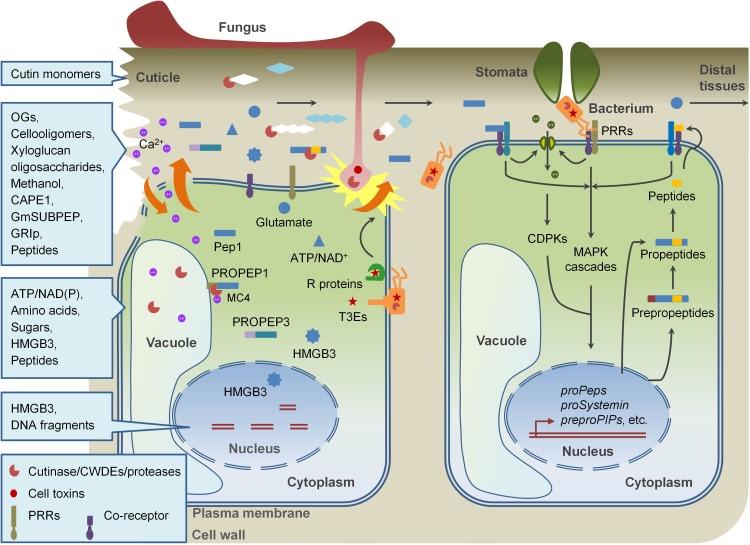
As a universal process in multicellular organisms, including animals and plants, cells usually emit danger signals when suffering from attacks of microbes and herbivores, or physical damage. These signals, termed as damage-associated molecular patterns (DAMPs), mainly include cell wall or extracellular protein fragments, peptides, nucleotides, and amino acids. Once exposed on cell surfaces, DAMPs are detected by plasma membrane-localized receptors of surrounding cells to regulate immune responses against the invading organisms and promote damage repair. DAMPs may also act as long-distance mobile signals to mediate systemic wounding responses. Generation, release, and perception of DAMPs, and signaling events downstream of DAMP perception are all rigorously modulated by plants. These processes integrate together to determine intricate mechanisms of DAMP-triggered immunity in plants. In this review, we present an extensive overview on our current understanding of DAMPs in plant immune system.
作为包括动物和植物在内的多细胞生物中的一个普遍过程,细胞在遭受微生物和食草动物的攻击或物理损伤时通常会发出危险信号。这些信号被称为损伤相关分子模式(DAMPs),主要包括细胞壁或细胞外蛋白质片段、肽、核苷酸和氨基酸。一旦暴露在细胞表面,DAMPs就会被周围细胞质膜定位的受体检测到,以调节针对入侵生物体的免疫反应并促进损伤修复。DAMPs还可能作为长距离移动信号来介导系统性创伤反应。植物对DAMPs的产生、释放、感知以及DAMP感知下游的信号事件都进行了严格的调控。这些过程共同整合,以确定植物中DAMP触发免疫的复杂机制。在这篇综述中,我们对目前对植物免疫系统中DAMPs的理解进行了广泛概述。
 Zotero 插件