
植物对昆虫食草动物的免疫:可持续害虫管理的机制、相互作用及创新
Plant immunity to insect herbivores: mechanisms, interactions, and innovations for sustainable pest management.
作者信息
Vasantha-Srinivasan Prabhakaran, Noh Mi Young, Park Ki Beom, Kim Tae Yoon, Jung Woo-Jin, Senthil-Nathan Sengottayan, Han Yeon Soo
机构信息
Department of Applied Biology, Institute of Environmentally Friendly Agriculture (IEFA), College of Agriculture and Life Sciences, Chonnam National University, Gwangju, Republic of Korea.
Department of Forest Resources, AgriBio Institute of Climate Change Management, Chonnam National University, Gwangju, Republic of Korea.
出版信息
Front Plant Sci. 2025 Jul 22;16:1599450. doi: 10.3389/fpls.2025.1599450. eCollection 2025.
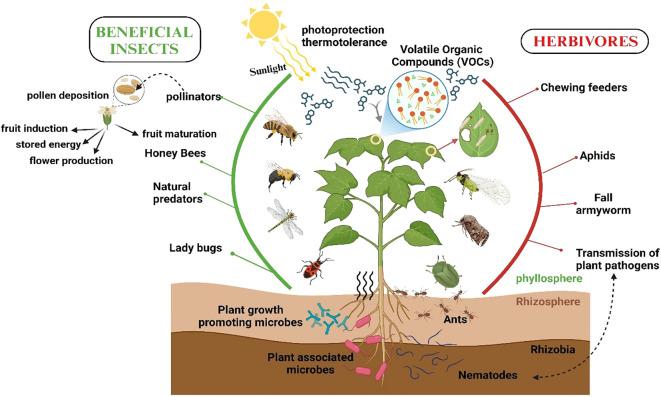
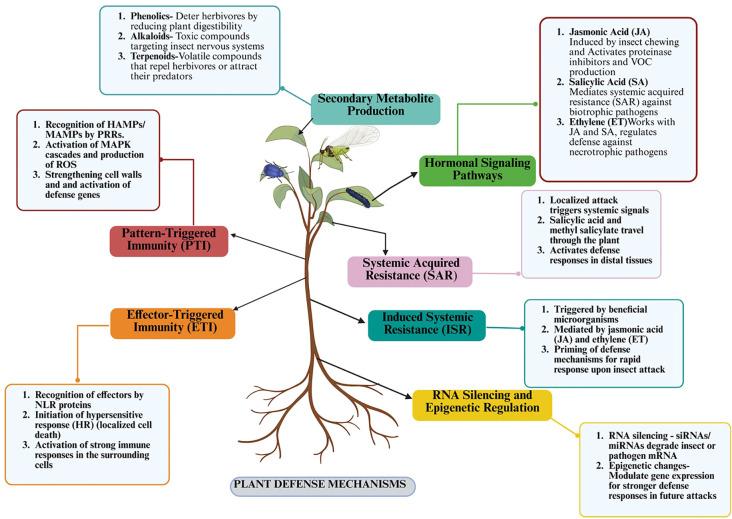
Plant-insect interactions pose a major threat to global food security and ecological stability. This review provides a comprehensive synthesis of the molecular and physiological mechanisms underlying plant immunity against herbivorous insects, with emphasis on structural defenses, secondary metabolites, and hormone signaling pathways including Jasmonic acid, salicylic acid, and ethylene. It highlights key advances in understanding defense signaling crosstalk, effector-triggered responses, and the role of microbiota and environmental cues. The review further discusses insect counterstrategies and explores cutting-edge technologies-CRISPR/Cas9, RNA interference, and metabolic engineering that are reshaping pest management. However, challenges remain, including limited field validation of engineered traits, ecological trade-offs, and regulatory hurdles. We conclude by outlining future research directions focused on multi-omics integration, climate-resilient defense networks, and ethical deployment of plant biotechnologies within sustainable agroecosystems.
植物与昆虫的相互作用对全球粮食安全和生态稳定构成重大威胁。本综述全面综合了植物对食草昆虫免疫的分子和生理机制,重点关注结构防御、次生代谢产物以及包括茉莉酸、水杨酸和乙烯在内的激素信号通路。它突出了在理解防御信号串扰、效应子触发反应以及微生物群和环境线索作用方面的关键进展。该综述进一步讨论了昆虫的应对策略,并探索了正在重塑害虫管理的前沿技术——CRISPR/Cas9、RNA干扰和代谢工程。然而,挑战依然存在,包括工程性状的田间验证有限、生态权衡和监管障碍。我们通过概述未来的研究方向来结束本文,这些方向集中在多组学整合、气候适应型防御网络以及在可持续农业生态系统中植物生物技术的伦理应用。




 Zotero 插件