
COPD:临床实践中吸入器装置的误用。
COPD: misuse of inhaler devices in clinical practice.
机构信息
Life and Health Sciences Research Institute (ICVS), School of Medicine, University of Minho, Braga, Portugal.
ICVS/3B's, PT Government Associate Laboratory, Braga/Guimarães, Portugal.
出版信息
Int J Chron Obstruct Pulmon Dis. 2019 May 30;14:1209-1217. doi: 10.2147/COPD.S178040. eCollection 2019.
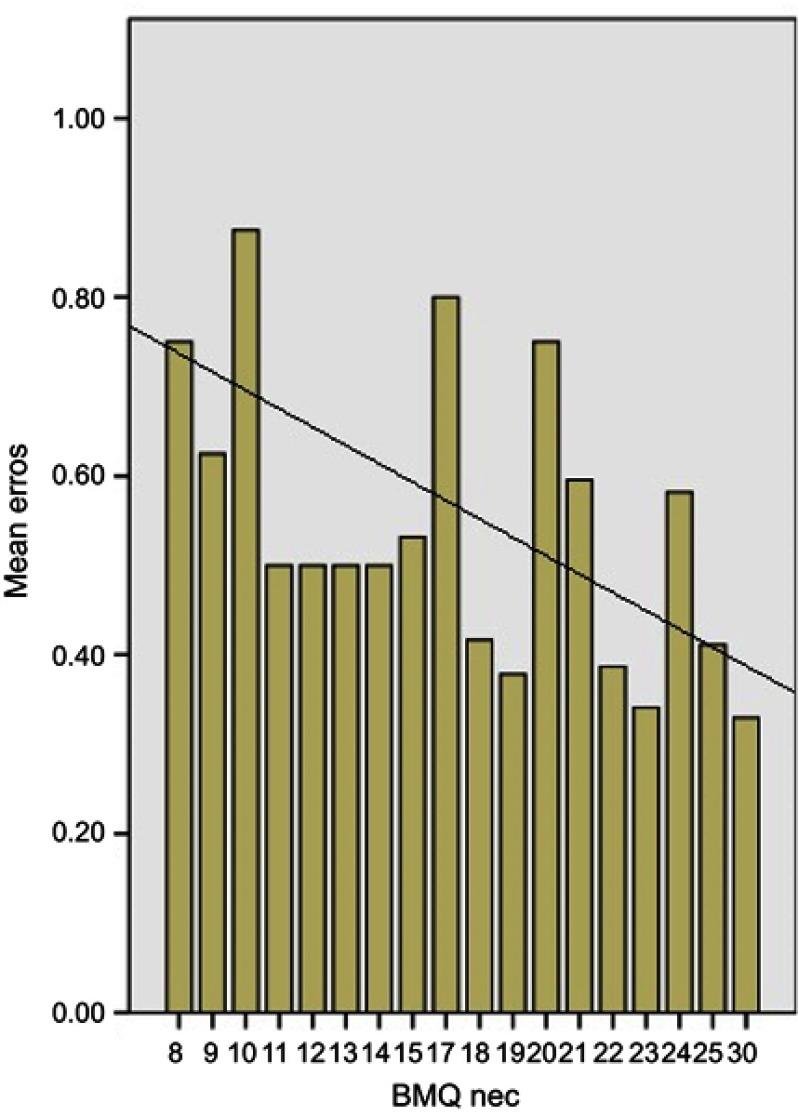
Inhalers mishandling remain an important clinical issue worldwide. The aim of this study was to evaluate inhalation technique in stable COPD out-patients. The variables under study were type of inhaler device (ID), patients' preference for an inhaler, number of IDs used by each patient, beliefs about inhaler medication and some demographic, clinical and functional patients' characteristics. We aim to assess how they are related to inhalation technique. A cross-sectional study was conducted in a hospital outpatient respiratory care. COPD patients over 40 years old, diagnosed according to GOLD criteria, and using IDs were included consecutively. The Beliefs about Medicines Questionnaire (BMQ), a demographic and a clinical survey were applied. The number of IDs used by each patient and the patients' preference for some IDs were recorded. Patients were asked to demonstrate the use of their prescribed inhalation devices, and inhaler technique was assessed by using previously defined checklists, including essential steps and critical errors. A statistics analysis was then performed. We studied 300 subjects performing a total of 521 inhalation manoeuvers with 10 different IDs. At least one step incorrectly performed was found in 48.2% of demonstrations and in 29.9% critical errors were observed. Misuse was related to priming/loading in 6.9%, to inhalation manoeuver in 13.1% and to both in 10%. There was a statistically significant association between critical errors and type of ID (<0.001). No significant relationship was found between correct performance of key manoeuvers and patients' preference or number of inhalers used per patient. Misuse due to critical errors was observed in 39.3% of patients and was positively related to female gender, age ≥65, lower education level and lower socioeconomic status (higher Graffar classification score), but not to patients' clinical or functional characteristics. In the sub-group of patients presenting critical errors when using IDs, there was a statistically significant inverse association between BMQ Necessity score and number of critical errors. Inhalers mishandling remains disappointingly common. A good inhalation technique depends on the type of ID, and failure of inhalation manoeuver was the main cause of ID misuse. It was not associated to multiple inhalers' use nor to patient's preference, but to the patient's beliefs about the necessity to use them. Elderly patients, women and those with lower education level or lower socioeconomic status demonstrate a worse inhalation technique.
吸入器使用不当仍然是一个全球性的重要临床问题。本研究的目的是评估稳定期 COPD 门诊患者的吸入技术。研究的变量包括吸入器设备类型(ID)、患者对吸入器的偏好、每位患者使用的 ID 数量、对吸入器药物的信念以及一些人口统计学、临床和功能患者特征。我们旨在评估它们与吸入技术的关系。
这是一项在医院门诊呼吸护理中进行的横断面研究。根据 GOLD 标准诊断为 COPD 且使用 ID 的 40 岁以上患者连续纳入研究。应用信念量表(BMQ)、人口统计学和临床调查。记录每位患者使用的 ID 数量和患者对某些 ID 的偏好。要求患者展示其规定的吸入装置使用方法,并使用先前定义的检查表评估吸入器技术,包括基本步骤和关键错误。然后进行统计分析。
我们研究了 300 名患者,共进行了 521 次吸入操作,使用了 10 种不同的 ID。在 48.2%的演示中发现至少有一步操作不正确,29.9%观察到关键错误。误用与预充/加载有关的占 6.9%,与吸入动作有关的占 13.1%,两者均有关的占 10%。关键错误与 ID 类型之间存在统计学显著关联(<0.001)。关键动作的正确执行与患者的偏好或每位患者使用的吸入器数量之间没有显著关系。由于关键错误导致的误用在 39.3%的患者中观察到,与女性、年龄≥65 岁、较低的教育水平和较低的社会经济地位(较高的 Graffar 分类评分)呈正相关,但与患者的临床或功能特征无关。在使用 ID 时出现关键错误的患者亚组中,BMQ 必要性评分与关键错误数量之间存在统计学显著的负相关。
吸入器使用不当仍然令人失望地普遍存在。良好的吸入技术取决于 ID 的类型,而吸入动作的失败是导致 ID 误用的主要原因。它与使用多个吸入器或患者偏好无关,而是与患者对使用吸入器的必要性的信念有关。老年患者、女性以及教育水平或社会经济地位较低的患者表现出较差的吸入技术。

 Zotero 插件