
应用 1H NMR 波谱法评估空腹和餐后血浆代谢物浓度的重现性和生物学变异性。
Assessment of reproducibility and biological variability of fasting and postprandial plasma metabolite concentrations using 1H NMR spectroscopy.
机构信息
Department of Clinical Epidemiology, Leiden University Medical Center, Leiden, the Netherlands.
MRC Integrative Epidemiology Unit, School of Social and Community Medicine, University of Bristol, Bristol, United Kingdom.
出版信息
PLoS One. 2019 Jun 20;14(6):e0218549. doi: 10.1371/journal.pone.0218549. eCollection 2019.
INTRODUCTION
It is crucial to understand the factors that introduce variability before applying metabolomics to clinical and biomarker research.
OBJECTIVES
We quantified technical and biological variability of both fasting and postprandial metabolite concentrations measured using 1H NMR spectroscopy in plasma samples.
METHODS
In the Netherlands Epidemiology of Obesity study (n = 6,671), 148 metabolite concentrations (101 metabolites belonging to lipoprotein subclasses) were measured under fasting and postprandial states (150 minutes after a mixed liquid meal). Technical variability was evaluated among 265 fasting and 851 postprandial samples, with the identical blood plasma sample being measured twice by the same laboratory protocol. Biological reproducibility was assessed by measuring 165 individuals twice across time for evaluation of short- (<6 months) and long-term (>3 years) biological variability. Intra-class coefficients (ICCs) were used to assess variability. The ICCs of the fasting metabolites were compared with the postprandial metabolites using two-sided paired Wilcoxon test separately for short- and long-term measurements.
RESULTS
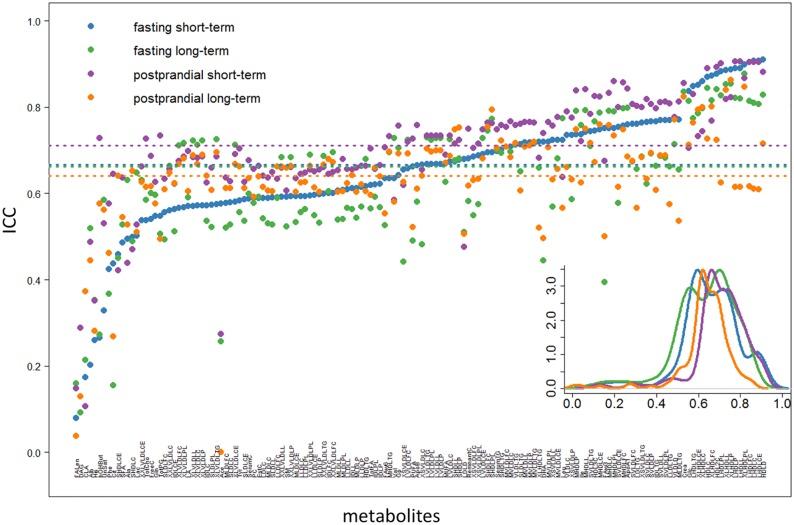
Both fasting and postprandial metabolite concentrations showed high technical reproducibility using 1H NMR spectroscopy (median ICC = 0.99). Postprandial metabolite concentrations revealed slightly higher ICC scores than fasting ones in short-term repeat measures (median ICC in postprandial and fasting metabolite concentrations 0.72 versus 0.67, Wilcoxon p-value = 8.0×10⁻¹⁴). Variability did not increase further in a long-term repeat measure, with median ICC in postprandial of 0.64 and in fasting metabolite concentrations 0.66.
CONCLUSION
Technical reproducibility is excellent. Biological reproducibility of postprandial metabolite concentrations showed a less or equal variability than fasting metabolite concentrations over time.
简介
在将代谢组学应用于临床和生物标志物研究之前,了解引入变异性的因素至关重要。
目的
我们量化了使用 1H NMR 光谱法测量的血浆样本中空腹和餐后代谢物浓度的技术和生物学变异性。
方法
在荷兰肥胖症流行病学研究(n=6671)中,在空腹和餐后状态下(混合液体餐后 150 分钟)测量了 148 种代谢物浓度(101 种代谢物属于脂蛋白亚类)。技术变异性通过 265 个空腹和 851 个餐后样本进行评估,相同的血浆样本由相同的实验室方案测量两次。通过在短时间(<6 个月)和长时间(>3 年)内两次测量 165 个个体来评估短期和长期生物学变异性,从而评估生物学重现性。使用组内相关系数(ICC)评估变异性。使用双侧配对 Wilcoxon 检验分别评估短期和长期测量的空腹和餐后代谢物的 ICC。
结果
使用 1H NMR 光谱法,空腹和餐后代谢物浓度均显示出较高的技术重现性(中位数 ICC=0.99)。在短期重复测量中,餐后代谢物浓度的 ICC 评分略高于空腹代谢物浓度(餐后和空腹代谢物浓度的中位数 ICC 分别为 0.72 和 0.67,Wilcoxon p 值=8.0×10⁻¹⁴)。在长期重复测量中,变异性没有进一步增加,餐后代谢物的中位数 ICC 为 0.64,空腹代谢物浓度的中位数 ICC 为 0.66。
结论
技术重现性非常出色。随着时间的推移,餐后代谢物浓度的生物学重现性显示出比空腹代谢物浓度更小或相等的变异性。


 Zotero 插件