
用中性红染料追踪小鼠中枢神经系统髓鞘再生病变。
Tracking the evolution of CNS remyelinating lesion in mice with neutral red dye.
机构信息
Department of Biology, Georgetown University, Washington, DC 20057.
Department of Biology, Georgetown University, Washington, DC 20057;
出版信息
Proc Natl Acad Sci U S A. 2019 Jul 9;116(28):14290-14299. doi: 10.1073/pnas.1819343116. Epub 2019 Jun 24.
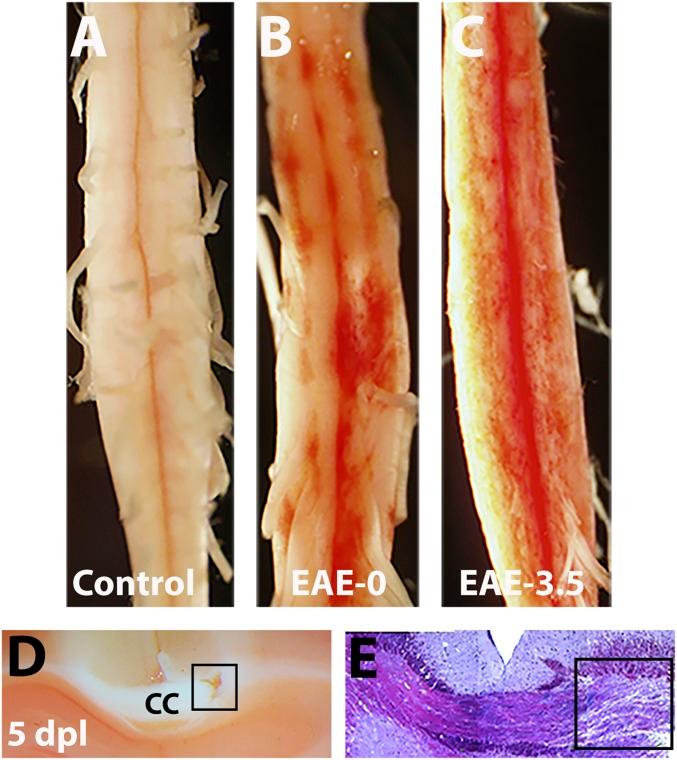
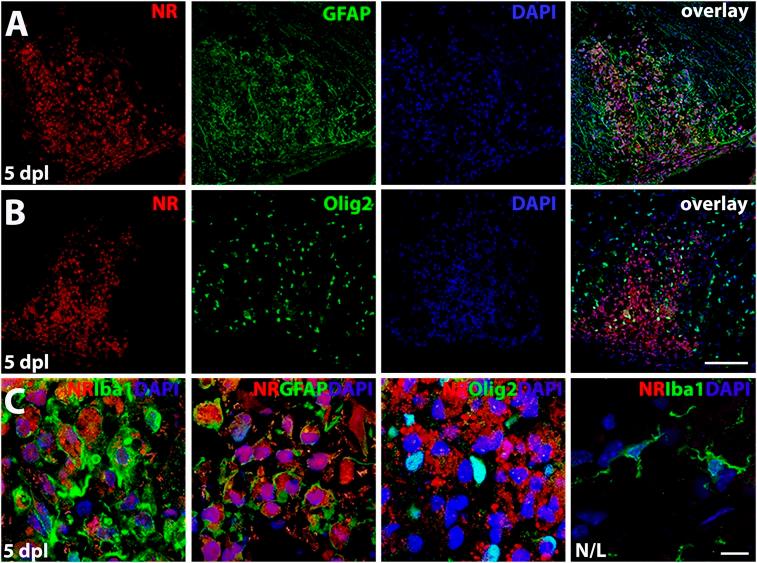
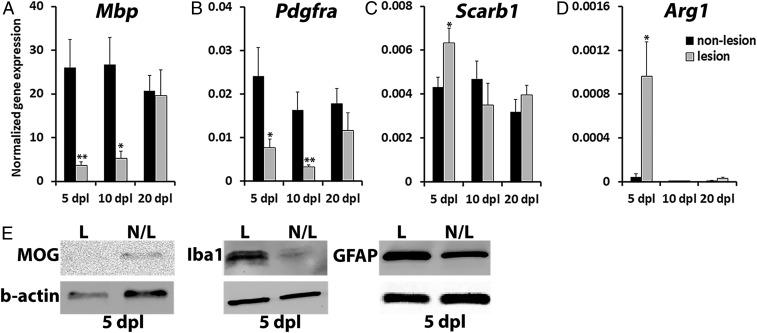
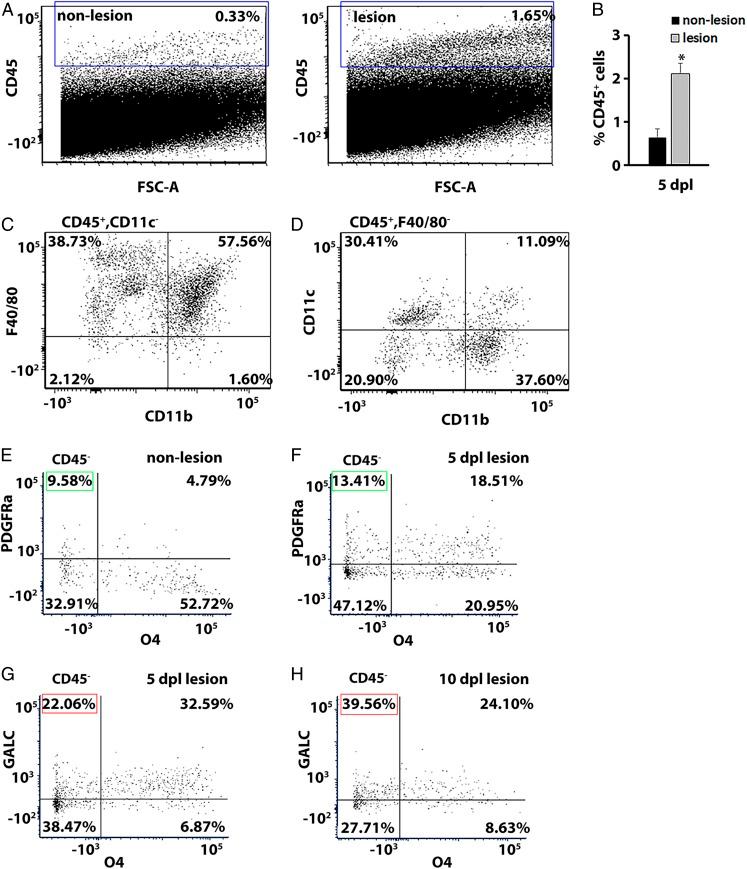
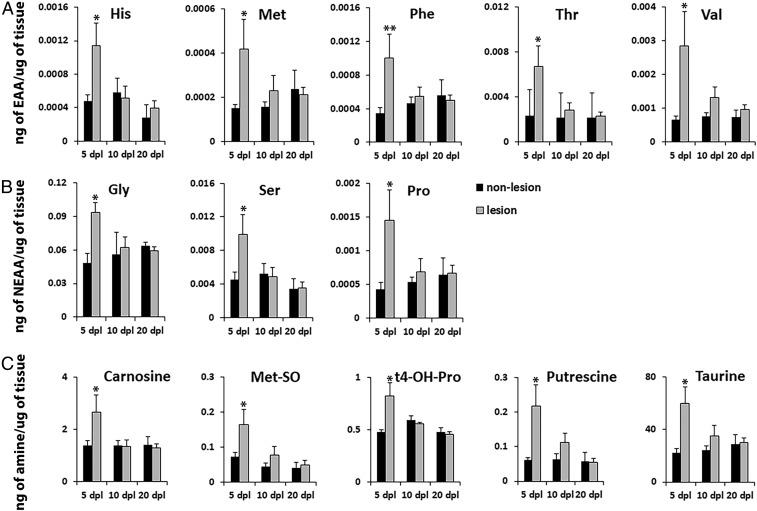
Animal models of central nervous system (CNS) demyelination, including toxin-induced focal demyelination and immune-mediated demyelination through experimental autoimmune encephalomyelitis (EAE), have provided valuable insights into the mechanisms of neuroinflammation and CNS remyelination. However, the ability to track changes in transcripts, proteins, and metabolites, as well as cellular populations during the evolution of a focal lesion, has remained challenging. Here, we developed a method to label CNS demyelinating lesions by the intraperitoneal injection of a vital dye, neutral red (NR), into mice before killing. We demonstrate that NR-labeled lesions can be easily identified on the intact spinal cord in both lysolecithin- and EAE-mediated demyelination models. Using fluorescence microscopy, we detected NR in activated macrophages/microglia and astrocytes, but not in oligodendrocytes present in lesions. Importantly, we successfully performed RT-qPCR, Western blot, flow cytometry, and mass spectrometry analysis of precisely dissected NR-labeled lesions at 5, 10, and 20 d postlesion (dpl) and found differential changes in transcripts, proteins, cell populations, and metabolites in lesions over the course of remyelination. Therefore, NR administration is a simple and powerful method to track and analyze the detailed molecular, cellular, and metabolic changes that occur within the lesion microenvironment over time following CNS injury. Furthermore, this method can be used to identify molecular and metabolic pathways that regulate neuroinflammation and remyelination and facilitate the development of therapies to promote repair in demyelinating disorders such as multiple sclerosis.
中枢神经系统(CNS)脱髓鞘的动物模型,包括毒素诱导的局灶性脱髓鞘和通过实验性自身免疫性脑脊髓炎(EAE)诱导的免疫介导的脱髓鞘,为神经炎症和 CNS 髓鞘再生的机制提供了有价值的见解。然而,在局灶性病变的发展过程中,跟踪转录物、蛋白质和代谢物以及细胞群体变化的能力仍然具有挑战性。在这里,我们开发了一种在杀死小鼠之前通过腹腔内注射活染料中性红(NR)来标记 CNS 脱髓鞘病变的方法。我们证明,NR 标记的病变可以在溶磷脂酶和 EAE 介导的脱髓鞘模型中的完整脊髓上轻松识别。使用荧光显微镜,我们在激活的巨噬细胞/小胶质细胞和星形胶质细胞中检测到 NR,但在病变中存在的少突胶质细胞中未检测到 NR。重要的是,我们成功地对 5、10 和 20 天病变后(dpl)精确解剖的 NR 标记病变进行了 RT-qPCR、Western blot、流式细胞术和质谱分析,发现髓鞘再生过程中病变中转录物、蛋白质、细胞群体和代谢物发生了差异变化。因此,NR 给药是一种简单而强大的方法,可以跟踪和分析 CNS 损伤后随时间推移在病变微环境中发生的详细分子、细胞和代谢变化。此外,该方法可用于鉴定调节神经炎症和髓鞘再生的分子和代谢途径,并促进促进脱髓鞘疾病(如多发性硬化症)修复的治疗方法的开发。


 Zotero 插件