
在中度至重度斑块型银屑病日本患者中的疗效和安全性:来自 SustaIMM 2/3 期研究的结果。
Efficacy and safety of risankizumab in Japanese patients with moderate to severe plaque psoriasis: Results from the SustaIMM phase 2/3 trial.
机构信息
Jichi Medical University, Shimotsuke, Japan.
Nihon University, Tokyo, Japan.
出版信息
J Dermatol. 2019 Aug;46(8):686-694. doi: 10.1111/1346-8138.14941. Epub 2019 Jun 25.
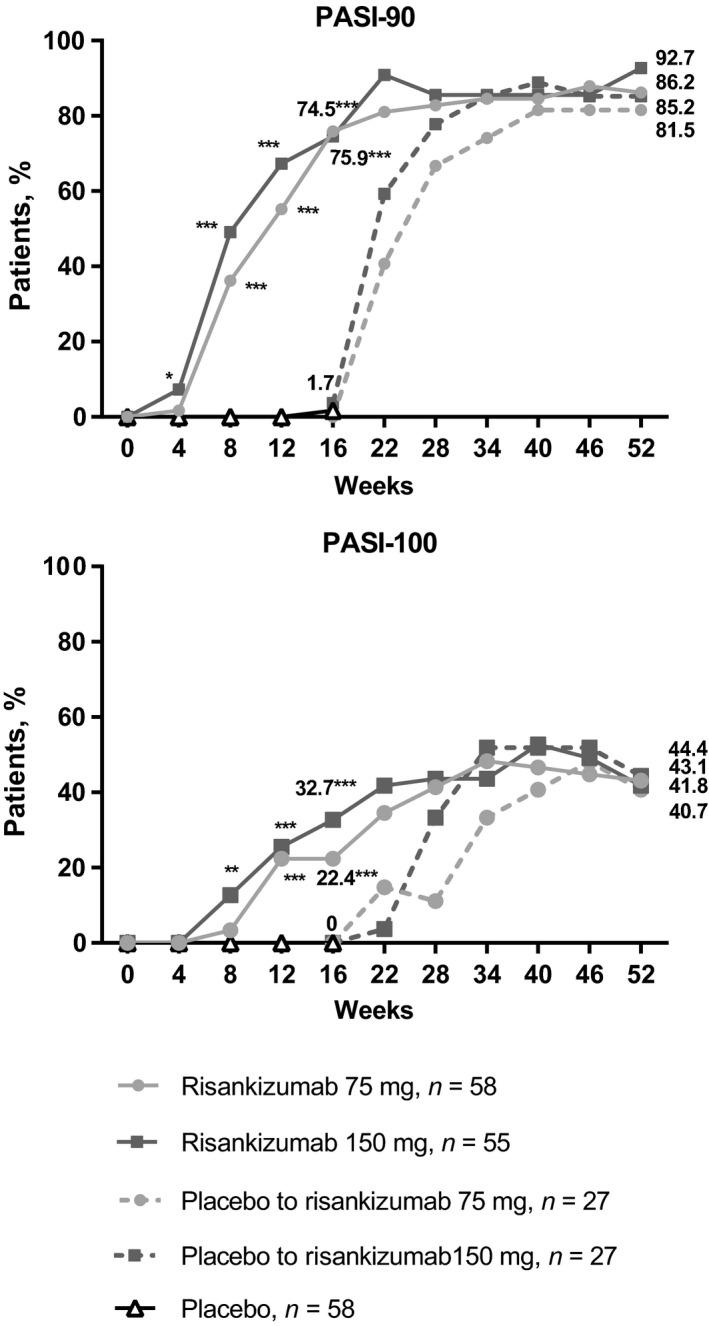
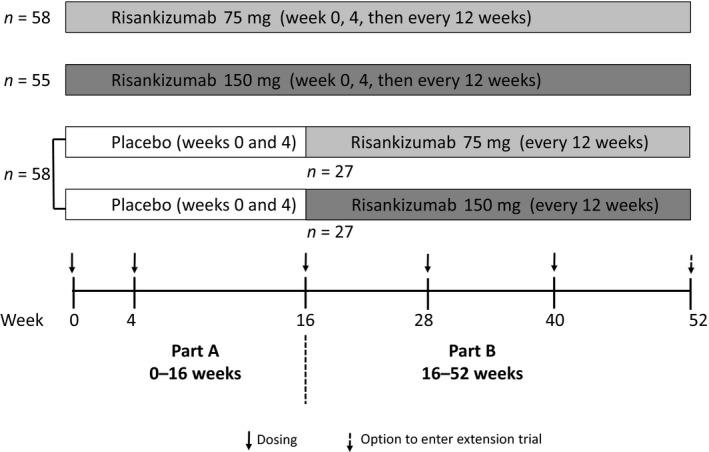
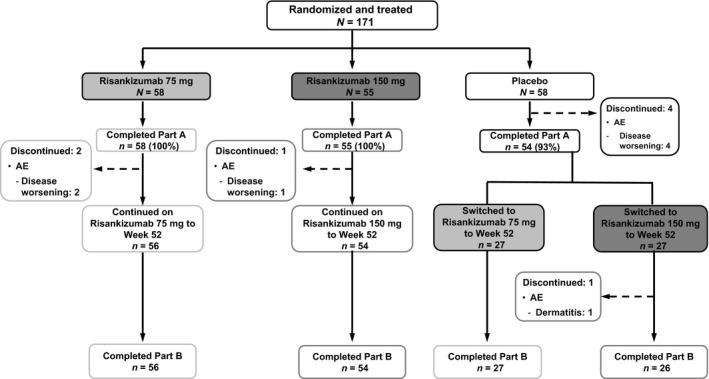
Risankizumab, a humanized immunoglobulin G1 monoclonal antibody, selectively inhibits interleukin-23, a key cytokine in the pathogenesis of psoriasis, by binding to its p19 subunit. In SustaIMM (ClinicalTrials.gov/NCT03000075), a phase 2/3, double-blinded, placebo-controlled study, Japanese patients with moderate to severe plaque psoriasis (n = 171) were stratified by bodyweight and concomitant psoriatic arthritis and randomized 2:2:1:1 to 75 mg risankizumab, 150 mg risankizumab, placebo with cross-over to 75 mg risankizumab and placebo with cross-over to 150 mg risankizumab. Dosing was at weeks 0, 4, 16, 28 and 40, with placebo cross-over to risankizumab at week 16. The primary end-point was 90% or more improvement from baseline in Psoriasis Area and Severity Index (PASI-90) at week 16 for risankizumab versus placebo. Missing data were imputed as non-response. All primary and psoriasis-related secondary end-points were met for both risankizumab doses (P < 0.001). At week 16, PASI-90 responses were significantly higher in patients receiving 75 mg (76%) or 150 mg (75%) risankizumab versus placebo (2%). Corresponding response rates were 86%, 93% and 10% for static Physician Global Assessment (sPGA) score of clear/almost clear; 90%, 95% and 9% for PASI-75; and 22%, 33% and 0% for PASI-100, with significantly higher responses for both risankizumab doses versus placebo. Through week 52, PASI and sPGA responses increased or were maintained and treatment-emergent adverse events were comparable across treatment groups. Both doses of risankizumab were superior to placebo in treating patients with moderate to severe plaque psoriasis. The safety profile was consistent with previous risankizumab trials, with no new or unexpected safety findings.
利纳西珠单抗是一种人源化 IgG1 单克隆抗体,通过与白介素-23 的 p19 亚单位结合,选择性地抑制其在银屑病发病机制中的关键细胞因子。在 SustaIMM(ClinicalTrials.gov/NCT03000075)中,一项 2/3 期、双盲、安慰剂对照研究中,将 171 例中度至重度斑块型银屑病日本患者(n=171)按体重和合并的银屑病关节炎分层,并以 2:2:1:1 的比例随机分配至 75mg 利纳西珠单抗、150mg 利纳西珠单抗、安慰剂加交叉至 75mg 利纳西珠单抗和安慰剂加交叉至 150mg 利纳西珠单抗。在 0、4、16、28 和 40 周时进行给药,在第 16 周时将安慰剂交叉至利纳西珠单抗。主要终点是与安慰剂相比,第 16 周时利纳西珠单抗治疗组中达到 PASI90 改善 90%或更多的患者比例。缺失数据采用无应答值进行估算。两种利纳西珠单抗剂量均达到所有主要和与银屑病相关的次要终点(P<0.001)。在第 16 周,接受 75mg(76%)或 150mg(75%)利纳西珠单抗治疗的患者的 PASI90 应答率显著高于安慰剂(2%)。相应的应答率分别为 86%、93%和 10%的静态医师总体评估(sPGA)评分为清除/几乎清除;90%、95%和 9%的 PASI-75;以及 22%、33%和 0%的 PASI-100,两种利纳西珠单抗剂量与安慰剂相比,应答率均显著更高。在第 52 周时,PASI 和 sPGA 应答增加或保持,且治疗期间出现的不良事件在各治疗组中相似。两种剂量的利纳西珠单抗在治疗中重度斑块型银屑病患者方面均优于安慰剂。安全性概况与之前的利纳西珠单抗试验一致,无新的或意外的安全性发现。


 Zotero 插件