
慢性热应激诱导育肥猪急性期反应和血清代谢组变化
Chronic Heat Stress Induces Acute Phase Responses and Serum Metabolome Changes in Finishing Pigs.
作者信息
Cui Yanjun, Wang Chong, Hao Yue, Gu Xianhong, Wang Haifeng
机构信息
Institute of Animal Nutrition, College of Animal Science and Technology, Zhejiang A & F University, Lin'an 311300, China.
Key Laboratory of Applied Technology on Green-Eco-Healthy Animal Husbandry of Zhejiang Province, Hangzhou 311300, China.
出版信息
Animals (Basel). 2019 Jun 28;9(7):395. doi: 10.3390/ani9070395.
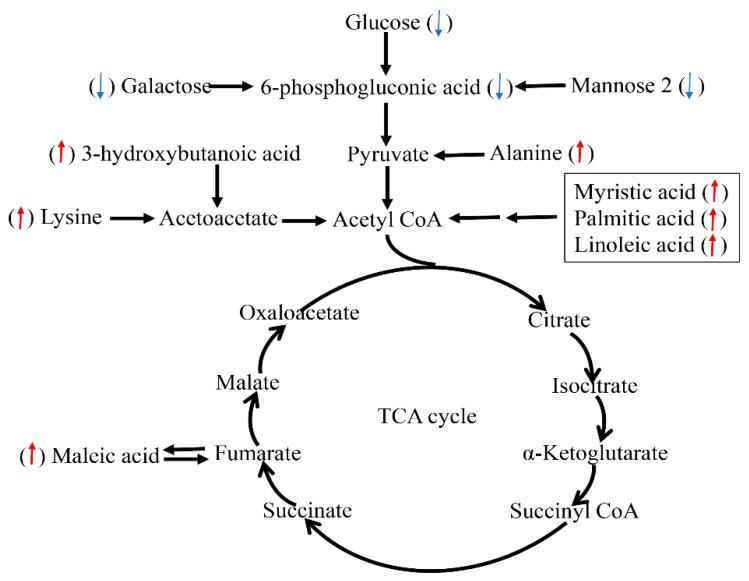
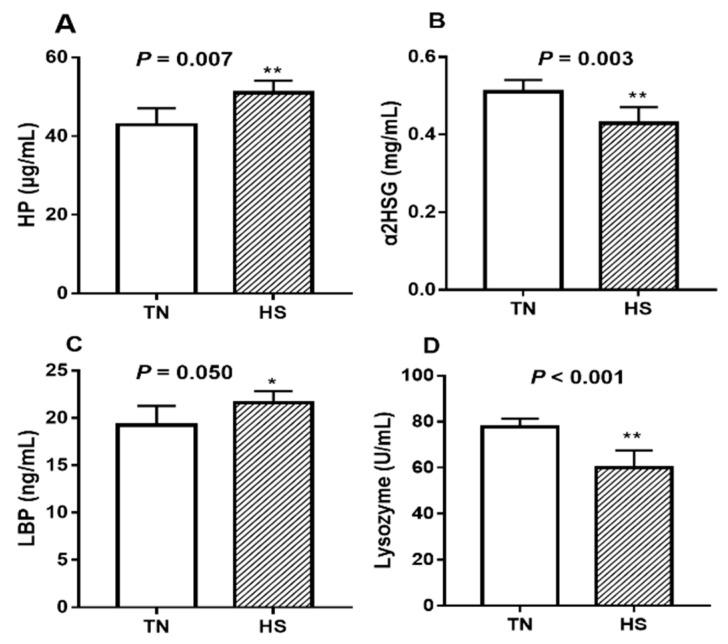
Heat stress (HS) is a main environmental challenge affecting the animal welfare and production efficiency in pig industry. In recent years, numerous reports have studied the alterations in gene expressions and protein profiles in heat-stressed pigs. However, the use of metabolome to unravel adaptive mechanisms of finishing pig in response to chronic HS have not yet been elucidated. We aimed to investigate the effects of chronic HS on serum metabolome in finishing pigs, and to identify the biomarkers of heat stress. Pigs (n = 8 per treatment) were exposed to either thermal neutral (TN; 22 °C) or heat stress (HS, 30 °C) conditions for three weeks. Serum metabonomics of TN- and HS-treated pigs were compared using the GC-MS approach. Metabonomics analysis revealed that twenty-four metabolites had significantly different levels in TN compared to HS (variable importance in the projection values >1 and < 0.05). These metabolites are involved in carbohydrate, amino acid, fatty acid, amines metabolism, and gut microbiome-derived metabolism. Three serum monoses (glucose, mannose 2, and galactose) and 6-phosphogluconic acid were decreased, indicating insufficient source of fuel for energy supply, resulting in negative energy balance (NEB) in heat-stressed pigs. Increased levels of non-esterified fatty acid (myristic acid, palmitic acid, and linoleic acid) and short-chain fatty acids (3-hydroxybutanoic acid and maleic acid) suggested fat decomposition compensating for energy shortage, which was an adaptive response to NEB. Increased concentrations of fluorine, lyxose 1, and D-galacturonic acid were significantly correlated with the levels of acute phase proteins (HP, LBP, α2-HSG, and Lysozyme), suggesting acute phase response in HS-stressed pigs. These metabolites are expected to be novel biomarkers of chronic HS in pigs, yet the use of which awaits further validation.
热应激(HS)是影响养猪业动物福利和生产效率的主要环境挑战。近年来,大量报告研究了热应激猪的基因表达和蛋白质谱变化。然而,利用代谢组学来揭示育肥猪对慢性热应激的适应机制尚未阐明。我们旨在研究慢性热应激对育肥猪血清代谢组的影响,并确定热应激的生物标志物。猪(每组n = 8)分别置于热中性(TN;22°C)或热应激(HS,30°C)条件下3周。采用气相色谱 - 质谱法比较TN组和HS组猪的血清代谢组学。代谢组学分析显示,与HS组相比,TN组有24种代谢物水平存在显著差异(投影变量重要性值>1且<0.05)。这些代谢物参与碳水化合物、氨基酸、脂肪酸、胺类代谢以及肠道微生物衍生代谢。三种血清单糖(葡萄糖、甘露糖2和半乳糖)和6 - 磷酸葡萄糖酸减少,表明能量供应的燃料来源不足,导致热应激猪出现负能量平衡(NEB)。非酯化脂肪酸(肉豆蔻酸、棕榈酸和亚油酸)和短链脂肪酸(3 - 羟基丁酸和马来酸)水平升高表明脂肪分解以补偿能量短缺,这是对NEB的一种适应性反应。氟、来苏糖1和D - 半乳糖醛酸浓度升高与急性期蛋白(HP、LBP、α2 - HSG和溶菌酶)水平显著相关,表明热应激猪存在急性期反应。这些代谢物有望成为猪慢性热应激的新型生物标志物,但其应用有待进一步验证。



 Zotero 插件