
尿皮质素 3 在听觉脑干中的信号传递有助于可逆性噪声诱导的阈值移位后听力的恢复。
Urocortin 3 signalling in the auditory brainstem aids recovery of hearing after reversible noise-induced threshold shift.
机构信息
Department of Biology II, Division Neurobiology, Ludwig-Maximilians-University, Munich, Germany.
German Center for Vertigo and Balance Disorders, University Hospital Munich, Ludwig-Maximilians-University, Munich, Germany.
出版信息
J Physiol. 2019 Aug;597(16):4341-4355. doi: 10.1113/JP278132. Epub 2019 Jul 24.
KEY POINTS
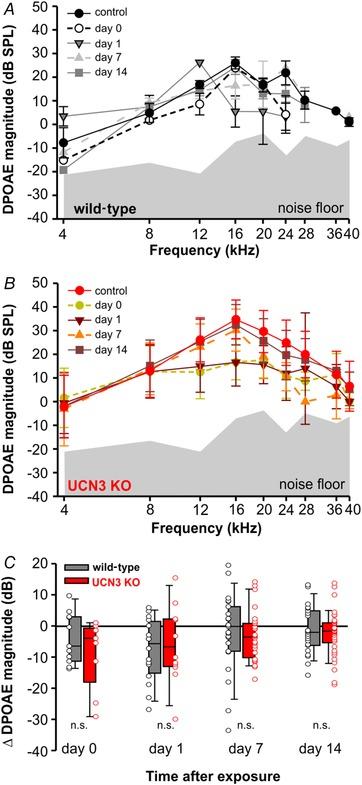
Ongoing, moderate noise exposure does not instantly damage the auditory system but may cause lasting deficits, such as elevated thresholds and accelerated ageing of the auditory system. The neuromodulatory peptide urocortin-3 (UCN3) is involved in the body's recovery from a stress response, and is also expressed in the cochlea and the auditory brainstem. Lack of UCN3 facilitates age-induced hearing loss and causes permanently elevated auditory thresholds following a single 2 h noise exposure at moderate intensities. Outer hair cell function in mice lacking UCN3 is unaffected, so that the observed auditory deficits are most likely due to inner hair cell function or central mechanisms. Highly specific, rather than ubiquitous, expression of UCN3 in the brain renders it a promising candidate for designing drugs to ameliorate stress-related auditory deficits, including recovery from acoustic trauma.
ABSTRACT
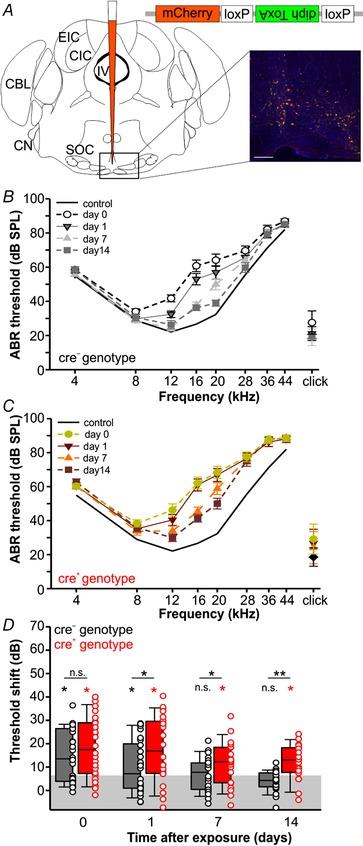
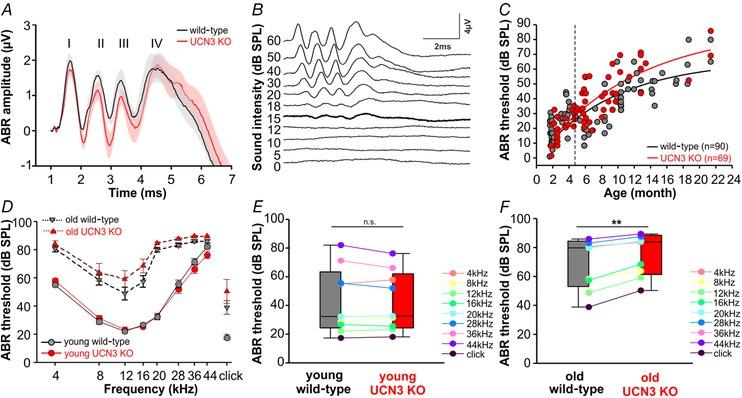
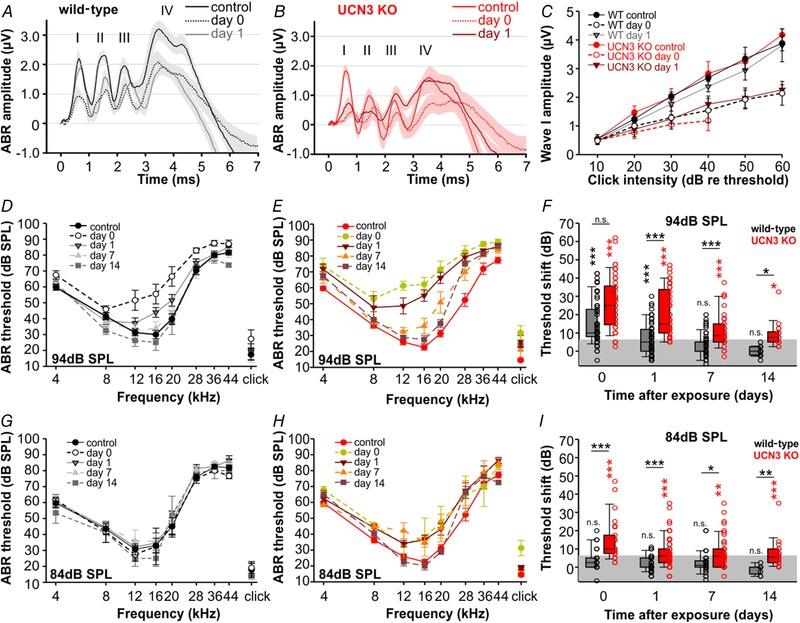
Environmental acoustic noise is omnipresent in our modern society, with sound levels that are considered non-damaging still causing long-lasting or permanent changes in the auditory system. The small neuromodulatory peptide urocortin-3 (UCN3) is the endogenous ligand for corticotropin-releasing factor receptor type 2 and together they are known to play an important role in stress recovery. UCN3 expression has been observed in the auditory brainstem, but its role remains unclear. Here we describe the detailed distribution of UCN3 expression in the murine auditory brainstem and provide evidence that UCN3 is expressed in the synaptic region of inner hair cells in the cochlea. We also show that mice with deficient UCN3 signalling experience premature ageing of the auditory system starting at an age of 4.7 months with significantly elevated thresholds of auditory brainstem responses (ABRs) compared to age-matched wild-type mice. Following a single, 2 h exposure to moderate (84 or 94 dB SPL) noise, UCN3-deficient mice exhibited significantly larger shifts in ABR thresholds combined with maladaptive recovery. In wild-type mice, the same noise exposure did not cause lasting changes to auditory thresholds. The presence of UCN3-expressing neurons throughout the auditory brainstem and the predisposition to hearing loss caused by preventing its normal expression suggests UCN3 as an important neuromodulatory peptide in the auditory system's response to loud sounds.
要点
持续的中度噪声暴露不会立即损害听觉系统,但可能导致永久性缺陷,如阈值升高和听觉系统加速老化。神经调制肽 UCN3(尿皮质素-3)参与身体从应激反应中恢复,也在耳蜗和听觉脑干中表达。缺乏 UCN3 会促进年龄相关性听力损失,并导致在中等强度的单次 2 小时噪声暴露后,永久性地升高听觉阈值。缺乏 UCN3 的小鼠的外毛细胞功能不受影响,因此观察到的听觉缺陷很可能是由于内毛细胞功能或中枢机制所致。UCN3 在大脑中的表达具有高度特异性,而非普遍性,使其成为设计药物以改善应激相关听觉缺陷的有希望的候选物,包括从声创伤中恢复。
摘要
环境声噪声在我们的现代社会中无处不在,即使是被认为不会造成损害的声级,仍会导致听觉系统产生长期或永久性的变化。小神经调制肽 UCN3(尿皮质素-3)是促肾上腺皮质素释放因子受体 2 的内源性配体,它们共同在应激恢复中发挥重要作用。已经观察到 UCN3 在听觉脑干中的表达,但它的作用尚不清楚。在这里,我们描述了 UCN3 在小鼠听觉脑干中的详细表达分布,并提供了证据表明 UCN3 在耳蜗内毛细胞的突触区表达。我们还表明,缺乏 UCN3 信号的小鼠从 4.7 个月大开始出现听觉系统过早衰老,与年龄匹配的野生型小鼠相比,听觉脑干反应(ABR)的阈值显著升高。在单次 2 小时暴露于中等(84 或 94 dB SPL)噪声后,缺乏 UCN3 的小鼠 ABR 阈值的变化明显更大,并且恢复不良。在野生型小鼠中,相同的噪声暴露不会导致听觉阈值的持久变化。UCN3 表达神经元存在于整个听觉脑干中,并且由于防止其正常表达而导致听力损失的易感性表明 UCN3 是听觉系统对大声响反应的重要神经调制肽。

 Zotero 插件