
基于日本痴呆症患者及其照护者相关因素的痴呆症照护者个人经济负担的分类树模型:一项横断面在线调查。
Classification tree model of the personal economic burden of dementia care by related factors of both people with dementia and caregivers in Japan: a cross-sectional online survey.
机构信息
Department of Healthcare Economics and Quality Management, Kyoto University Graduate School of Medicine, Kyoto, Japan.
KI Alzheimer's Disease Research Center (ADRC), Karolinska Institute, Karolinska, Sweden.
出版信息
BMJ Open. 2019 Jul 9;9(7):e026733. doi: 10.1136/bmjopen-2018-026733.
OBJECTIVE
The purpose of this study was to clarify the microlevel determinants of the economic burden of dementia care at home in Japanese community settings by classifying them into subgroups of factors related to people with dementia and their caregivers.
DESIGN
A cross-sectional online survey.
PARTICIPANTS
4313 panels of Japanese research company who fulfilled the following criteria: (1) aged 30 years or older, (2) non-professional caregiver of someone with dementia, (3) caring for only one person with dementia and (4) having no conflicts of interest with advertising or marketing research entities.
PRIMARY OUTCOME MEASURES
Informal care costs and out-of-pocket payments for long-term care (LTC) services.
RESULTS
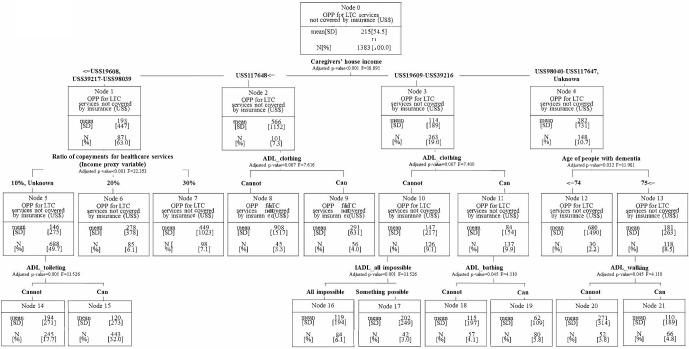
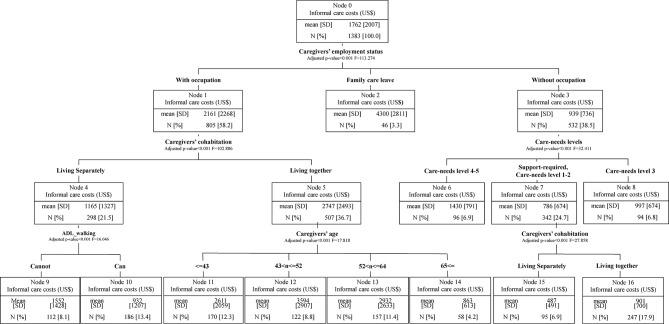
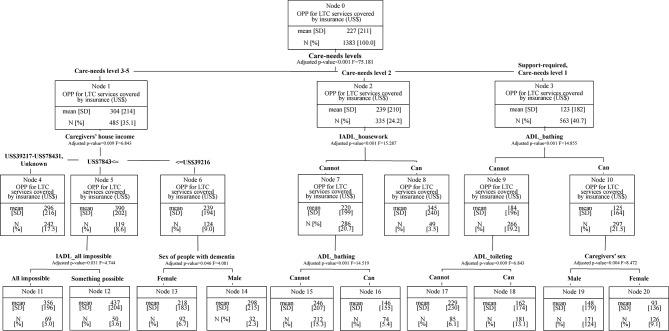
From 4313 respondents, only 1383 caregivers in community-settings were included in this analysis. We conducted a χ² automatic interaction detection analysis to identify the factors related to each cost (informal care costs and out-of-pocket payments for LTC services) divided into subcategories. In the resultant classifications, informal care cost was mainly related to caregivers' employment status. When caregivers acquired family care leave, informal care costs were the highest. On the other hand, out-of-pocket payments for LTC were related to care-need levels and family economic status. Activities of Daily Living and Instrumental Activities of Daily Living functions such as bathing, toileting and cleaning were related to all costs.
CONCLUSION
This study clarified the difference in dementia care costs between classified subgroups by considering the combination of the situations of both people with dementia and their caregivers. Informal care costs were related to caregivers' employment and cohabitation status rather to the situations of people with dementia. On the other hand, out-of-pocket payments for LTC services were related to care-need levels and family economic status. These classifications will be useful in understanding which situation represents a greater economic burden and helpful in improving the sustainability of the dementia care system in Japan.
目的
本研究旨在通过将与痴呆症患者及其照护者相关的因素分类为亚组,阐明日本社区环境中家庭痴呆症照护经济负担的微观决定因素。
设计
横断面在线调查。
参与者
4313 名日本研究公司的小组,符合以下标准:(1)年龄在 30 岁或以上,(2)非痴呆症患者的专业照护者,(3)仅照护一名痴呆症患者,(4)与广告或市场研究实体无利益冲突。
主要结局测量指标
非正规护理成本和长期护理(LTC)服务的自付费用。
结果
在 4313 名受访者中,仅有 1383 名社区环境中的照护者被纳入本分析。我们进行了 χ² 自动交互检测分析,以确定每个成本(非正规护理成本和 LTC 服务的自付费用)分为亚类的相关因素。在得出的分类中,非正规护理成本主要与照护者的就业状况有关。当照护者获得家庭护理假时,非正规护理成本最高。另一方面,LTC 的自付费用与护理需求水平和家庭经济状况有关。日常生活活动和工具性日常生活活动功能,如洗澡、上厕所和清洁,与所有费用有关。
结论
本研究通过考虑痴呆症患者及其照护者情况的组合,阐明了分类亚组中痴呆症照护费用的差异。非正规护理成本与照护者的就业和同居状况有关,而与痴呆症患者的状况无关。另一方面,LTC 服务的自付费用与护理需求水平和家庭经济状况有关。这些分类将有助于理解哪种情况代表更大的经济负担,并有助于改善日本痴呆症照护系统的可持续性。

 Zotero 插件