
一种用于改善前列腺癌Gleason评分的深度学习算法的开发与验证
Development and validation of a deep learning algorithm for improving Gleason scoring of prostate cancer.
作者信息
Nagpal Kunal, Foote Davis, Liu Yun, Chen Po-Hsuan Cameron, Wulczyn Ellery, Tan Fraser, Olson Niels, Smith Jenny L, Mohtashamian Arash, Wren James H, Corrado Greg S, MacDonald Robert, Peng Lily H, Amin Mahul B, Evans Andrew J, Sangoi Ankur R, Mermel Craig H, Hipp Jason D, Stumpe Martin C
机构信息
1Google AI Healthcare, Google, Mountain View, CA USA.
2Laboratory Department, Naval Medical Center San Diego, San Diego, CA USA.
出版信息
NPJ Digit Med. 2019 Jun 7;2:48. doi: 10.1038/s41746-019-0112-2. eCollection 2019.
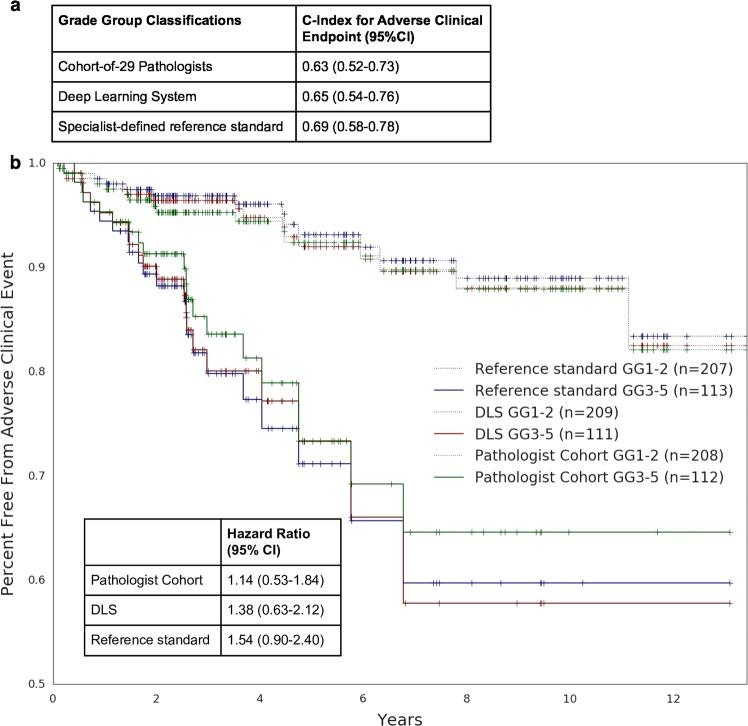
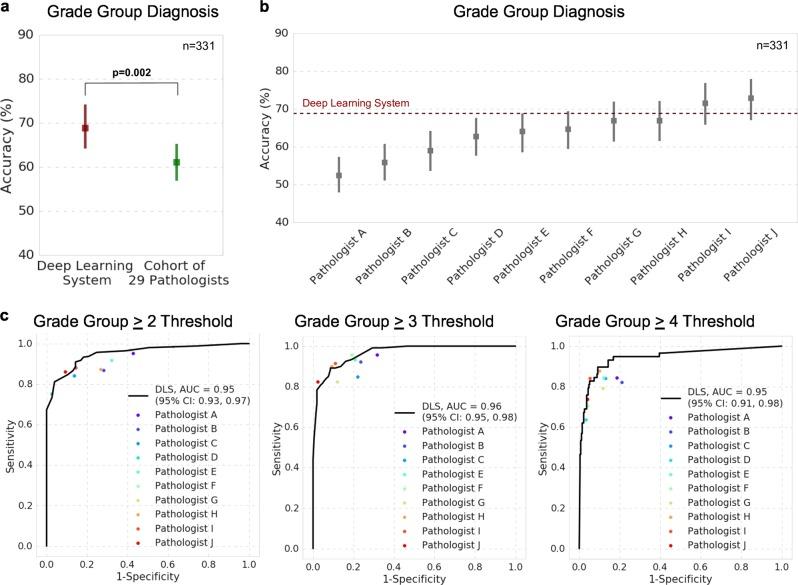
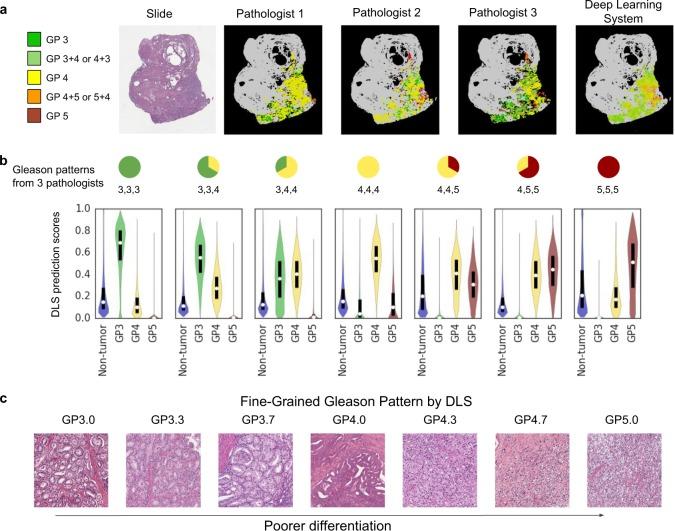
For prostate cancer patients, the Gleason score is one of the most important prognostic factors, potentially determining treatment independent of the stage. However, Gleason scoring is based on subjective microscopic examination of tumor morphology and suffers from poor reproducibility. Here we present a deep learning system (DLS) for Gleason scoring whole-slide images of prostatectomies. Our system was developed using 112 million pathologist-annotated image patches from 1226 slides, and evaluated on an independent validation dataset of 331 slides. Compared to a reference standard provided by genitourinary pathology experts, the mean accuracy among 29 general pathologists was 0.61 on the validation set. The DLS achieved a significantly higher diagnostic accuracy of 0.70 ( = 0.002) and trended towards better patient risk stratification in correlations to clinical follow-up data. Our approach could improve the accuracy of Gleason scoring and subsequent therapy decisions, particularly where specialist expertise is unavailable. The DLS also goes beyond the current Gleason system to more finely characterize and quantitate tumor morphology, providing opportunities for refinement of the Gleason system itself.
对于前列腺癌患者,Gleason评分是最重要的预后因素之一,可能独立于分期决定治疗方案。然而,Gleason评分基于对肿瘤形态的主观显微镜检查,且重复性较差。在此,我们展示了一种用于对前列腺切除标本的全切片图像进行Gleason评分的深度学习系统(DLS)。我们的系统是使用来自1226张切片的1.12亿个经病理学家标注的图像块开发的,并在一个由331张切片组成的独立验证数据集上进行了评估。与泌尿生殖系统病理专家提供的参考标准相比,29位普通病理学家在验证集上的平均准确率为0.61。DLS实现了显著更高的诊断准确率,为0.70(=0.002),并且在与临床随访数据的相关性方面,有更好地对患者进行风险分层的趋势。我们的方法可以提高Gleason评分的准确性以及后续的治疗决策,特别是在缺乏专家专业知识的情况下。DLS还超越了当前的Gleason系统,能够更精细地描述和量化肿瘤形态,为改进Gleason系统本身提供了机会。


 Zotero 插件