
揭示前列腺癌自动诊断和Gleason分级评估的关键病理特征。
Unveiling key pathomic features for automated diagnosis and Gleason grade estimation in prostate cancer.
作者信息
Brancato Valentina, Verdicchio Mario, Cavaliere Carlo, Isgrò Francesco, Salvatore Marco, Aiello Marco
机构信息
IRCCS SYNLAB SDN, Via E. Gianturco 113, 80143, Naples, Italy.
Department of Electrical Engineering and Information Technologies, University of Naples Federico II, Claudio 21, 80125, Naples, Italy.
出版信息
BMC Med Imaging. 2025 Jul 28;25(1):299. doi: 10.1186/s12880-025-01841-8.
BACKGROUND
Recent advances in histology scanning technology and Artificial Intelligence (AI) offer great opportunities to support cancer diagnosis. The inability to interpret the extracted features and model predictions is one of the major issues limiting the acceptance of AI models in clinical practice, and a clear representation of the relevance of the extracted features and model predictions is lacking. Focusing on the problem of prostate cancer (PCa) diagnosis and grading, this study aims to detect which are the most discriminant features for distinguishing malignant from non-malignant tissue and Gleason patterns, leaving the evaluation of models' classification performances as a secondary goal.
METHODS
Utilizing a dataset of 187 annotated H&E-stained whole-slide images, the study explores three magnification levels, extracting 1971 features per tile. Two machine-learning classification tasks are conducted (Malignant vs. Non-malignant and High-grade vs. Low-grade) for each magnification. SHapley Additive exPlanations method was used to investigate models' interpretability, estimating the importance of pathomic features and their impact on prediction models.
RESULTS
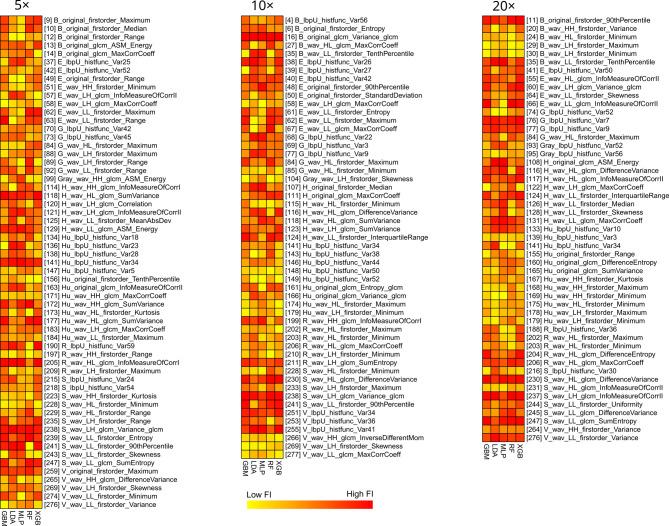
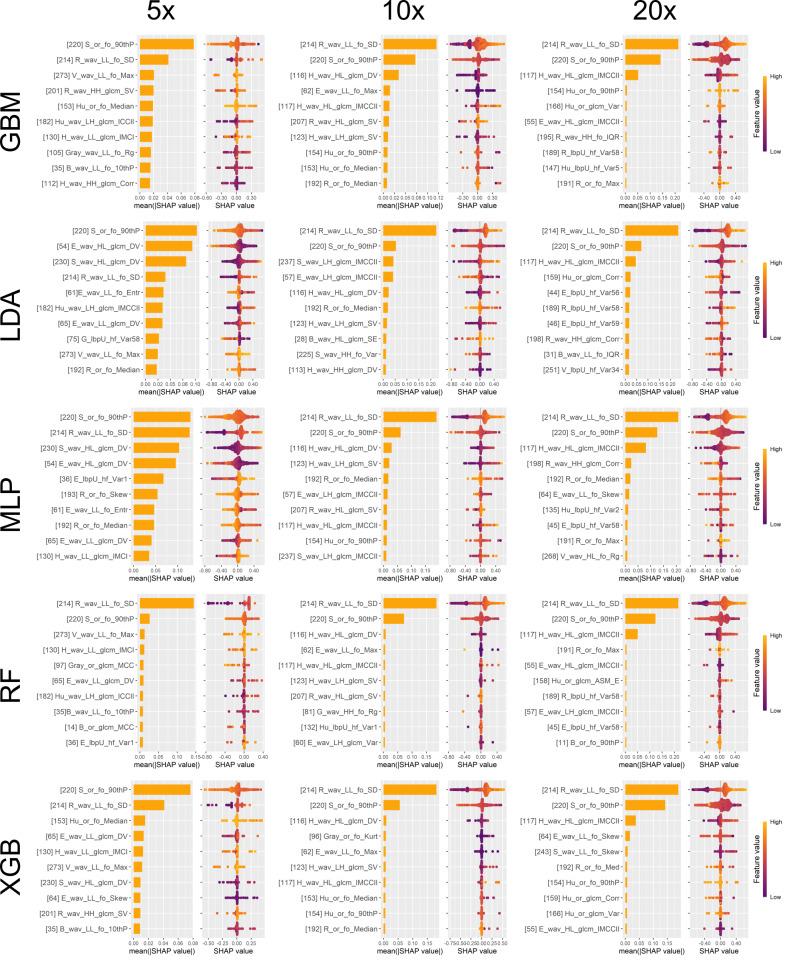
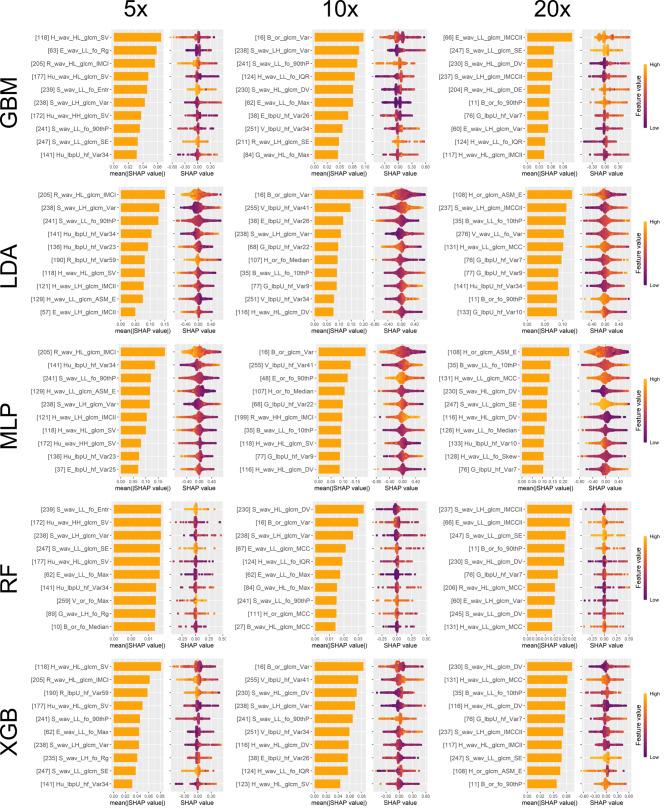
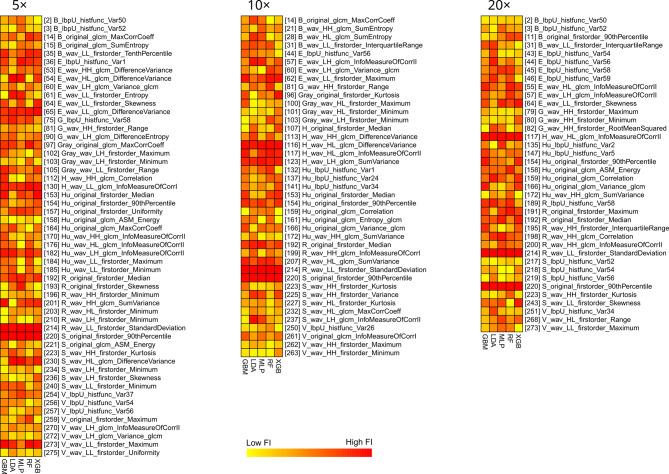
Wavelet features were consistently prominent in "High-grade vs Low-grade" classification task, together with local binary pattern descriptors. Some histogram features appeared as key features for diagnostic classification tasks. The identified key discriminant features were classified for their specificity with respect to WSI magnification. Very high AUC values were reached for PCa diagnosis task (0.97 < AUC < 0.99), while task involving Low- versus High-grade classification exhibit lower AUC values (maximum AUC: 0.72-0.73).
CONCLUSIONS
This work provides new insights for the explanation of hand-crafted pathomic-based classification models for PCa diagnosis and grading.
CLINICAL TRIAL NUMBER
Not applicable.
背景
组织学扫描技术和人工智能(AI)的最新进展为支持癌症诊断提供了巨大机遇。无法解释提取的特征和模型预测结果是限制AI模型在临床实践中被接受的主要问题之一,并且缺乏对提取特征和模型预测相关性的清晰表示。本研究聚焦于前列腺癌(PCa)诊断和分级问题,旨在检测区分恶性与非恶性组织以及Gleason分级模式的最具判别力的特征,将模型分类性能的评估作为次要目标。
方法
利用包含187张标注的苏木精和伊红(H&E)染色全切片图像的数据集,该研究探索了三个放大倍数级别,每个切片提取1971个特征。针对每个放大倍数进行了两项机器学习分类任务(恶性与非恶性以及高级别与低级别)。使用SHapley加性解释方法来研究模型的可解释性,估计病理特征的重要性及其对预测模型的影响。
结果
在“高级别与低级别”分类任务中,小波特征与局部二值模式描述符始终表现突出。一些直方图特征成为诊断分类任务的关键特征。根据其相对于全切片图像(WSI)放大倍数的特异性对识别出的关键判别特征进行了分类。PCa诊断任务达到了非常高的AUC值(0.97 < AUC < 0.99),而涉及低级别与高级别分类的任务AUC值较低(最大AUC:0.72 - 0.73)。
结论
这项工作为基于手工制作的病理特征的PCa诊断和分级分类模型的解释提供了新的见解。
临床试验编号
不适用。



 Zotero 插件