
抗 N-甲基-D-天冬氨酸受体脑炎患者脑脊液轻链和重链神经丝水平升高。
Cerebrospinal fluid light and heavy neurofilament level increased in anti-N-methyl-d-aspartate receptor encephalitis.
机构信息
Department of Neurology, Nanfang Hospital, Southern Medical University, Guangzhou, China.
Institute of Clinical Pharmacology, Guangzhou University of Chinese Medicine, Guangzhou, China.
出版信息
Brain Behav. 2019 Aug;9(8):e01354. doi: 10.1002/brb3.1354. Epub 2019 Jul 17.
BACKGROUND
Neurofilaments (Nf) are a series of highly specific scaffolding proteins of neurons. Neurofilament light chains (Nf-L) and the heavy one (Nf-H) are subunits of Nf, and they are recognized as potent productions of neural damage. The concentrations of Nf aggrandized significantly in neurological disease including neuromyelitis optica, multiple sclerosis, and Alzheimer's disease. However, whether Nf in cerebrospinal fluid (CSF) elevated in anti-N-methyl-d-aspartate receptor (NMDAR) encephalitis is unclear. Here, we aimed to detect whether CSF Nf is altered in NMDAR and whether changes in CSF Nf can serve as an objective and effective biomarker to evaluate disease severity and prognosis.
METHODS
We collected 24 anti-NMDAR encephalitis patients, 11 viral meningoencephalitis/encephalitis (VM) patients, and 21 controls in this study. CSF Nf-L, Nf-H, and cytokine levels (IL-1β, IL-6, and IL-17A) were determined by enzyme-linked immunosorbent assay (ELISA) and compared between groups. We evaluated patients' clinical outcomes or prognosis according to modified Rankin scale (mRS) score.
RESULTS
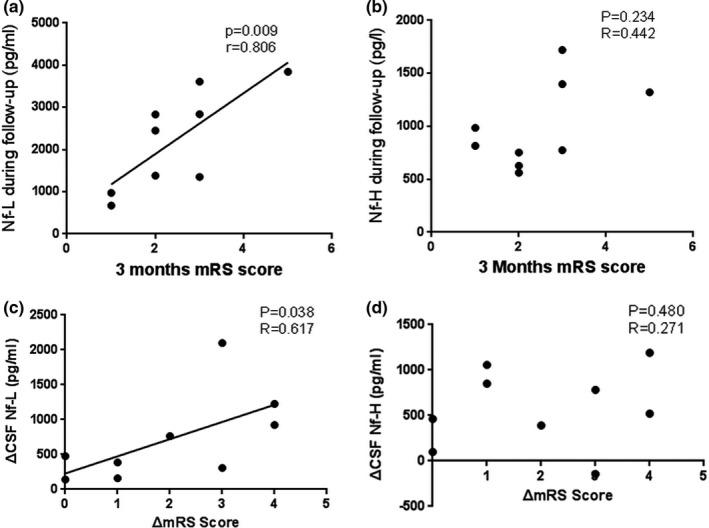
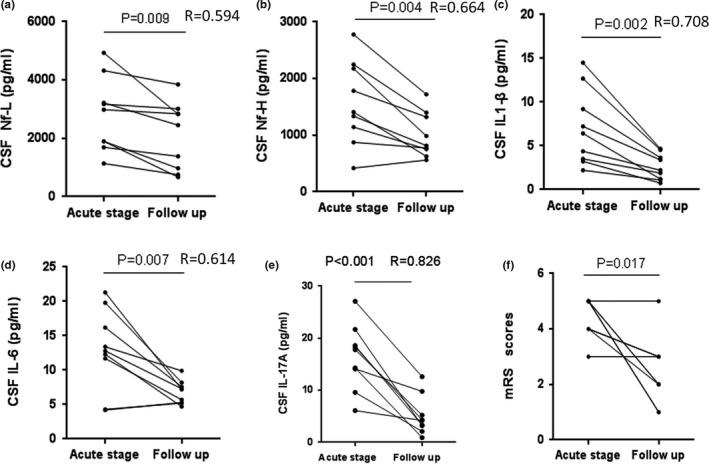
Compared with controls, both CSF Nf-L and Nf-H levels were significantly increased in anti-NMDAR encephalitis patients. While compared with VM patients, only Nf-L were increased in anti-NMDAR encephalitis patients. Moreover, CSF Nf-L were positively correlated with concentration of cytokines (IL-1β, IL-17A) and mRS scores in anti-NMDAR encephalitis patients. After treatment, both CSF Nf-L and Nf-H levels decreased. Furthermore, the Nf-L during follow-up positively correlated with 3-month mRS scores, and ΔNf-L positively correlated with ΔmRS.
CONCLUSIONS
Briefly, CSF Nf-L levels notably increased in anti-NMDAR encephalitis patients in acute phase and positively correlated with disease severity. It could be considered as a useful indicator for clinical outcomes and prognosis.
背景
神经丝(Nf)是神经元的一系列高度特异性支架蛋白。神经丝轻链(Nf-L)和重链(Nf-H)是 Nf 的亚单位,它们被认为是神经损伤的有效产物。在神经肌炎性脑脊髓炎、多发性硬化症和阿尔茨海默病等神经疾病中,Nf 的浓度显著增加。然而,抗 N-甲基-D-天冬氨酸受体(NMDAR)脑炎患者脑脊液(CSF)中的 Nf 是否升高尚不清楚。在这里,我们旨在检测 NMDAR 中 CSF Nf 是否发生改变,以及 CSF Nf 的变化是否可以作为评估疾病严重程度和预后的客观有效的生物标志物。
方法
本研究共纳入 24 例抗 NMDAR 脑炎患者、11 例病毒性脑膜脑炎/脑炎(VM)患者和 21 例对照。通过酶联免疫吸附试验(ELISA)检测 CSF Nf-L、Nf-H 和细胞因子水平(IL-1β、IL-6 和 IL-17A),并比较各组间的差异。根据改良 Rankin 量表(mRS)评分评估患者的临床结局或预后。
结果
与对照组相比,抗 NMDAR 脑炎患者的 CSF Nf-L 和 Nf-H 水平均显著升高。与 VM 患者相比,只有抗 NMDAR 脑炎患者的 CSF Nf-L 升高。此外,抗 NMDAR 脑炎患者的 CSF Nf-L 与细胞因子(IL-1β、IL-17A)浓度和 mRS 评分呈正相关。治疗后,CSF Nf-L 和 Nf-H 水平均降低。此外,随访期间 CSF Nf-L 与 3 个月 mRS 评分呈正相关,ΔNf-L 与 ΔmRS 呈正相关。
结论
总之,在急性期,抗 NMDAR 脑炎患者的 CSF Nf-L 水平显著升高,且与疾病严重程度呈正相关。它可以被认为是一个有用的指标,用于预测临床结局和预后。

 Zotero 插件