
脑脊液中的无细胞线粒体 DNA:抗 NMDAR 脑炎的潜在预后生物标志物。
Cell-Free Mitochondrial DNA in the CSF: A Potential Prognostic Biomarker of Anti-NMDAR Encephalitis.
机构信息
Department of Neurology, Nanfang Hospital, Southern Medical University, Guangzhou, China.
Department of Neurology, the Affiliated Brain Hospital of Guangzhou Medical University, Guangzhou, China.
出版信息
Front Immunol. 2019 Feb 6;10:103. doi: 10.3389/fimmu.2019.00103. eCollection 2019.
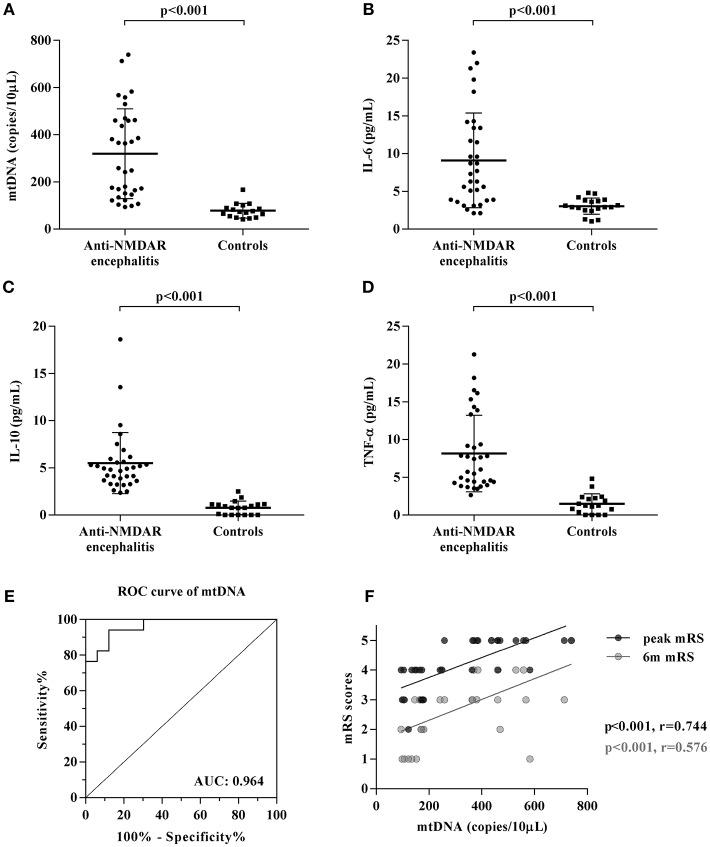
Anti-N-methyl-D-aspartate receptor (NMDAR) encephalitis is an autoimmune inflammatory brain disease that can develop a variety of neuropsychiatric presentations. However, the underlying nature of its inflammatory neuronal injury remains unclear. Mitochondrial DNA (mtDNA) is recently regarded as a damage-associated molecular pattern molecule (DAMP) that can initiate an inflammatory response. In the presenting study, we aimed to evaluate the levels of cell-free mtDNA in cerebrospinal fluid (CSF) of patients with anti-NMDAR encephalitis and to determine a potential role of cell-free mtDNA in the prognosis of anti-NMDAR encephalitis. A total of 33 patients with NMDAR encephalitis and 17 patients with other non-inflammatory disorders as controls were included in this study. The CSF levels of cell-free mtDNA were measured by quantitative polymerase chain reaction (qPCR). Cytokines including interleukin (IL)-6, IL-10, and tumor necrosis factor alpha (TNF-α) were measured by ELISA. The modified Rankin scale (mRS) score was evaluated for neurologic disabilities. Our data showed that the CSF levels of cell-free mtDNA and inflammation-associated cytokines were significantly higher in the patients with anti-NMDAR encephalitis compared with those in controls. Positive correlations were detected between the CSF levels of cell-free mtDNA and mRS scores of patients with anti-NMDAR encephalitis at both their admission and 6-month follow up. These findings suggest that the CSF level of cell-free mtDNA reflects the underlying neuroinflammatory process in patients with anti-NMDAR encephalitis and correlates with their clinical mRS scores. Therefore, cell-free mtDNA may be a potential prognostic biomarker for anti-NMDAR encephalitis.
抗 N-甲基-D-天冬氨酸受体(NMDAR)脑炎是一种自身免疫性炎症性脑病,可引起多种神经精神表现。然而,其炎症性神经元损伤的潜在性质尚不清楚。线粒体 DNA(mtDNA)最近被认为是一种损伤相关分子模式分子(DAMP),可引发炎症反应。在本研究中,我们旨在评估抗 NMDAR 脑炎患者脑脊液(CSF)中细胞游离 mtDNA 的水平,并确定细胞游离 mtDNA 在抗 NMDAR 脑炎预后中的潜在作用。本研究共纳入 33 例 NMDAR 脑炎患者和 17 例非炎症性疾病患者作为对照。通过定量聚合酶链反应(qPCR)测量细胞游离 mtDNA 的 CSF 水平。通过 ELISA 测量细胞因子,包括白细胞介素(IL)-6、IL-10 和肿瘤坏死因子-α(TNF-α)。通过改良 Rankin 量表(mRS)评分评估神经功能障碍。我们的数据显示,与对照组相比,抗 NMDAR 脑炎患者的 CSF 中细胞游离 mtDNA 和炎症相关细胞因子水平明显升高。在抗 NMDAR 脑炎患者的入院和 6 个月随访时,CSF 中细胞游离 mtDNA 水平与 mRS 评分呈正相关。这些发现表明,CSF 中细胞游离 mtDNA 水平反映了抗 NMDAR 脑炎患者潜在的神经炎症过程,并与他们的临床 mRS 评分相关。因此,细胞游离 mtDNA 可能是抗 NMDAR 脑炎的潜在预后生物标志物。
 Zotero 插件