
叶酸灌注给药可减少起始阿伯丁·阿可斯肉鸡的腹部脂肪沉积。
Folic acid perfusion administration reduced abdominal fat deposition in starter Arbor Acres broilers.
机构信息
College of Animal Science and Technology, Northwest A&F University, Yangling 712100, China.
出版信息
Poult Sci. 2019 Dec 1;98(12):6816-6825. doi: 10.3382/ps/pez413.
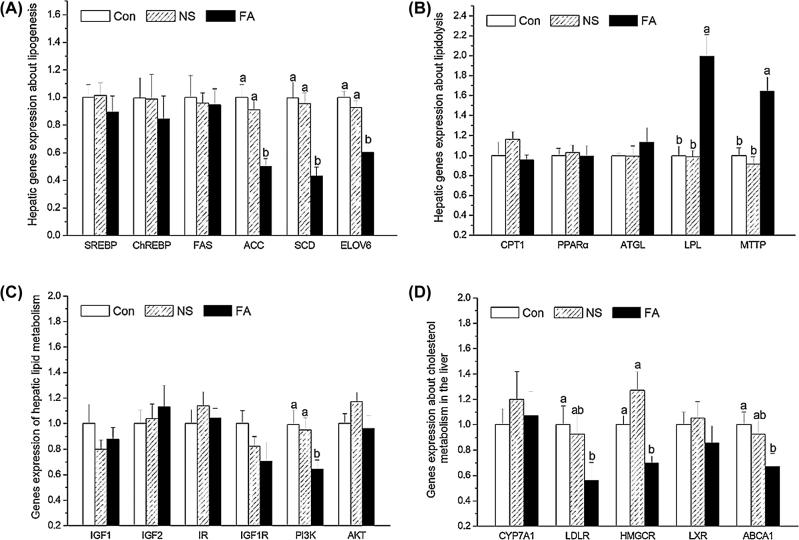
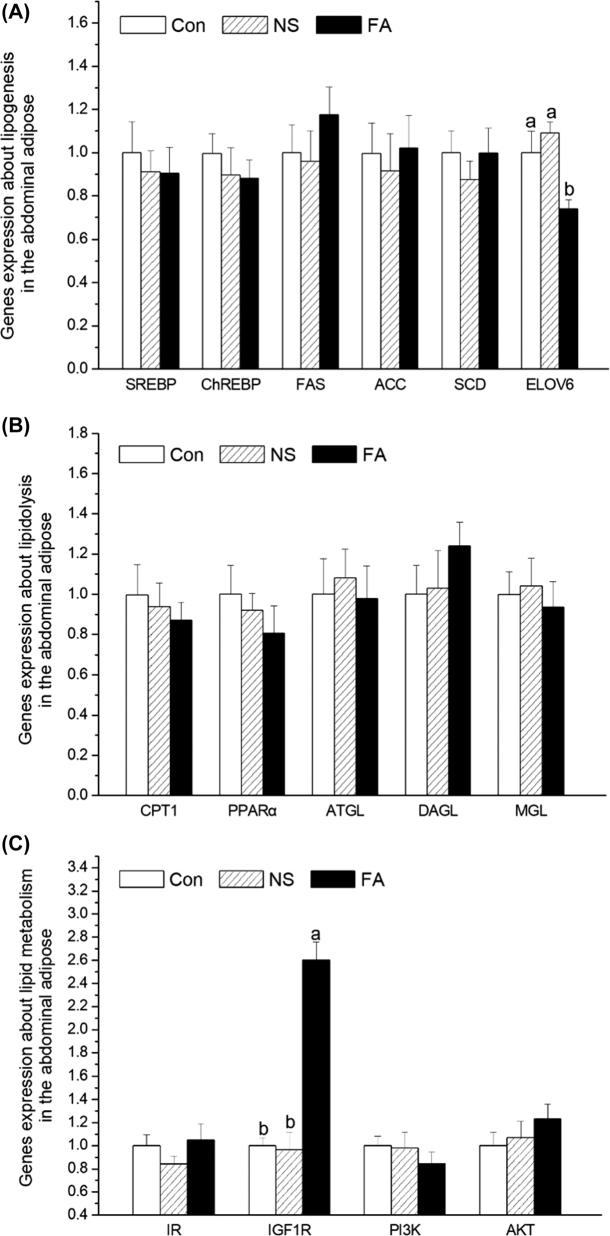
With intensive selection for meat production in broilers, excessive fat accumulation is also accompanied and causes economic concerns. Folic acid was reported to be involved in lipid metabolism. The present study was conducted to investigate the role of folic acid in reducing abdominal fat deposition. A total of 105 one-day-old healthy Arbor Acres broilers were randomly distributed into 3 treatments, including the control (Con), saline-perfusion group (NS), and folic acid perfusion group (FA). The growth performance, biochemical characteristics in serum, and lipid metabolism in the liver and abdominal fat tissues were evaluated. Results have shown that folic acid significantly reduced abdominal fat percentage (P < 0.05) and had no effects on BW, ADFI, ADG, and FCR (P > 0.05). Serum triglycerides (TG), total cholesterol (TC), and alanine aminotransferase (ALT) levels were lower in FA group but albumin concentration was higher (P < 0.05). Hepatic ACC, SCD, ELOVL6, PI3K, LDLR, HMGCR, and ABCA1 mRNA abundance were all down-regulated in FA group (P < 0.05) when compared with the Con and NS groups, while CPT1 and PPARα were not affected. In addition, MTTP mRNA abundance was higher in the liver of birds subjected to folic acid (P < 0.05). There was no difference about TG deposition in the liver among all groups based on hematoxylin-eosin (HE) and Oil Red O staining. On the other hand, ELOVL6, PPARγ, IGF1, and TGFβ2 expression were notably decreased in the abdominal fat in FA group (P < 0.05). In conclusion, our data demonstrated that folic acid has reduced abdominal fat percentage by decreasing hepatic lipogenesis and suppressing adipocytes proliferation and differentiation. And the inhibiting effect of adipocytes might be mediated by IGF1 and TGFβ2 down-regulation.
在肉鸡的肉质生产中进行了密集的选择,过度的脂肪积累也随之而来,并引起了经济方面的关注。据报道,叶酸参与脂质代谢。本研究旨在探讨叶酸在减少腹部脂肪沉积中的作用。将 105 只 1 日龄健康的 Arbor Acres 肉鸡随机分为 3 个处理组,包括对照组(Con)、生理盐水灌注组(NS)和叶酸灌注组(FA)。评估了生长性能、血清生化特性以及肝脏和腹部脂肪组织中的脂质代谢。结果表明,叶酸显著降低了腹部脂肪百分比(P < 0.05),但对 BW、ADFI、ADG 和 FCR 没有影响(P > 0.05)。FA 组血清甘油三酯(TG)、总胆固醇(TC)和丙氨酸转氨酶(ALT)水平较低,但白蛋白浓度较高(P < 0.05)。与 Con 和 NS 组相比,FA 组肝脏中的 ACC、SCD、ELOVL6、PI3K、LDLR、HMGCR 和 ABCA1 mRNA 丰度均下调(P < 0.05),而 CPT1 和 PPARα 不受影响。此外,叶酸处理的鸡肝脏中的 MTTP mRNA 丰度较高(P < 0.05)。各组肝脏 TG 沉积量均无差异,根据苏木精-伊红(HE)和油红 O 染色。另一方面,FA 组腹部脂肪中的 ELOVL6、PPARγ、IGF1 和 TGFβ2 表达显著降低(P < 0.05)。综上所述,我们的数据表明,叶酸通过减少肝脏脂肪生成和抑制脂肪细胞增殖和分化来降低腹部脂肪百分比。脂肪细胞的抑制作用可能是通过下调 IGF1 和 TGFβ2 介导的。


 Zotero 插件