
二甲双胍通过 STAT3/NF-κB 通路逆转原发性乳腺癌细胞的间充质表型。
Metformin reverses mesenchymal phenotype of primary breast cancer cells through STAT3/NF-κB pathways.
机构信息
Red de Apoyo a la Investigación (RAI), Universidad Nacional Autónoma de México- Instituto Nacional de Ciencias Médicas y Nutrición Salvador Zubirán, Vasco de Quiroga 15, Col. Belisario Domínguez Sección XVI, Delegación Tlalpan, 14080, Mexico City, CP, Mexico.
Unidad de Bioquímica, Instituto Nacional de Ciencias Médicas y Nutrición, Salvador Zubirán Vasco de Quiroga 15, Col. Belisario Domínguez Sección XVI, Delegación Tlalpan, 14080, Mexico City, CP, Mexico.
出版信息
BMC Cancer. 2019 Jul 23;19(1):728. doi: 10.1186/s12885-019-5945-1.
BACKGROUND
Breast cancer currently is the most frequently diagnosed neoplasm and the leading cause of death from cancer in women worldwide, which is mainly due to metastatic disease. Increasing our understanding of the molecular mechanisms leading to metastasis might thus improve the pharmacological management of the disease. Epithelial-mesenchymal transition (EMT) is a key factor that plays a major role in tumor metastasis. Some pro-inflammatory cytokines, like IL-6, have been shown to stimulate phenotypes consistent with EMT in transformed epithelial cells as well as in carcinoma cell lines. Since the EMT is one of the crucial steps for metastasis, we studied the effects of metformin (MTF) on EMT.
METHODS
Cytotoxic effect of MTF was evaluated in eight primary breast cancer cell cultures by crystal violet assay. EMT markers and downstream signaling molecules were measured by Western blot. The effect of MTF on cell proliferation and cell migration were analyzed by MTT and Boyden chamber assays respectively.
RESULTS
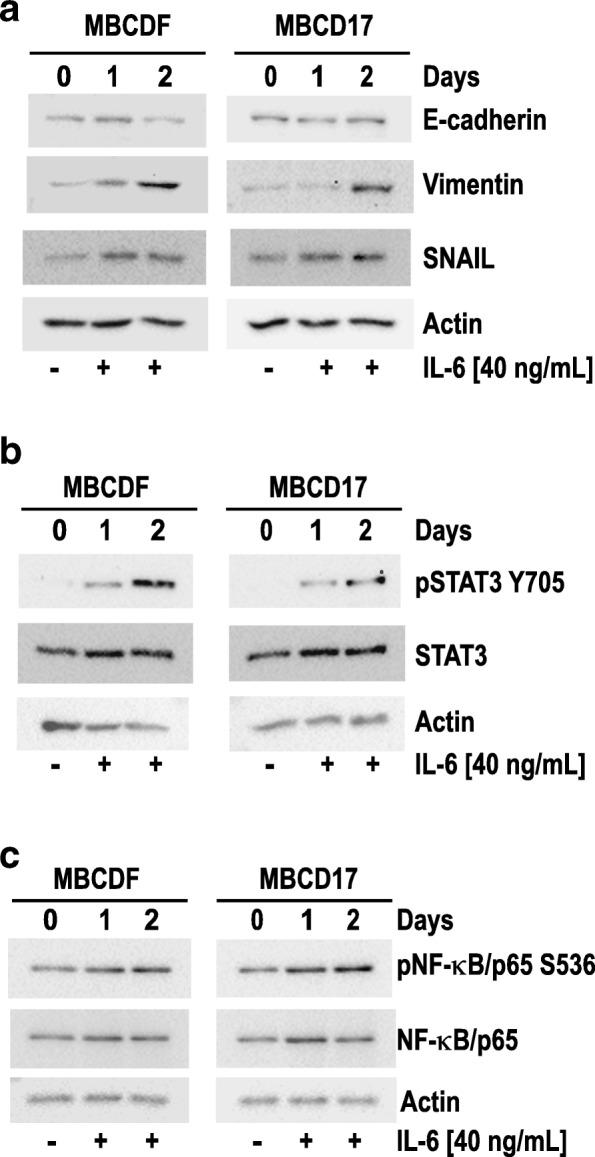
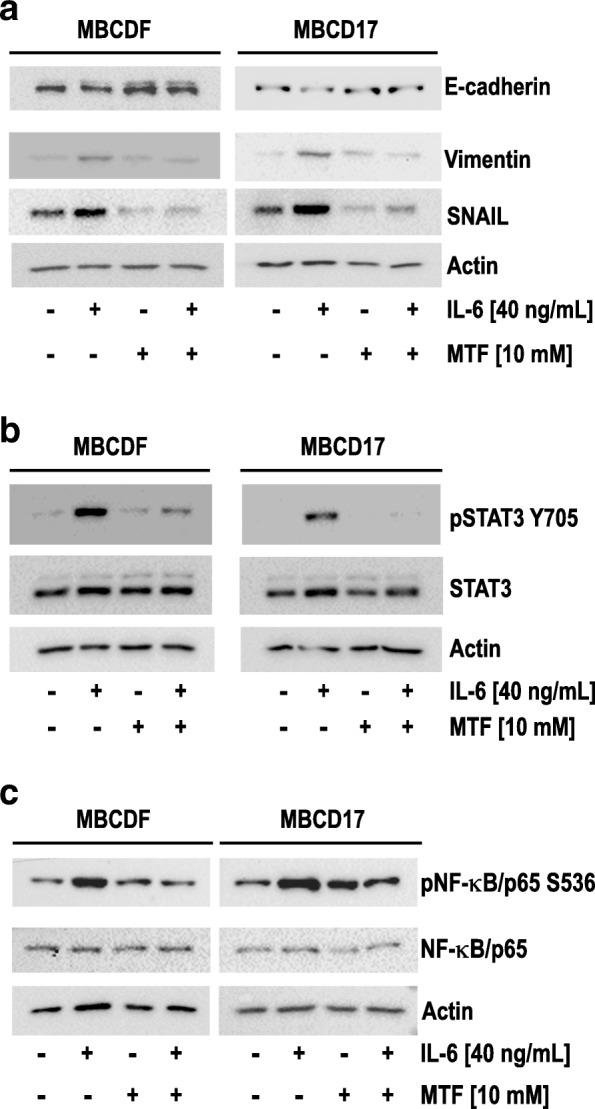
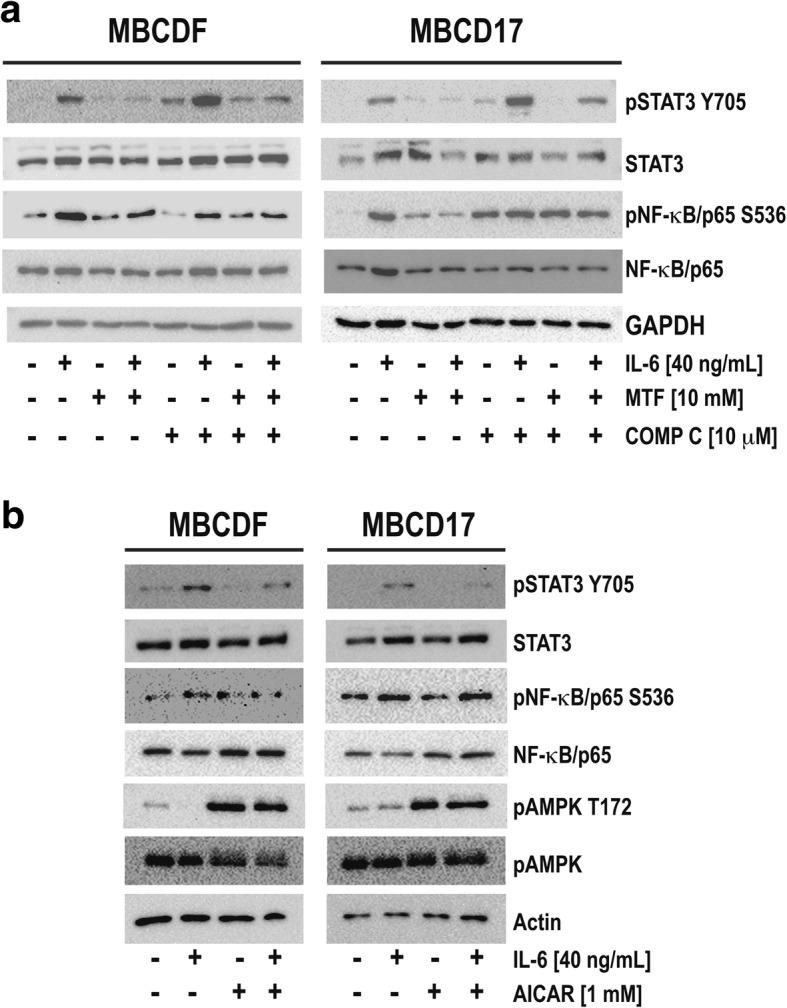
We observed that the response of cultured breast cancer primary cells to MTF varied; mesenchymal cells were resistant to 10 mM MTF and expressed Vimentin and SNAIL, which are associated with a mesenchymal phenotype, whereas epithelial cells were sensitive to this MTF dose, and expressed E-cadherin but not mesenchymal markers. Further, exposure of mesenchymal cells to MTF down-regulated both Vimentin and SNAIL as well as cell proliferation, but not cell migration. In an in vitro IL-6-induced EMT assay, primary breast cancer cells showing an epithelial phenotype underwent EMT upon exposure to IL-6, with concomitant activation of STAT3 and NF-κB; addition of MTF to IL-6-induced EMT reversed the expression of the mesenchymal markers Vimentin and SNAIL, decreased pSTAT3 Y705 and pNF-κB S536 and increased E-cadherin. In addition, downregulation of STAT3·activation was dependent on AMPK, but not NF-κB phosphorylation. Further, MTF inhibited cell proliferation and migration stimulated by IL-6.
CONCLUSION
These results suggest that MTF inhibits IL-6-induced EMT, cell proliferation, and migration of primary breast cancer cells by preventing the activation of STAT3 and NF-κB. STAT3 inactivation occurs through AMPK, but not NF-κB.
背景
乳腺癌目前是全球最常见的肿瘤,也是女性癌症死亡的主要原因,主要是由于转移性疾病。因此,增加我们对导致转移的分子机制的理解可能会改善疾病的药物治疗。上皮-间充质转化(EMT)是肿瘤转移中起主要作用的关键因素。一些促炎细胞因子,如 IL-6,已被证明可刺激转化上皮细胞以及癌细胞系中与 EMT 一致的表型。由于 EMT 是转移的关键步骤之一,因此我们研究了二甲双胍(MTF)对 EMT 的影响。
方法
通过结晶紫测定法评估 MTF 在八种原发性乳腺癌细胞培养物中的细胞毒性作用。通过 Western blot 测定 EMT 标志物和下游信号分子。通过 MTT 和 Boyden 室测定分别分析 MTF 对细胞增殖和细胞迁移的影响。
结果
我们观察到培养的乳腺癌原代细胞对 MTF 的反应不同;间质细胞对 10mM MTF 有抗性,并表达与间质表型相关的波形蛋白和 SNAIL,而上皮细胞对该 MTF 剂量敏感,并表达 E-钙粘蛋白而不表达间质标志物。此外,间质细胞暴露于 MTF 可下调波形蛋白和 SNAIL 以及细胞增殖,但不影响细胞迁移。在体外 IL-6 诱导的 EMT 测定中,具有上皮表型的原发性乳腺癌细胞在暴露于 IL-6 时会发生 EMT,同时激活 STAT3 和 NF-κB;将 MTF 添加到 IL-6 诱导的 EMT 中可逆转间质标志物波形蛋白和 SNAIL 的表达,降低 pSTAT3 Y705 和 pNF-κB S536 并增加 E-钙粘蛋白。此外,STAT3 的下调依赖于 AMPK,而不依赖于 NF-κB 磷酸化。此外,MTF 抑制了由 IL-6 刺激的细胞增殖和迁移。
结论
这些结果表明,MTF 通过防止 STAT3 和 NF-κB 的激活来抑制 IL-6 诱导的原发性乳腺癌细胞的 EMT、增殖和迁移。STAT3 的失活是通过 AMPK 发生的,而不是 NF-κB。


 Zotero 插件