
同步转移性胃食管交界癌患者一线姑息性全身治疗的异质性:一项真实世界证据研究。
Heterogeneity of first-line palliative systemic treatment in synchronous metastatic esophagogastric cancer patients: A real-world evidence study.
机构信息
Department of Medical Oncology, Cancer Center Amsterdam, Amsterdam UMC, University of Amsterdam, Amsterdam, The Netherlands.
Department of Research & Development, Netherlands Comprehensive Cancer Organisation (IKNL), Utrecht, The Netherlands.
出版信息
Int J Cancer. 2020 Apr 1;146(7):1889-1901. doi: 10.1002/ijc.32580. Epub 2019 Aug 24.
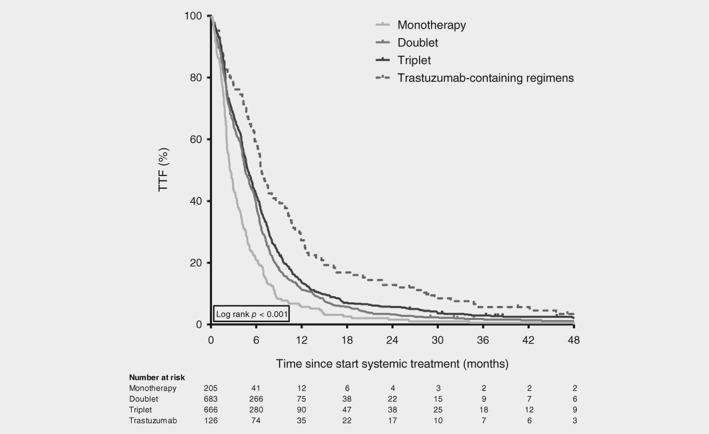
The optimal first-line palliative systemic treatment strategy for metastatic esophagogastric cancer is not well defined. The aim of our study was to explore real-world use of first-line systemic treatment in esophagogastric cancer and assess the effect of treatment strategy on overall survival (OS), time to failure (TTF) of first-line treatment and toxicity. We selected synchronous metastatic esophagogastric cancer patients treated with systemic therapy (2010-2016) from the nationwide Netherlands Cancer Registry (n = 2,204). Systemic treatment strategies were divided into monotherapy, doublet and triplet chemotherapy, and trastuzumab-containing regimens. Data on OS were available for all patients, on TTF for patients diagnosed from 2010 to 2015 (n = 1,700), and on toxicity for patients diagnosed from 2010 to 2014 (n = 1,221). OS and TTF were analyzed using multivariable Cox regression, with adjustment for relevant tumor and patient characteristics. Up to 45 different systemic treatment regimens were found to be administered, with a median TTF of 4.6 and OS of 7.5 months. Most patients (45%) were treated with doublet chemotherapy; 34% received triplets, 10% monotherapy and 10% a trastuzumab-containing regimen. The highest median OS was found in patients receiving a trastuzumab-containing regimen (11.9 months). Triplet chemotherapy showed equal survival rates compared to doublets (OS: HR 0.92, 95%CI 0.83-1.02; TTF: HR 0.92, 95%CI 0.82-1.04) but significantly more grade 3-5 toxicity than doublets (33% vs. 21%, respectively). In conclusion, heterogeneity of first-line palliative systemic treatment in metastatic esophagogastric cancer patients is striking. Based on our data, doublet chemotherapy is the preferred treatment strategy because of similar survival and less toxicity compared to triplets.
转移性胃食管交界癌的一线姑息性系统治疗策略尚未明确。本研究旨在探讨转移性胃食管交界癌患者的一线系统治疗的实际应用,并评估治疗策略对总生存期(OS)、一线治疗失败时间(TTF)和毒性的影响。我们从全国性的荷兰癌症登记处(n = 2204)中选择了接受系统治疗(2010-2016 年)的同步转移性胃食管交界癌患者。系统治疗策略分为单药治疗、双药联合化疗和三药联合化疗以及曲妥珠单抗治疗方案。所有患者的 OS 数据均可用,2010 年至 2015 年(n = 1700)诊断的患者的 TTF 数据可用,2010 年至 2014 年(n = 1221)诊断的患者的毒性数据可用。使用多变量 Cox 回归分析 OS 和 TTF,调整了相关的肿瘤和患者特征。共发现 45 种不同的系统治疗方案,中位 TTF 为 4.6 个月,OS 为 7.5 个月。大多数患者(45%)接受了双药联合化疗;34%接受了三药联合化疗,10%接受了单药治疗,10%接受了曲妥珠单抗治疗方案。接受曲妥珠单抗治疗方案的患者中位 OS 最高(11.9 个月)。三药联合化疗与双药联合化疗的生存结果相当(OS:HR 0.92,95%CI 0.83-1.02;TTF:HR 0.92,95%CI 0.82-1.04),但毒性显著更高(分别为 33%和 21%)。总之,转移性胃食管交界癌患者的一线姑息性系统治疗的异质性非常明显。根据我们的数据,与三药联合化疗相比,双药联合化疗是首选的治疗策略,因为其生存结果相似且毒性更小。


 Zotero 插件