
#CuttingCRC 研究方案:一项基于理发店的探索性序贯混合方法设计,旨在研究非裔美国男性的男性气质障碍与结直肠癌筛查参与之间的关系。
Study protocol for developing #CuttingCRC: a barbershop-based trial on masculinity barriers to care and colorectal cancer screening uptake among African-American men using an exploratory sequential mixed-methods design.
机构信息
Family & Preventive Medicine, University of Utah School of Medicine, Salt Lake City, Utah, USA.
Internal Medicine, College of Medicine, Ohio State University, Columbus, Ohio, USA.
出版信息
BMJ Open. 2019 Jul 24;9(7):e030000. doi: 10.1136/bmjopen-2019-030000.
INTRODUCTION
Colorectal cancer (CRC) is preventable, as screening leads to the identification and removal of precancerous polyps. African-American men consistently have the highest CRC mortality rates, and their CRC-screening uptake remains low for complex reasons. Culture-specific masculinity barriers to care may contribute to the low uptake among African-American men. Examining these barriers to care is vital as CRC screening may challenge cultural role expectations of African-American men, whose tendency is to delay help-seeking medical care. Barbershops provide a pathway for reaching African-American men with masculinity barriers to care who are not regularly receiving healthcare services and CRC screening. This study aims to develop and pilot test a theory-driven, culture-specific, barbershop-based intervention targeting masculinity barriers to care and CRC-screening uptake among African-American men ages 45-75.
METHODS AND ANALYSIS
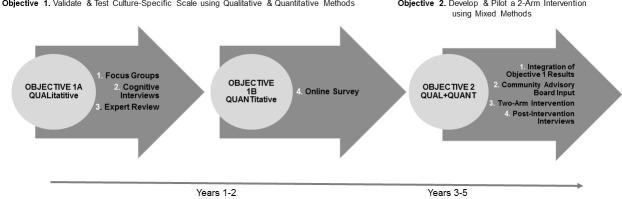
Guided by the theory of planned behaviour and the behaviour change wheel, we will use a multistage mixed-methods study design, beginning with an exploratory sequential approach to validate items for subsequent use in a pilot mixed-methods intervention. First, we will collect and analyse qualitative data from focus groups, cognitive interviews and expert item review to validate and test a culture-specific Masculinity Barriers to Care Scale (MBCS) among African-American men. Next, we will administer the MBCS to our target population as an online quantitative survey and evaluate the association between scores and CRC-screening uptake. Then, we will consider existing evidence-based approaches, our integrated results (qualitative +quantitative), and community input to design a culture-specific, behavioural intervention aimed at increasing CRC-screening uptake among African-American men and feasible for barbershop delivery. We will test the peer intervention in a pilot study with a two-arm cluster randomised design (six barbershops, randomised by site) to reduce contamination and account for barbershop culture differences. Our primary outcomes for the pilot are recruitment, sample size estimation, preliminary efficacy and acceptability.
ETHICS AND DISSEMINATION
Ethics approval was obtained from the University of Utah Institutional Review Board (00113679), who will also be responsible for receiving communication updates regarding important protocol modifications. To ensure confidentiality, data dispersed to project team members will be blinded of any identifying participant information. Study results will be disseminated through publications in peer-reviewed journals, community dialogue sessions, and presentations at conferences.
TRIAL REGISTRATION NUMBER
ClinicalTrials.gov identifier: NCT03733197 (Pre-results);https://clinicaltrials.gov/ct2/show/NCT03733197.
简介
结直肠癌(CRC)是可以预防的,因为筛查可以发现并切除癌前息肉。非裔美国男性的 CRC 死亡率一直最高,而且由于多种复杂原因,他们的 CRC 筛查率仍然很低。针对特定文化的男性护理障碍可能导致非裔美国男性的筛查率低。因此,研究这些护理障碍至关重要,因为 CRC 筛查可能会挑战非裔美国男性的文化角色期望,他们往往会延迟寻求医疗保健。理发店为接触到没有定期接受医疗保健服务和 CRC 筛查的、存在男性护理障碍的非裔美国男性提供了一种途径。本研究旨在开发并试点检验一种基于理论、特定文化、以理发店为基础的干预措施,该措施针对的是 45-75 岁非裔美国男性的男性护理障碍和 CRC 筛查参与度。
方法和分析
本研究以计划行为理论和行为改变车轮为指导,将采用多阶段混合方法研究设计,首先采用探索性顺序方法验证项目,然后再将其用于试点混合方法干预。首先,我们将通过焦点小组、认知访谈和专家项目审查收集和分析定性数据,以验证和测试针对非裔美国男性的特定文化的男性护理障碍量表(MBCS)。接下来,我们将以在线定量调查的形式向目标人群发放 MBCS,并评估评分与 CRC 筛查参与度之间的关联。然后,我们将考虑现有的循证方法、我们的综合结果(定性+定量)和社区投入,设计一种针对非裔美国男性的、旨在提高 CRC 筛查参与度的、并可行于理发店实施的行为干预措施。我们将在一项两臂聚类随机设计的试点研究(六家理发店,按地点随机)中测试同伴干预,以减少污染并考虑理发店文化差异。我们的试点主要结局为招募、样本量估计、初步疗效和可接受性。
伦理与传播
犹他大学机构审查委员会已批准本研究(00113679),该委员会还将负责接收有关重要方案修改的沟通更新。为了确保机密性,分发给项目团队成员的数据将被屏蔽任何可识别参与者信息。研究结果将通过在同行评议期刊上发表文章、社区对话会议和会议演讲进行传播。
试验注册号
ClinicalTrials.gov 标识符:NCT03733197(预结果);https://clinicaltrials.gov/ct2/show/NCT03733197。

 Zotero 插件