
具有白条和木胸肌病变的鸡骨骼肌中缺氧诱导因子-1α(HIF1A)转录物及其相关基因的绝对表达。
Absolute expressions of hypoxia-inducible factor-1 alpha (HIF1A) transcript and the associated genes in chicken skeletal muscle with white striping and wooden breast myopathies.
机构信息
National Center for Genetic Engineering and Biotechnology (BIOTEC), Khlong Nueng, Khlong Luang, Pathum Thani, Thailand.
Department of Agricultural and Food Sciences, Alma Mater Studiorum, University of Bologna, Cesena (FC), Italy.
出版信息
PLoS One. 2019 Aug 8;14(8):e0220904. doi: 10.1371/journal.pone.0220904. eCollection 2019.
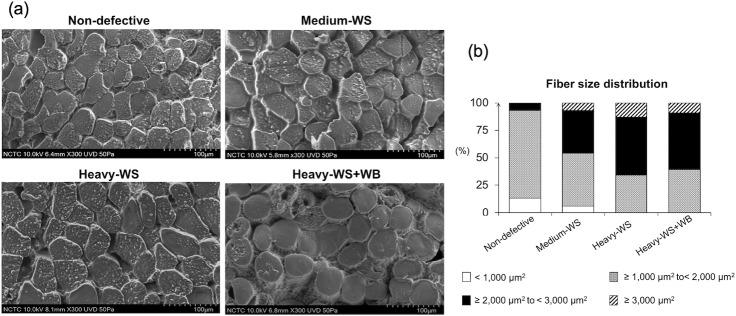
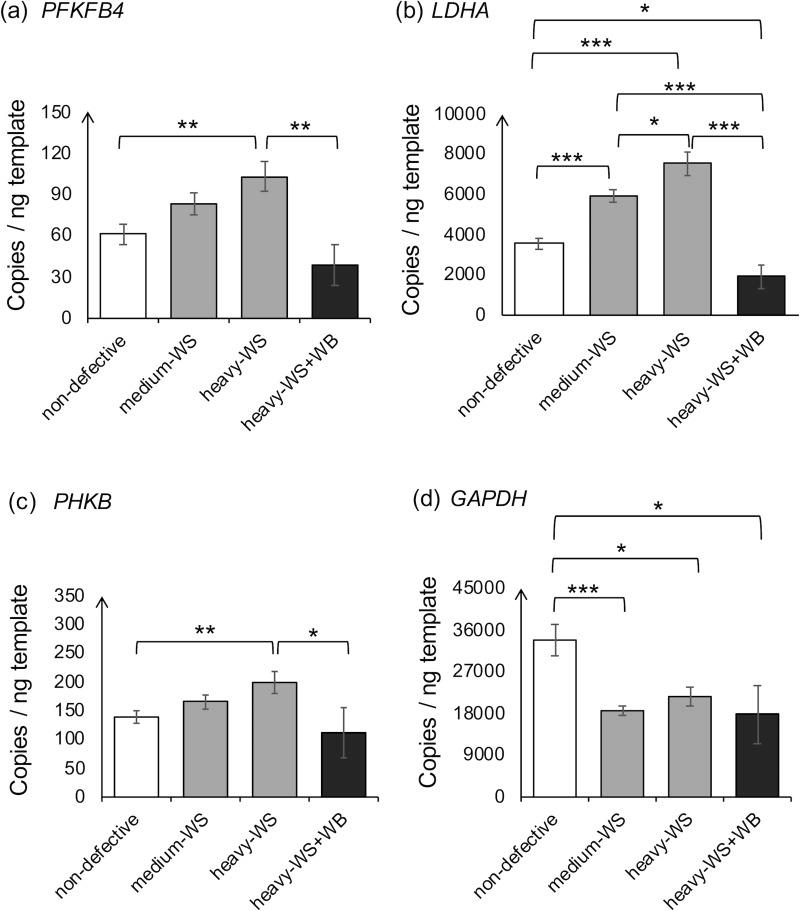
Development of white striping (WS) and wooden breast (WB) in broiler breast meat have been linked to hypoxia, but their etiologies are not fully understood. This study aimed at investigating absolute expression of hypoxia-inducible factor-1 alpha subunit (HIF1A) and genes involved in stress responses and muscle repair using a droplet digital polymerase chain reaction. Total RNA was isolated from pectoralis major collected from male 6-week-old medium (carcass weight ≤ 2.5 kg) and heavy (carcass weight > 2.5 kg) broilers. Samples were classified as "non-defective" (n = 4), "medium-WS" (n = 6), "heavy-WS" (n = 7) and "heavy-WS+WB" (n = 3) based on abnormality scores. The HIF1A transcript was up-regulated in all of the abnormal groups. Transcript abundances of genes encoding 6-phosphofructo-2-kinase/fructose-2,6-biphosphatase 4 (PFKFB4), lactate dehydrogenase-A (LDHA), and phosphorylase kinase beta subunit (PHKB) were increased in heavy-WS but decreased in heavy-WS+WB. Glyceraldehyde-3-phosphate dehydrogenase (GAPDH) was up-regulated in non-defective samples. The muscle-specific mu-2 isoform of glutathione S-transferases (GSTM2) was up-regulated in the abnormal samples, particularly in the heavy groups. The genes encoding myogenic differentiation (MYOD1) and myosin light chain kinase (MYLK) exhibited similar expression pattern, of which medium-WS and heavy-WS significantly increased compared to non-defective whereas expression in heavy-WS+WB was not different from either non-defective or WS-affected group. The greatest and the lowest levels of calpain-3 (CAPN3) and delta-sarcoglycan (SCGD) were observed in heavy-WS and heavy-WS+WB, respectively. Based on micrographs, the abnormal muscles primarily comprised fibers with cross-sectional areas ranging from 2,000 to 3,000 μm2. Despite induced glycolysis at the transcriptional level, lower stored glycogen in the abnormal muscles corresponded with the reduced lactate and higher pH within their meats. The findings support hypoxia within the abnormal breasts, potentially associated with oversized muscle fibers. Between WS and WB, divergent glucose metabolism, cellular detoxification and myoregeneration at the transcriptional level could be anticipated.
肌间白条(WS)和胸肉木质化(WB)的产生与缺氧有关,但它们的病因尚不完全清楚。本研究旨在通过数字式聚合酶链反应检测缺氧诱导因子-1 ɑ 亚基(HIF1A)和应激反应及肌肉修复相关基因的绝对表达量。从 6 周龄雄性中(胴体重量≤2.5kg)重(胴体重量>2.5kg)肉鸡胸大肌采集总 RNA。根据异常评分,将样本分为“无缺陷”(n = 4)、“中 WS”(n = 6)、“重 WS”(n = 7)和“重 WS+WB”(n = 3)。所有异常组的 HIF1A 转录本均上调。6-磷酸果糖-2-激酶/果糖-2,6-二磷酸酶 4(PFKFB4)、乳酸脱氢酶-A(LDHA)和磷酸化酶激酶β亚基(PHKB)的编码基因转录物在重 WS 中增加,但在重 WS+WB 中减少。甘油醛-3-磷酸脱氢酶(GAPDH)在无缺陷样本中上调。肌肉特异性μ-2 同工型谷胱甘肽 S-转移酶(GSTM2)在异常样本中上调,尤其是在重组中。肌源性分化(MYOD1)和肌球蛋白轻链激酶(MYLK)的编码基因表达模式相似,其中中 WS 和重 WS 与无缺陷组相比显著增加,而重 WS+WB 组的表达与无缺陷或 WS 影响组无差异。钙蛋白酶-3(CAPN3)和δ-肌聚糖(SCGD)的最大和最低水平分别在重 WS 和重 WS+WB 中观察到。根据显微镜照片,异常肌肉主要由横截面积在 2000 到 3000μm2 之间的纤维组成。尽管转录水平上诱导了糖酵解,但异常肌肉中储存的糖原减少与肉中乳酸减少和 pH 值升高相对应。这些发现支持异常乳房中的缺氧,可能与过大的肌肉纤维有关。在 WS 和 WB 之间,可以预期在转录水平上葡萄糖代谢、细胞解毒和肌肉再生存在差异。



 Zotero 插件