
监测白羽肉鸡(家鸡)的白条纹和木鸡胸病例及其对从商业肉鸡采集的胸肉品质的影响。
Monitoring of white striping and wooden breast cases and impacts on quality of breast meat collected from commercial broilers (Gallus gallus).
作者信息
Malila Yuwares, U-Chupaj Juthawut, Srimarut Yanee, Chaiwiwattrakul Premsak, Uengwetwanit Tanaporn, Arayamethakorn Sopacha, Punyapornwithaya Veerasak, Sansamur Chalutwan, Kirschke Catherine P, Huang Liping, Tepaamorndech Surapun, Petracci Massimiliano, Rungrassamee Wanilada, Visessanguan Wonnop
机构信息
Food Biotechnology Research Unit, National Center for Genetic Engineering and Biotechnology, Khlong Nueng, Khlong Luang, Pathum Thani 12120, Thailand.
Bio-sensing Technology Research Unit, National Center for Genetic Engineering and Biotechnology, Khlong Nueng, Khlong Luang, Pathum Thani 12120, Thailand.
出版信息
Asian-Australas J Anim Sci. 2018 Nov;31(11):1807-1817. doi: 10.5713/ajas.18.0355. Epub 2018 Aug 27.
OBJECTIVE
This study aimed at investigating white striping (WS) and wooden breast (WB) cases in breast meat collected from commercial broilers.
METHODS
A total of 183 breast samples were collected from male Ross 308 broilers slaughtered at the age of 6 weeks (n = 100) and 7 weeks (n = 83). The breasts were subjected to meat defect inspection, meat quality determination and histology evaluation.
RESULTS
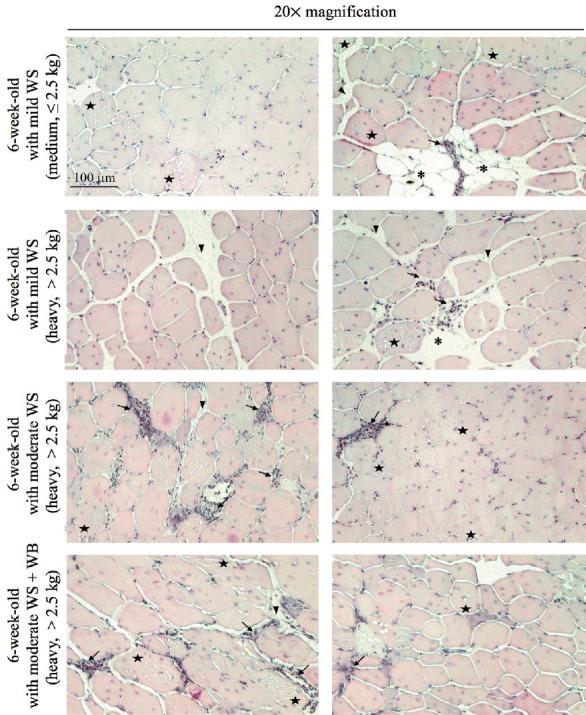
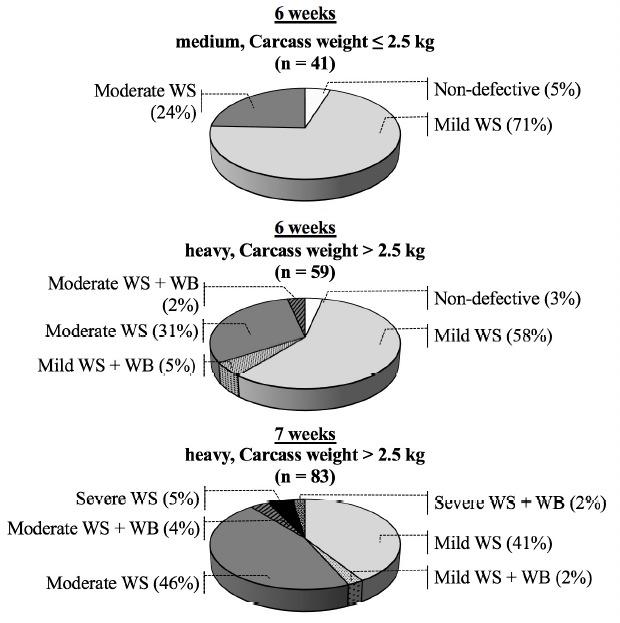
Of 183, 4 breasts from 6-week-old broilers were classified as non-defective while the others exhibited the WS lesion. Among the 6-week-old birds, the defective samples from the medium size birds (carcass weight ≤2.5 kg) showed mild to moderate WS degree with no altered meat quality. Some of the breasts from the 6-week-old birds with carcass weight above 2.5 kg exhibited WB in accompanied with the WS condition. Besides of a reduction of protein content, increases in collagen matter and pH values in the defective samples (p<0.05), no other impaired quality indices were detected within this group. All 7-week-old broilers yielded carcasses weighing above 2.5 kg and showed abnormal characteristics with progressive severity. The breasts affected with severe WS and WB showed the greatest cook loss, hardness, springiness and chewiness (p<0.05). Development of WB induced significantly increased drip loss in the samples (p<0.05). Histology indicated necrotic events in the defective myofibers. Based on logistic regression, increasing percent breast weight by one unit enhanced the chance of WS and WB development with advanced severity by 50.9% and 61.0%, respectively. Delayed slaughter age from 6 to 7 weeks increased the likelihood of obtaining increased WS severity by 56.3%.
CONCLUSION
Cases of WS and WB defects in Southeast Asia have been revealed. Despite few cases of the severe WS and WB, such abnormal conditions significantly impaired technological properties and nutritional quality of broiler breasts.
目的
本研究旨在调查从商业肉鸡采集的胸肉中的白条(WS)和木胸(WB)情况。
方法
从6周龄(n = 100)和7周龄(n = 83)屠宰的雄性罗斯308肉鸡中总共采集了183份胸肉样本。对这些胸肉进行肉质缺陷检查、肉质测定和组织学评估。
结果
在183份样本中,6周龄肉鸡的4份胸肉被归类为无缺陷,其他样本则表现出WS病变。在6周龄的鸡中,中等体型鸡(胴体重≤2.5千克)的缺陷样本显示出轻度至中度的WS程度,肉质未改变。一些胴体重超过2.5千克的6周龄鸡的胸肉在出现WS情况的同时还伴有WB。除了缺陷样本中的蛋白质含量降低、胶原蛋白物质和pH值升高(p<0.05)外,该组内未检测到其他受损的质量指标。所有7周龄肉鸡的胴体重均超过2.5千克,并表现出逐渐严重的异常特征。受严重WS和WB影响的胸肉表现出最大的蒸煮损失、硬度、弹性和咀嚼性(p<0.05)。WB的发展导致样本中的滴水损失显著增加(p<0.05)。组织学显示缺陷肌纤维中有坏死事件。基于逻辑回归分析,胸肉重量百分比每增加一个单位,WS和WB发展至严重程度的几率分别提高50.9%和61.0%。屠宰年龄从6周推迟到7周,WS严重程度增加的可能性提高了56.3%。
结论
已揭示东南亚存在WS和WB缺陷情况。尽管严重的WS和WB病例较少,但这种异常情况显著损害了肉鸡胸肉的加工性能和营养质量。
 Zotero 插件