
肿瘤新生抗原疫苗:一种新兴的肿瘤免疫疗法。
Neoantigen vaccine: an emerging tumor immunotherapy.
机构信息
NHC Key Laboratory of Carcinogenesis and Hunan Key Laboratory of Translational Radiation Oncology, Hunan Cancer Hospital and The Affiliated Cancer Hospital of Xiangya School of Medicine, Central South University, Changsha, Hunan, China.
Key Laboratory of Carcinogenesis and Cancer Invasion of the Chinese Ministry of Education, Cancer Research Institute, Central South University, Changsha, Hunan, China.
出版信息
Mol Cancer. 2019 Aug 23;18(1):128. doi: 10.1186/s12943-019-1055-6.
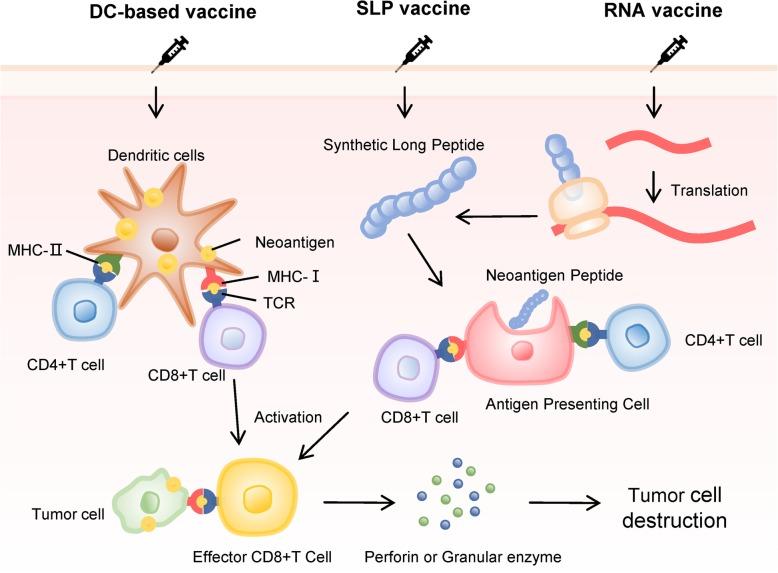
Genetic instability of tumor cells often leads to the occurrence of a large number of mutations, and expression of non-synonymous mutations can produce tumor-specific antigens called neoantigens. Neoantigens are highly immunogenic as they are not expressed in normal tissues. They can activate CD4+ and CD8+ T cells to generate immune response and have the potential to become new targets of tumor immunotherapy. The development of bioinformatics technology has accelerated the identification of neoantigens. The combination of different algorithms to identify and predict the affinity of neoantigens to major histocompatibility complexes (MHCs) or the immunogenicity of neoantigens is mainly based on the whole-exome sequencing technology. Tumor vaccines targeting neoantigens mainly include nucleic acid, dendritic cell (DC)-based, tumor cell, and synthetic long peptide (SLP) vaccines. The combination with immune checkpoint inhibition therapy or radiotherapy and chemotherapy might achieve better therapeutic effects. Currently, several clinical trials have demonstrated the safety and efficacy of these vaccines. Further development of sequencing technologies and bioinformatics algorithms, as well as an improvement in our understanding of the mechanisms underlying tumor development, will expand the application of neoantigen vaccines in the future.
肿瘤细胞的遗传不稳定性常导致大量突变的发生,而非同义突变的表达可产生肿瘤特异性抗原,称为新抗原。新抗原具有高度免疫原性,因为它们不在正常组织中表达。它们可以激活 CD4+和 CD8+T 细胞,引发免疫反应,并有可能成为肿瘤免疫治疗的新靶点。生物信息学技术的发展加速了新抗原的鉴定。不同算法的组合,用于鉴定和预测新抗原与主要组织相容性复合物(MHCs)的亲和力或新抗原的免疫原性,主要基于全外显子组测序技术。针对新抗原的肿瘤疫苗主要包括核酸疫苗、树突状细胞(DC)疫苗、肿瘤细胞疫苗和合成长肽(SLP)疫苗。与免疫检查点抑制治疗或放化疗相结合可能会取得更好的治疗效果。目前,几项临床试验已经证明了这些疫苗的安全性和有效性。测序技术和生物信息学算法的进一步发展,以及对肿瘤发生机制的深入理解,将扩大新抗原疫苗在未来的应用。


 Zotero 插件