
超声微血管成像与传统超声鉴别BI-RADS 4类乳腺病变的对比研究
A comparative study on superb microvascular imaging and conventional ultrasonography in differentiating BI-RADS 4 breast lesions.
作者信息
Zhu Yi-Cheng, Zu Dao-Ming, Zhang Yuan, Shan Jun, Shi Xiu-Rong, Deng Shu-Hao, Jiang Quan
机构信息
Department of Ultrasound, Pudong New Area People's Hospital Affiliated to Shanghai University of Medicine and Health Sciences, Shanghai 201299, P.R. China.
Department of Minor Surgery, Pudong New Area People's Hospital Affiliated to Shanghai University of Medicine and Health Sciences, Shanghai 201299, P.R. China.
出版信息
Oncol Lett. 2019 Sep;18(3):3202-3210. doi: 10.3892/ol.2019.10603. Epub 2019 Jul 11.
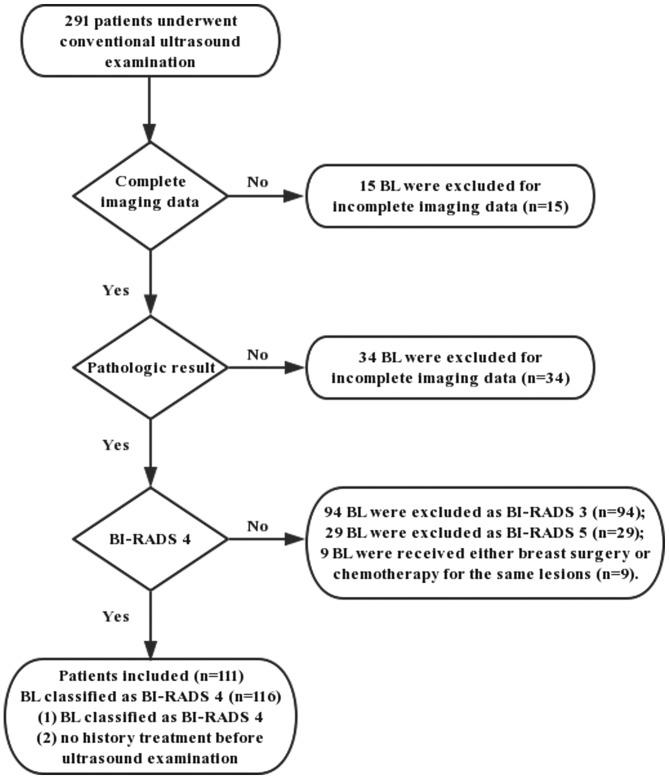
This prospective study aimed to explore the diagnostic value of superb microvascular imaging (SMI) in differentiating Breast Imaging Reporting and Data System (BI-RADS) 4 breast lesions compared with conventional ultrasonography (US). A total of 111 patients with 116 breast lesions underwent grayscale ultrasound (US), colour Doppler flow imaging (CDFI) and SMI breast imaging between February 2016 and May 2018. CDFI and SMI were performed to evaluate vascular quantity, morphology, and distribution characteristics. The detection of malignancy was compared between grayscale US alone, US + CDFI and US + SMI in terms of the BI-RADS stratification system. SMI was observed to be significantly more accurate in distinguishing malignant breast lesions (86.67%) compared with CDFI (80.00%) (P<0.001). Among malignant lesions, SMI detected 80.00% of those that contained ≥4 vessels, while CDFI only detected 56.67%. Penetrating and branching vessels were identified by SMI in 53.33% of malignant breast lesions and by CDFI in 10.00%. There was no significant difference in vascular distribution by SMI (P=0.094) and by CDFI (P=0.087). US + SMI was associated with higher sensitivity, specificity, and accuracy rates (86.67, 83.72 and 84.48%, respectively) compared with US + CDFI (80.00, 72.09 and 74.14%, respectively). The area under the curve values from receiver operating characteristic analysis of US + SMI, US + CDFI and US alone were 0.852 [95% confidence interval (CI): 0.768-0.936)] 0.760 (95% CI: 0.660-0.860), 0.698 (95% CI: 0.589-0.807), respectively (P<0.001). SMI yielded more detailed vascular information associated with malignant breast masses when compared with conventional US. Therefore, as an adjunct to grayscale, SMI exhibited a markedly improved diagnostic capability in distinguishing malignant and benign breast lesions, particularly those of BI-RADS category 4.
本前瞻性研究旨在探讨与传统超声(US)相比,超微血管成像(SMI)在鉴别乳腺影像报告和数据系统(BI-RADS)4类乳腺病变中的诊断价值。2016年2月至2018年5月期间,共有111例患有116个乳腺病变的患者接受了灰阶超声(US)、彩色多普勒血流成像(CDFI)和SMI乳腺成像检查。采用CDFI和SMI评估血管数量、形态及分布特征。依据BI-RADS分层系统,比较单纯灰阶US、US+CDFI以及US+SMI对恶性病变的检测情况。结果显示,与CDFI(80.00%)相比,SMI在鉴别乳腺恶性病变方面的准确性显著更高(86.67%)(P<0.001)。在恶性病变中,SMI检测出80.00%含有≥4支血管的病变,而CDFI仅检测出56.67%。SMI在53.33%的乳腺恶性病变中识别出穿透性和分支状血管,而CDFI仅识别出10.00%。SMI(P=0.094)和CDFI(P=0.087)在血管分布方面无显著差异。与US+CDFI(分别为80.00%、72.09%和74.14%)相比,US+SMI具有更高的敏感性、特异性和准确率(分别为86.67%、83.72%和84.48%)。US+SMI、US+CDFI及单纯US的受试者操作特征分析曲线下面积值分别为0.852[95%置信区间(CI):0.768-0.936]、0.760(95%CI:0.660-0.860)、0.698(95%CI:0.589-0.807)(P<0.001)。与传统US相比,SMI能提供与乳腺恶性肿块相关的更详细血管信息。因此,作为灰阶超声的辅助手段,SMI在鉴别乳腺良恶性病变,尤其是BI-RADS 4类病变时,诊断能力有显著提高。



 Zotero 插件