
基于深度学习的肾脏组织病理评估
Deep Learning-Based Histopathologic Assessment of Kidney Tissue.
机构信息
Departments of Pathology and.
Department of Pathology, Amsterdam Infection & Immunity, Amsterdam Cardiovascular Sciences, Amsterdam UMC, and.
出版信息
J Am Soc Nephrol. 2019 Oct;30(10):1968-1979. doi: 10.1681/ASN.2019020144. Epub 2019 Sep 5.
BACKGROUND
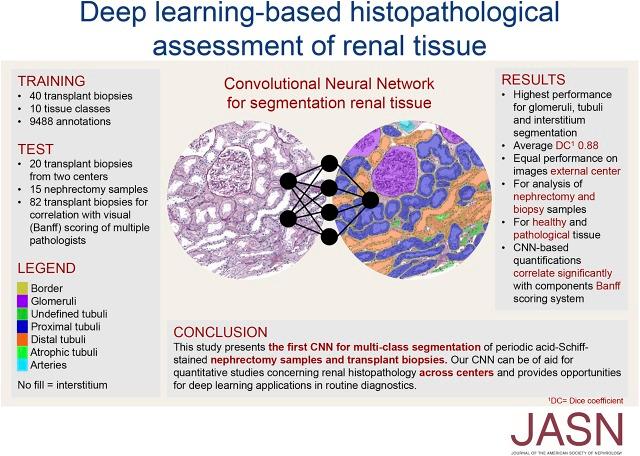
The development of deep neural networks is facilitating more advanced digital analysis of histopathologic images. We trained a convolutional neural network for multiclass segmentation of digitized kidney tissue sections stained with periodic acid-Schiff (PAS).
METHODS
We trained the network using multiclass annotations from 40 whole-slide images of stained kidney transplant biopsies and applied it to four independent data sets. We assessed multiclass segmentation performance by calculating Dice coefficients for ten tissue classes on ten transplant biopsies from the Radboud University Medical Center in Nijmegen, The Netherlands, and on ten transplant biopsies from an external center for validation. We also fully segmented 15 nephrectomy samples and calculated the network's glomerular detection rates and compared network-based measures with visually scored histologic components (Banff classification) in 82 kidney transplant biopsies.
RESULTS
The weighted mean Dice coefficients of all classes were 0.80 and 0.84 in ten kidney transplant biopsies from the Radboud center and the external center, respectively. The best segmented class was "glomeruli" in both data sets (Dice coefficients, 0.95 and 0.94, respectively), followed by "tubuli combined" and "interstitium." The network detected 92.7% of all glomeruli in nephrectomy samples, with 10.4% false positives. In whole transplant biopsies, the mean intraclass correlation coefficient for glomerular counting performed by pathologists versus the network was 0.94. We found significant correlations between visually scored histologic components and network-based measures.
CONCLUSIONS
This study presents the first convolutional neural network for multiclass segmentation of PAS-stained nephrectomy samples and transplant biopsies. Our network may have utility for quantitative studies involving kidney histopathology across centers and provide opportunities for deep learning applications in routine diagnostics.
背景
深度学习网络的发展促进了对经帕氏染色的组织切片的更先进的数字分析。我们训练了一个用于对经帕氏染色的肾组织切片进行多类分割的卷积神经网络。
方法
我们使用来自 40 张染色肾移植活检全切片的多类注释对网络进行训练,并将其应用于四个独立的数据集。我们通过计算尼梅根拉德布德大学医学中心的 10 份移植活检和外部中心的 10 份移植活检中十种组织类别的骰子系数来评估多类分割性能。我们还对 15 个肾切除样本进行了完全分割,并计算了网络的肾小球检测率,并在 82 份肾移植活检中比较了基于网络的测量值与视觉评分的组织学成分(Banff 分类)。
结果
在尼梅根拉德布德中心和外部中心的 10 份移植活检中,所有类别的加权平均骰子系数分别为 0.80 和 0.84。在两个数据集的最佳分割类都是“肾小球”(分别为 0.95 和 0.94 的骰子系数),其次是“肾小管组合”和“间质”。网络在肾切除样本中检测到了 92.7%的所有肾小球,假阳性率为 10.4%。在整个移植活检中,病理学家与网络相比进行肾小球计数的组内相关系数为 0.94。我们发现视觉评分的组织学成分与基于网络的测量值之间存在显著相关性。
结论
本研究首次提出了用于帕氏染色的肾切除样本和移植活检的多类分割的卷积神经网络。我们的网络可能对涉及肾脏组织病理学的中心间的定量研究具有实用性,并为常规诊断中的深度学习应用提供了机会。
 Zotero 插件