
利用量子化学分析预测不同氧化剂对酸性蓝113的降解潜力。
Predicting the degradation potential of Acid blue 113 by different oxidants using quantum chemical analysis.
作者信息
Asghar Anam, Bello Mustapha Mohammed, Raman Abdul Aziz Abdul, Daud Wan Mohd Ashri Wan, Ramalingam Anantharaj, Zain Sharifuddin Bin Md
机构信息
Department of Chemical Engineering, University of Engineering & Technology, G.T. Road, Lahore, 54890, Pakistan.
Department of Chemical Engineering, Faculty of Engineering, University of Malaya, Kuala Lumpur, 50603, Malaysia.
出版信息
Heliyon. 2019 Sep 6;5(9):e02396. doi: 10.1016/j.heliyon.2019.e02396. eCollection 2019 Sep.
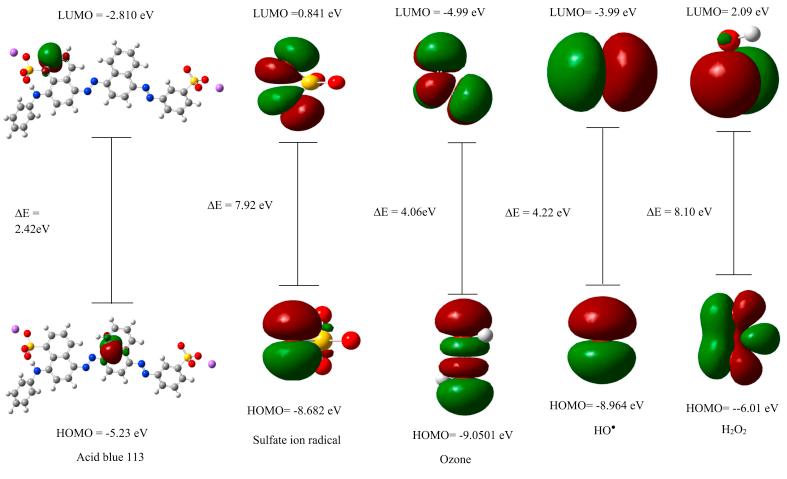
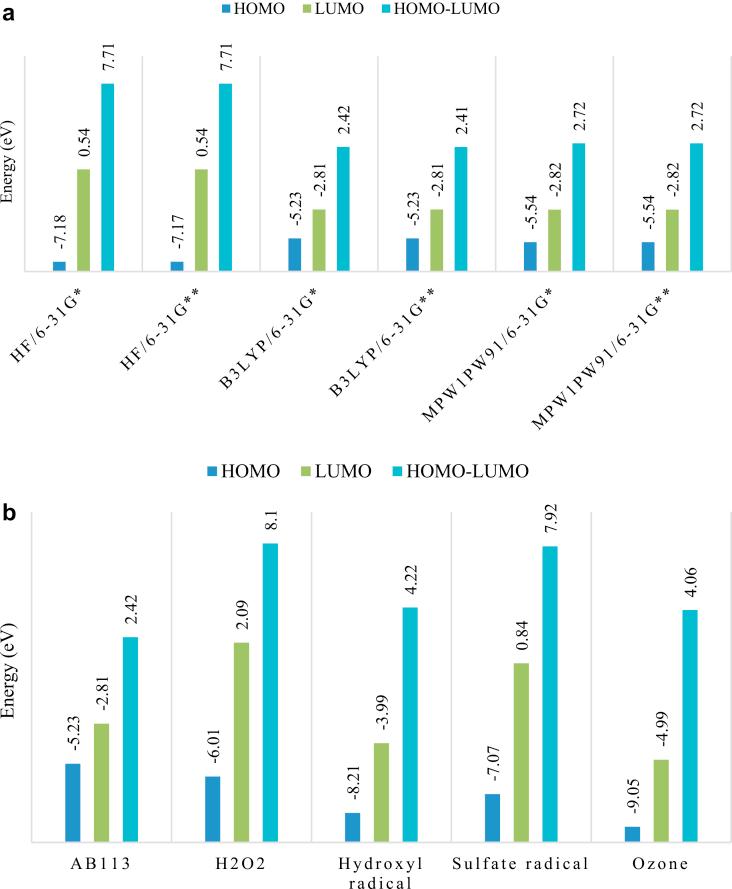
In this work, quantum chemical analysis was used to predict the degradation potential of a recalcitrant dye, Acid blue 113, by hydrogen peroxide, ozone, hydroxyl radical and sulfate radical. Geometry optimization and frequency calculations were performed at 'Hartree Fock', 'Becke, 3-parameter, Lee-Yang-Parr' and 'Modified Perdew-Wang exchange combined with PW91 correlation' levels of study using 6-31G* and 6-31G** basis sets. The Fourier Transform-Raman spectra of Acid blue 113 were recorded and a complete analysis on vibrational assignment and fundamental modes of model compound was performed. Natural bond orbital analysis revealed that Acid blue 113 has a highly stable structure due to strong intermolecular and intra-molecular interactions. Mulliken charge distribution and molecular electrostatic potential map of the dye also showed a strong influence of functional groups on the neighboring atoms. Subsequently, the reactivity of the dye towards the oxidants was compared based on the highest occupied molecular orbital (HOMO) and lowest unoccupied molecular orbital (LUMO) energy values. The results showed that Acid blue 113 with a HOMO value -5.227 eV exhibits a nucleophilic characteristic, with a high propensity to be degraded by ozone and hydroxyl radical due to their lower HOMO-LUMO energy gaps of 4.99 and 4.22 eV respectively. On the other hand, sulfate radical and hydrogen peroxide exhibit higher HOMO-LUMO energy gaps of 7.92 eV and 8.10 eV respectively, indicating their lower reactivity towards Acid blue 113. We conclude that oxidation processes based on hydroxyl radical and ozone would offer a more viable option for the degradation of Acid blue 113. This study shows that quantum chemical analysis can assist in selecting appropriate advanced oxidation processes for the treatment of textile effluent.
在本研究中,采用量子化学分析方法预测了难降解染料酸性蓝113在过氧化氢、臭氧、羟基自由基和硫酸根自由基作用下的降解潜力。使用6-31G*和6-31G**基组,在“哈特里-福克”、“贝克三参数李-杨-帕尔”以及“修正的佩德韦-王交换结合PW91相关”研究水平上进行了几何优化和频率计算。记录了酸性蓝113的傅里叶变换拉曼光谱,并对模型化合物的振动归属和基本模式进行了全面分析。自然键轨道分析表明,由于分子间和分子内的强相互作用,酸性蓝113具有高度稳定的结构。该染料的 Mulliken 电荷分布和分子静电势图也显示了官能团对相邻原子的强烈影响。随后,基于最高占据分子轨道(HOMO)和最低未占据分子轨道(LUMO)的能量值比较了该染料对氧化剂的反应活性。结果表明,HOMO值为-5.227 eV的酸性蓝113表现出亲核特性,由于臭氧和羟基自由基的HOMO-LUMO能隙分别较低,为4.99 eV和4.22 eV,因此它极易被它们降解。另一方面,硫酸根自由基和过氧化氢的HOMO-LUMO能隙分别较高,为7.92 eV和8.10 eV,这表明它们对酸性蓝113的反应活性较低。我们得出结论,基于羟基自由基和臭氧的氧化过程为酸性蓝113的降解提供了更可行的选择。本研究表明,量子化学分析有助于选择合适的高级氧化工艺来处理纺织废水。


 Zotero 插件