
长链非编码 RNA CASC2 通过直接下调 miR-183 抑制肝癌细胞的活力、迁移和侵袭。
The Long Non-Coding RNA CASC2 Suppresses Cell Viability, Migration, and Invasion in Hepatocellular Carcinoma Cells by Directly Downregulating miR-183.
机构信息
Department II of General Surgery, The People's Hospital of Hanchuan, Hanchuan, Hubei, China.
Department of Gynaecology and Obstetrics, The People's Hospital of Hanchuan, Hanchuan, Hubei, China.
出版信息
Yonsei Med J. 2019 Oct;60(10):905-913. doi: 10.3349/ymj.2019.60.10.905.
PURPOSE
Hepatocellular carcinoma (HCC) is the most common malignant tumor of liver cells. Researchers have reported that cancer susceptibility candidate 2 (CASC2), a long non-coding RNA, is down-regulated in various cancers, including HCC. Our study aimed to investigate the molecular mechanism(s) of CASC2 in HCC.
MATERIALS AND METHODS
Real-time quantitative PCR (RT-qPCR) was used to analyze the expression of CASC2 and miR-183 in HCC tissues and cells. The viability of HCC SMMC-7721 and Huh-7 cells was detected through MTT assay. Colony formation assay was performed to assess the colony formation ability of HCC cells. The migration and invasion abilities of HCC cells were evaluated by Transwell assay. Western blot was conducted to examine levels of key Wnt/β-catenin signaling pathway factors, C-myc, cyclinD, survivin, and β-catenin. The interaction between CASC2 and miR-183 was affirmed by bioinformatics analysis and luciferase reporter assay.
RESULTS
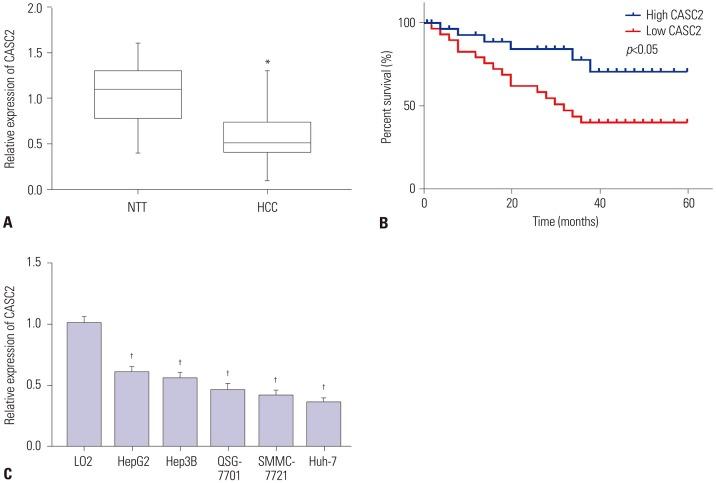
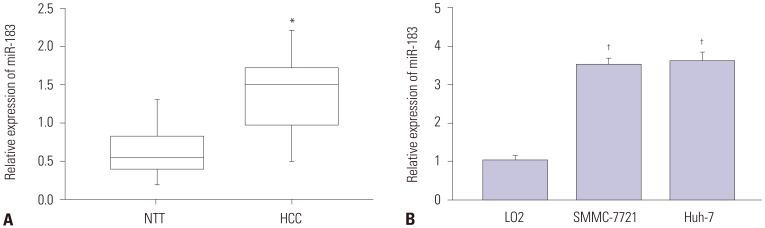
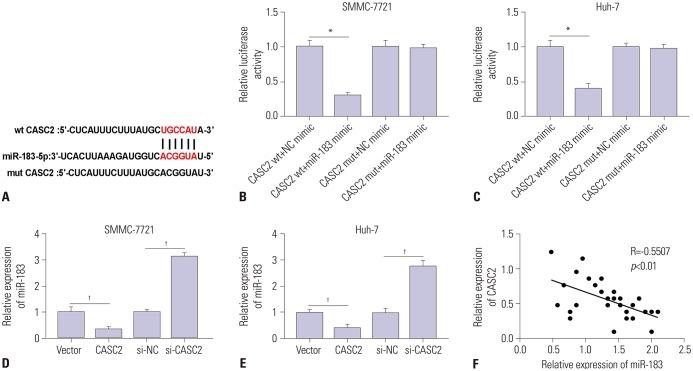
CASC2 was down-regulated in HCC tissues and cell lines, while miR-183 was up-regulated. The expression of miR-183 was negatively correlated with CASC2 expression in HCC tissues. Overexpression of CASC2 inhibited cell viability, colony formation, migration, and invasion in HCC cells, as well as Wnt/β-catenin signaling pathway activity. miR-183 was a downstream target of CASC2 and negatively regulated by CASC2. Introduction of miR-183 rescued CASC2-induced suppressive effects on HCC cell viability, colony formation, migration, and invasion and Wnt/β-catenin signaling.
CONCLUSION
CASC2 inhibited cell viability and the colony formation, migration, and invasion abilities of HCC cells by directly downregulating miR-183 through inactivation of the Wnt/β-catenin signaling pathway.
目的
肝细胞癌(HCC)是最常见的肝实质恶性肿瘤。研究人员报道,长链非编码 RNA 癌症易感性候选基因 2(CASC2)在多种癌症中下调,包括 HCC。本研究旨在探讨 CASC2 在 HCC 中的分子机制。
材料与方法
实时定量 PCR(RT-qPCR)用于分析 HCC 组织和细胞中 CASC2 和 miR-183 的表达。MTT 法检测 HCC SMMC-7721 和 Huh-7 细胞的活力。集落形成实验评估 HCC 细胞的集落形成能力。Transwell 实验评估 HCC 细胞的迁移和侵袭能力。Western blot 检测关键 Wnt/β-catenin 信号通路因子 C-myc、cyclinD、survivin 和 β-catenin 的水平。通过生物信息学分析和荧光素酶报告基因实验证实 CASC2 与 miR-183 的相互作用。
结果
CASC2 在 HCC 组织和细胞系中下调,而 miR-183 上调。CASC2 在 HCC 组织中的表达与 miR-183 的表达呈负相关。CASC2 的过表达抑制 HCC 细胞的活力、集落形成、迁移和侵袭以及 Wnt/β-catenin 信号通路活性。miR-183 是 CASC2 的下游靶基因,并受 CASC2 负调控。miR-183 的引入挽救了 CASC2 对 HCC 细胞活力、集落形成、迁移和侵袭以及 Wnt/β-catenin 信号的抑制作用。
结论
CASC2 通过失活 Wnt/β-catenin 信号通路直接下调 miR-183 抑制 HCC 细胞活力和集落形成、迁移和侵袭能力。



 Zotero 插件