
使用结构磁共振成像和静息态功能磁共振成像识别阿尔茨海默病的早期阶段
Identification of the Early Stage of Alzheimer's Disease Using Structural MRI and Resting-State fMRI.
作者信息
Hojjati Seyed Hani, Ebrahimzadeh Ata, Babajani-Feremi Abbas
机构信息
Department of Pediatrics, University of Tennessee Health Science Center, Memphis, TN, United States.
Department of Electrical Engineering, Babol University of Technology, Babol, Iran.
出版信息
Front Neurol. 2019 Aug 30;10:904. doi: 10.3389/fneur.2019.00904. eCollection 2019.
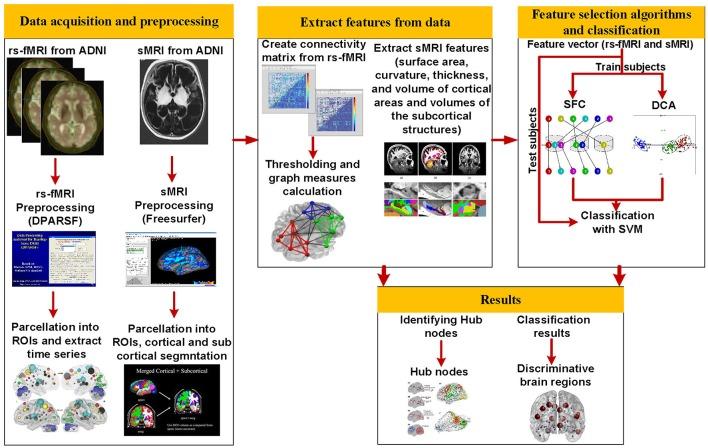
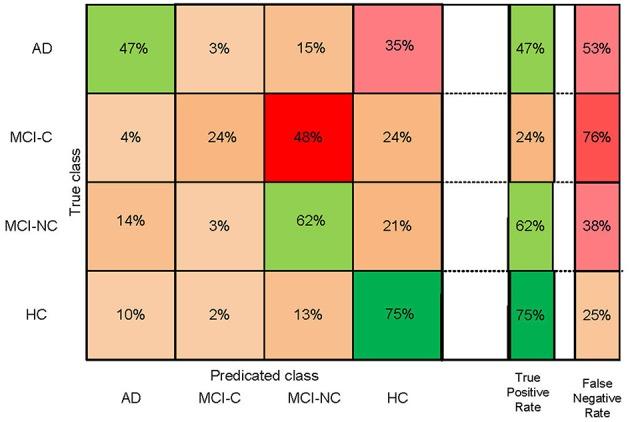
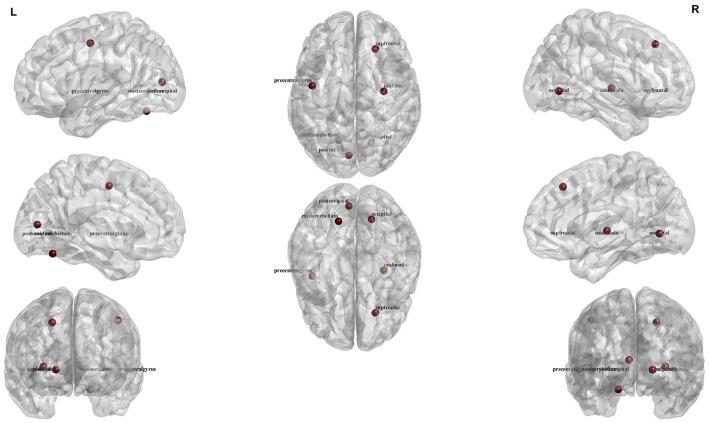
Accurate prediction of the early stage of Alzheimer's disease (AD) is important but very challenging. The goal of this study was to utilize predictors for diagnosis conversion to AD based on integrating resting-state functional MRI (rs-fMRI) connectivity analysis and structural MRI (sMRI). We included 177 subjects in this study and aimed at identifying patients with mild cognitive impairment (MCI) who progress to AD, MCI converter (MCI-C), patients with MCI who do not progress to AD, MCI non-converter (MCI-NC), patients with AD, and healthy controls (HC). The graph theory was used to characterize different aspects of the rs-fMRI brain network by calculating measures of integration and segregation. The cortical and subcortical measurements, e.g., cortical thickness, were extracted from sMRI data. The rs-fMRI graph measures were combined with the sMRI measures to construct input features of a support vector machine (SVM) and classify different groups of subjects. Two feature selection algorithms [i.e., the discriminant correlation analysis (DCA) and sequential feature collection (SFC)] were used for feature reduction and selecting a subset of optimal features. Maximum accuracy of 67 and 56% for three-group ("AD, MCI-C, and MCI-NC" or "MCI-C, MCI-NC, and HC") and four-group ("AD, MCI-C, MCI-NC, and HC") classification, respectively, were obtained with the SFC feature selection algorithm. We also identified hub nodes in the rs-fMRI brain network which were associated with the early stage of AD. Our results demonstrated the potential of the proposed method based on integration of the functional and structural MRI for identification of the early stage of AD.
准确预测阿尔茨海默病(AD)的早期阶段很重要,但极具挑战性。本研究的目的是基于静息态功能磁共振成像(rs-fMRI)连接性分析和结构磁共振成像(sMRI)来利用预测指标诊断向AD的转化。本研究纳入了177名受试者,旨在识别进展为AD的轻度认知障碍(MCI)患者,即MCI转化者(MCI-C)、未进展为AD的MCI患者,即MCI非转化者(MCI-NC)、AD患者以及健康对照(HC)。通过计算整合和分离指标,利用图论来表征rs-fMRI脑网络的不同方面。从sMRI数据中提取皮质和皮质下测量值,例如皮质厚度。将rs-fMRI图指标与sMRI指标相结合,构建支持向量机(SVM)的输入特征,并对不同组别的受试者进行分类。使用两种特征选择算法[即判别相关分析(DCA)和顺序特征收集(SFC)]进行特征约简并选择最优特征子集。使用SFC特征选择算法对三组(“AD、MCI-C和MCI-NC”或“MCI-C、MCI-NC和HC”)和四组(“AD、MCI-C、MCI-NC和HC”)分类分别获得了67%和56%的最大准确率。我们还在rs-fMRI脑网络中识别出了与AD早期阶段相关的枢纽节点。我们的结果证明了基于功能和结构MRI整合的所提出方法在识别AD早期阶段方面的潜力。
 Zotero 插件