
阿加糖酶α-紫外线 A 病原体灭活血小板保存长达 7 天的临床影响。
Clinical impact of amotosalen-ultraviolet A pathogen-inactivated platelets stored for up to 7 days.
机构信息
Regional Blood Transfusion Service, Swiss Red Cross, Basel, Switzerland.
Hematology, University Hospital Basel, University of Basel, Basel, Switzerland.
出版信息
Transfusion. 2019 Nov;59(11):3350-3361. doi: 10.1111/trf.15511. Epub 2019 Oct 1.
BACKGROUND
Universal pathogen inactivation of platelet concentrates (PCs) using amotosalen/ultraviolet A with 7-day storage was implemented in Switzerland in 2011. Routine-use data were analyzed at the University Hospital Basel, Switzerland.
STUDY DESIGN
A retrospective two-cohort study of patient and PC characteristics, component usage, patient outcomes, count increments (CIs), and adverse events were analyzed for two consecutive 5-year periods with either 0- to 5-day-old conventional PC (C-PC) (n = 14,181) or 0- to 7-day-old pathogen-inactivated PC (PI-PC) (n = 22,579).
RESULTS
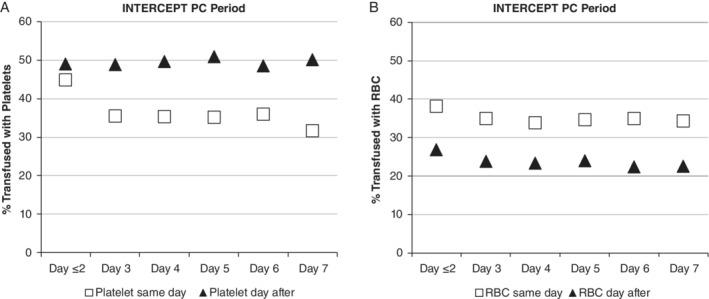
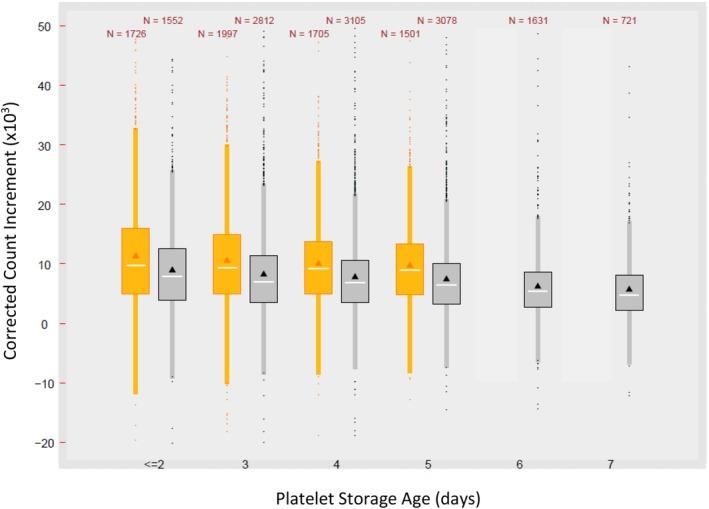
In both periods, PCs were issued for transfusion on a "first in, first out" basis. With 7-day PI-PC, wastage was reduced from 8.7% to 1.5%; 16.6% of transfused PI-PCs were more than 5 days old. Transfusion of PI-PC more than 5 days old compared with 5 days old or less did not increase platelet and RBC use on the same or next day as an indirect measure of hemostasis and did not increase transfusion reactions. Mean corrected count increments (CCIs) for PI-PC stored for 5 days or less were 22.6% lower than for C-PC (p < 0.001), and declined with increasing storage duration for both, although the correlation was weak (r = 0.005-0.014). Mean number of PCs used per patient and duration of PC support were not different for hematology/oncology, allogeneic and autologous hematopoietic stem cell transplant (HSCT), and general medical/surgical patients, who used the majority (~92.0%) of PI-PCs. Five-year treatment-related mortality in allogeneic HSCT was unchanged in the PI-PC period.
CONCLUSIONS
PI-PCs with 7-day storage reduced wastage and did not increase PC or red blood cell utilization or adverse reactions compared with fresh PI-PC or a historical control group, demonstrating preserved efficacy and safety.
背景
2011 年,瑞士采用光照化学法(amotosalen/ultraviolet A)对血小板浓缩物(PC)进行通用病原体灭活处理,并将其储存 7 天。本研究对巴塞尔大学医院的患者和 PC 特征、成分使用、患者结局、血小板计数增加(CCI)和不良事件进行回顾性分析,将连续两个 5 年的数据分为两组,一组为 0-5 天的传统 PC(C-PC)(n=14181),另一组为 0-7 天的病原体灭活 PC(PI-PC)(n=22579)。
研究设计
这是一项回顾性的两队列研究,分析了连续两个 5 年的数据,其中一组为 0-5 天的传统 PC(C-PC)(n=14181),另一组为 0-7 天的病原体灭活 PC(PI-PC)(n=22579)。两组患者的 PC 均按照“先进先出”的原则发放用于输血。采用 7 天的 PI-PC,浪费率从 8.7%降至 1.5%;16.6%的输注 PI-PC 超过 5 天。与 5 天或更短时间的 PI-PC 相比,超过 5 天的 PI-PC 输注不会增加同一天或次日血小板和红细胞的使用,这间接反映了止血效果,也不会增加输血反应。储存 5 天或更短时间的 PI-PC 的平均校正计数增加(CCI)比 C-PC 低 22.6%(p<0.001),并且随着储存时间的延长,CCI 呈下降趋势,尽管相关性较弱(r=0.005-0.014)。血液学/肿瘤学、同种异体和自体造血干细胞移植(HSCT)以及普通内科/外科患者的每位患者使用的 PC 数量和 PC 支持时间没有差异,他们使用了大部分(~92.0%)的 PI-PC。同种异体 HSCT 的 5 年治疗相关死亡率在 PI-PC 期间保持不变。
结论
与新鲜的 PI-PC 或历史对照组相比,7 天储存的 PI-PC 可减少浪费,且不增加 PC 或红细胞的使用量或不良反应,表明其疗效和安全性得以保留。


 Zotero 插件