
洪都拉斯引入7天氨甲环酸/紫外线A光病原体灭活血小板:对中低收入国家血小板供应的影响
Introduction of 7-day amotosalen/ultraviolet A light pathogen-reduced platelets in Honduras: Impact on platelet availability in a lower middle-income country.
作者信息
Pedraza Marcelo, Mejia Julio, Pitman John P, Arriaga Glenda
机构信息
Programa Nacional de Sangre, Cruz Roja Hondureña (Honduran Red Cross [HRC]), Tegucigalpa, Honduras.
Scientific and Medical Affairs, Cerus Corporation, Concord, California, USA.
出版信息
Vox Sang. 2024 Dec;119(12):1268-1277. doi: 10.1111/vox.13740. Epub 2024 Oct 7.
BACKGROUND AND OBJECTIVES
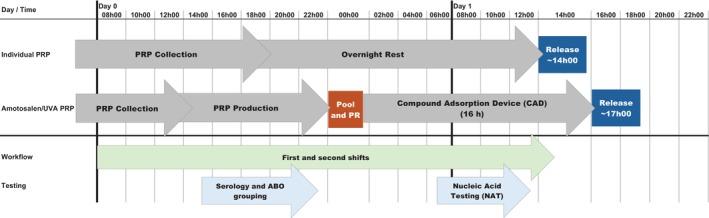
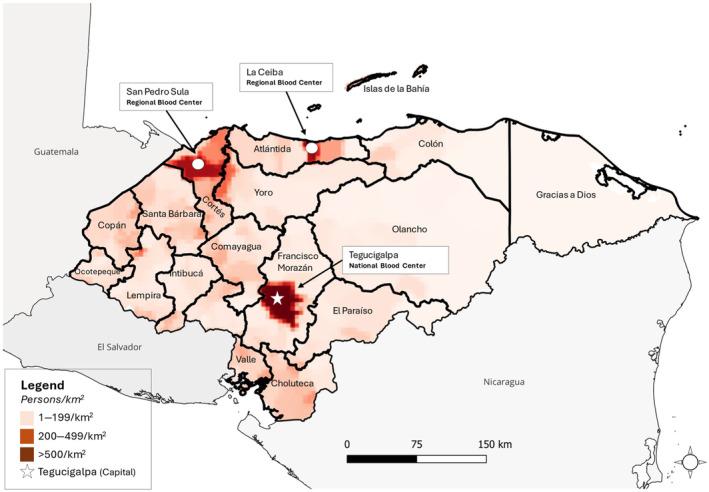
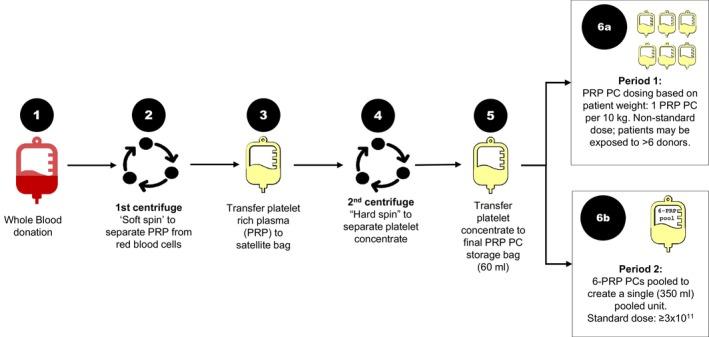
Honduras became the first lower middle-income country (LMIC) to adopt amotosalen/UVA pathogen-reduced (PR) platelet concentrates (PCs) as a national platelet safety measure in 2018. The Honduran Red Cross (HRC) produces ~70% of the national platelet supply using the platelet-rich plasma (PRP) method. Between 2015 and 2018, PCs were screened with bacterial culture and issued as individual, non-pooled PRP units with weight-based dosing and 5-day shelf-life. PR PCs were produced in six-PRP pools with a standardized dose (≥3.0 × 10), no bacterial screening and 7-day shelf-life. Gamma irradiation and leukoreduction were not used.
MATERIALS AND METHODS
PC production and distribution data were retrospectively analysed in two periods. Period 1 (P1) included 3 years of PRP PCs and a transition year (2015-18). Period 2 (P2) included 5 years of PR PCs (2019-23). PC doses were standardized to an equivalent adult dose for both periods. Descriptive statistics were calculated.
RESULTS
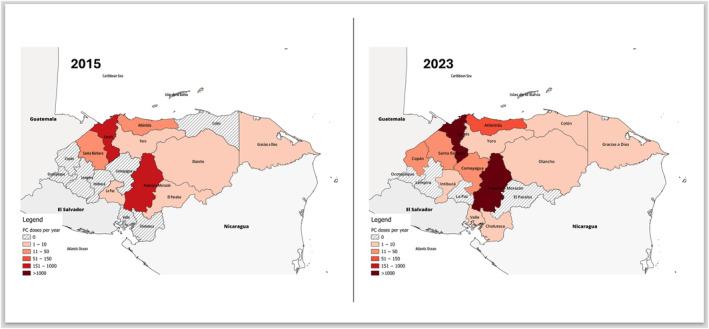
HRC produced 10% more PC doses per year on average in P2 compared to P1. Mean annual waste at HRC declined from 23.9% in P1 to 1.1% in P2. Two urban regions consumed 96% of PC doses in P1 and 88.3% in P2. PC distributions increased in 14/18 regions.
CONCLUSION
Standardized dosage, PR and 7-day shelf-life increased PC availability, reduced waste, eliminated bacterial screening and avoided additional costs for arboviral testing, leukoreduction and irradiation. Access to PC transfusion remains limited in Honduras; however, the conversion to pooled PR PCs illustrates the potential to sustainably expand PC distribution in an LMIC.
背景与目标
洪都拉斯于2018年成为首个采用氨甲环酸/紫外线A病原体灭活(PR)血小板浓缩物(PCs)作为国家血小板安全措施的中低收入国家(LMIC)。洪都拉斯红十字会(HRC)使用富血小板血浆(PRP)方法生产全国约70%的血小板供应。2015年至2018年期间,通过细菌培养对PCs进行筛查,并作为单独的、非混合的PRP单位发放,采用基于体重的剂量和5天保质期。PR PCs以标准化剂量(≥3.0×10)在六个PRP池中生产,不进行细菌筛查,保质期为7天。未使用伽马射线辐照和白细胞去除术。
材料与方法
对两个时期的PC生产和分发数据进行回顾性分析。第1期(P1)包括3年的PRP PCs和一个过渡年(2015 - 18年)。第2期(P2)包括5年的PR PCs(2019 - 23年)。两个时期的PC剂量均标准化为等效成人剂量。计算描述性统计数据。
结果
与P1相比,HRC在P2期间平均每年生产的PC剂量多10%。HRC的年平均浪费率从P1的23.9%降至P2的1.1%。两个城市地区在P1消耗了96%的PC剂量,在P2消耗了88.3%。18个地区中有14个地区的PC分发量增加。
结论
标准化剂量、PR和7天保质期提高了PC的可用性,减少了浪费,消除了细菌筛查,并避免了虫媒病毒检测、白细胞去除术和辐照的额外成本。在洪都拉斯,获得PC输血的机会仍然有限;然而,向混合PR PCs的转变表明了在中低收入国家可持续扩大PC分发的潜力。
 Zotero 插件