
高速力谱学:使用超短悬臂梁进行微秒级力测量。
High-speed force spectroscopy: microsecond force measurements using ultrashort cantilevers.
作者信息
Valotteau Claire, Sumbul Fidan, Rico Felix
机构信息
Aix-Marseille Univ, INSERM, CNRS, LAI, 13009, Marseille, France.
出版信息
Biophys Rev. 2019 Oct;11(5):689-699. doi: 10.1007/s12551-019-00585-4. Epub 2019 Oct 7.
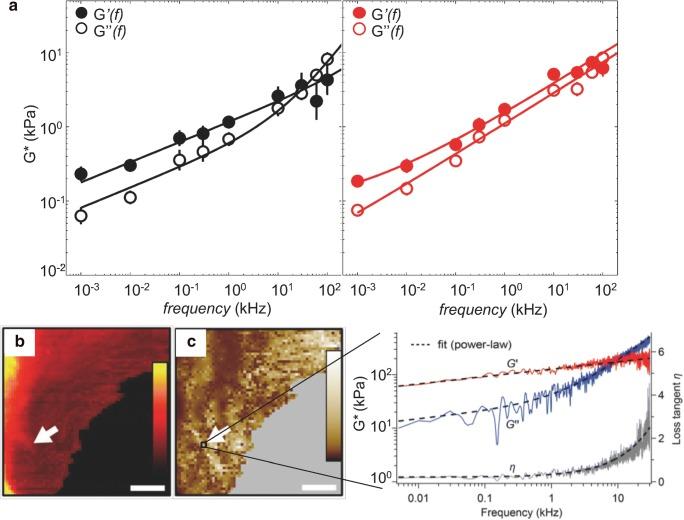
Complete understanding of the role of mechanical forces in biological processes requires knowledge of the mechanical properties of individual proteins and living cells. Moreover, the dynamic response of biological systems at the nano- and microscales span over several orders of magnitude in time, from sub-microseconds to several minutes. Thus, access to force measurements over a wide range of length and time scales is required. High-speed atomic force microscopy (HS-AFM) using ultrashort cantilevers has emerged as a tool to study the dynamics of biomolecules and cells at video rates. The adaptation of HS-AFM to perform high-speed force spectroscopy (HS-FS) allows probing protein unfolding and receptor/ligand unbinding up to the velocity of molecular dynamics (MD) simulations with sub-microsecond time resolution. Moreover, application of HS-FS on living cells allows probing the viscoelastic response at short time scales providing deep understanding of cytoskeleton dynamics. In this mini-review, we assess the principles and recent developments and applications of HS-FS using ultrashort cantilevers to probe molecular and cellular mechanics.
要全面理解机械力在生物过程中的作用,需要了解单个蛋白质和活细胞的力学特性。此外,生物系统在纳米和微米尺度上的动态响应在时间上跨越了几个数量级,从亚微秒到几分钟不等。因此,需要在广泛的长度和时间尺度上进行力测量。使用超短悬臂的高速原子力显微镜(HS-AFM)已成为一种以视频速率研究生物分子和细胞动力学的工具。HS-AFM用于执行高速力谱(HS-FS),能够以亚微秒时间分辨率探测蛋白质解折叠和受体/配体解离,速度可达分子动力学(MD)模拟的速度。此外,将HS-FS应用于活细胞可以在短时间尺度上探测粘弹性响应,从而深入了解细胞骨架动力学。在本综述中,我们评估了使用超短悬臂的HS-FS探测分子和细胞力学的原理、最新进展及应用。


 Zotero 插件