
绝对改善绝经前妇女远处无复发生存率,以指导辅助内分泌治疗:TEXT 和 SOFT 的结果。
Absolute Improvements in Freedom From Distant Recurrence to Tailor Adjuvant Endocrine Therapies for Premenopausal Women: Results From TEXT and SOFT.
机构信息
Institute of Oncology of Southern Switzerland, Geneva University Hospitals, and Swiss Group for Clinical Cancer Research (SAKK), Lugano Viganello, Switzerland.
Peter MacCallum Cancer Center, St Vincent's Hospital, and University of Melbourne, Melbourne, Victoria, Australia.
出版信息
J Clin Oncol. 2020 Apr 20;38(12):1293-1303. doi: 10.1200/JCO.18.01967. Epub 2019 Oct 16.
PURPOSE
The Tamoxifen and Exemestane Trial (TEXT)/Suppression of Ovarian Function Trial (SOFT) showed superior outcomes for premenopausal women with hormone receptor (HR)-positive breast cancer treated with adjuvant exemestane plus ovarian function suppression (OFS) or tamoxifen plus OFS versus tamoxifen alone. We previously reported the magnitude of absolute improvements in freedom from any recurrence across a continuous, composite measure of recurrence risk to tailor decision making. With longer follow-up, we now focus on distant recurrence.
METHODS
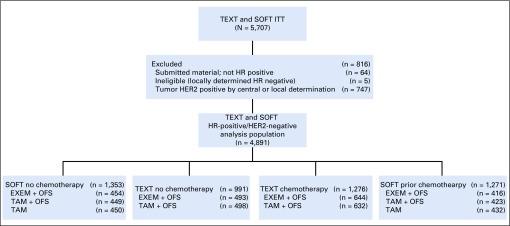
The TEXT/SOFT HR-positive/human epidermal growth factor receptor 2 (HER2)-negative analysis population included 4,891 women stratified by predetermined chemotherapy use. Kaplan-Meier estimates of 8-year freedom from distant recurrence were analyzed using subpopulation treatment effect pattern plot (STEPP) methodology across subpopulations defined by the continuous composite measure of recurrence risk. For each patient, the composite risk value was obtained from a Cox model that incorporated age; nodal status; tumor size; grade; and estrogen receptor, progesterone receptor, and Ki-67 labeling index expression levels.
RESULTS
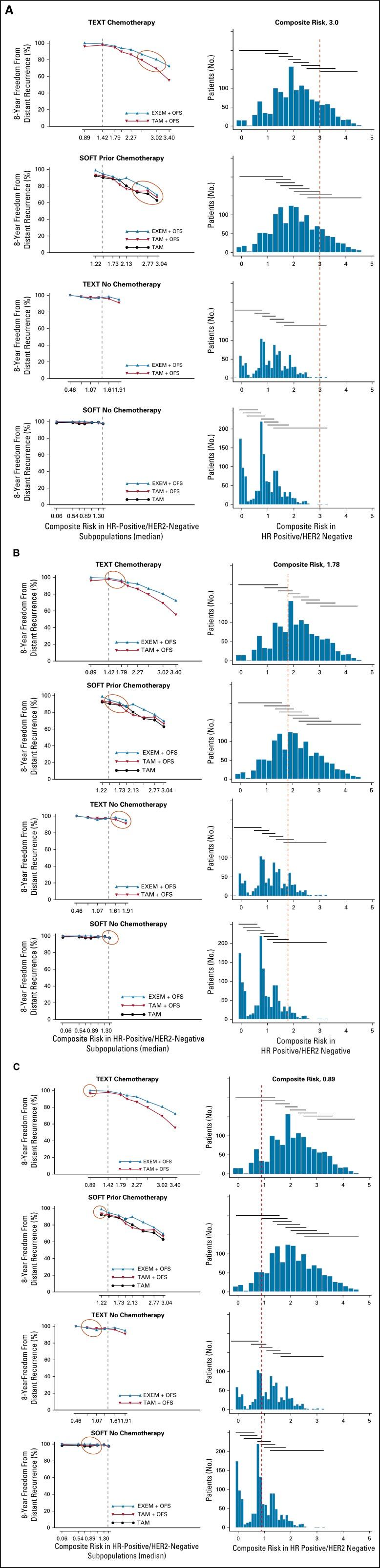
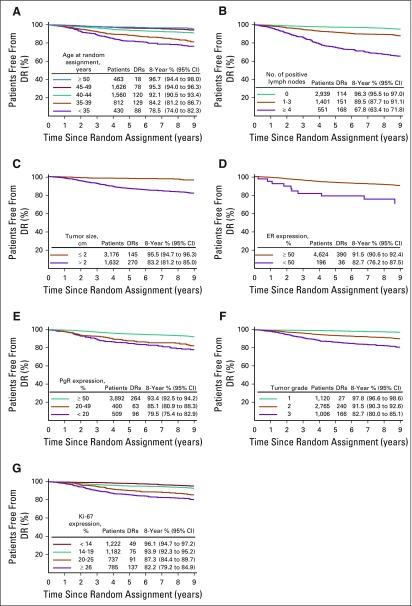
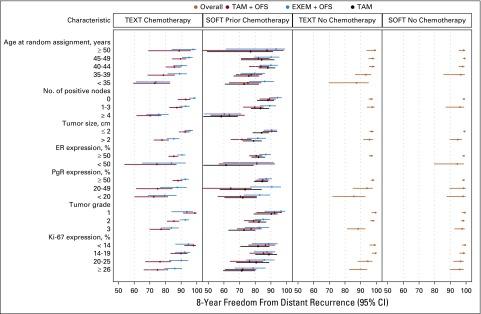
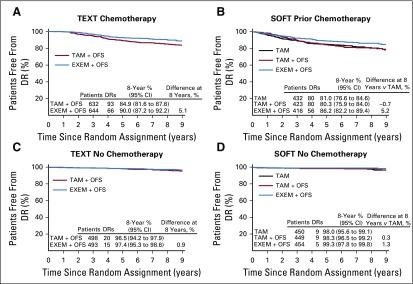
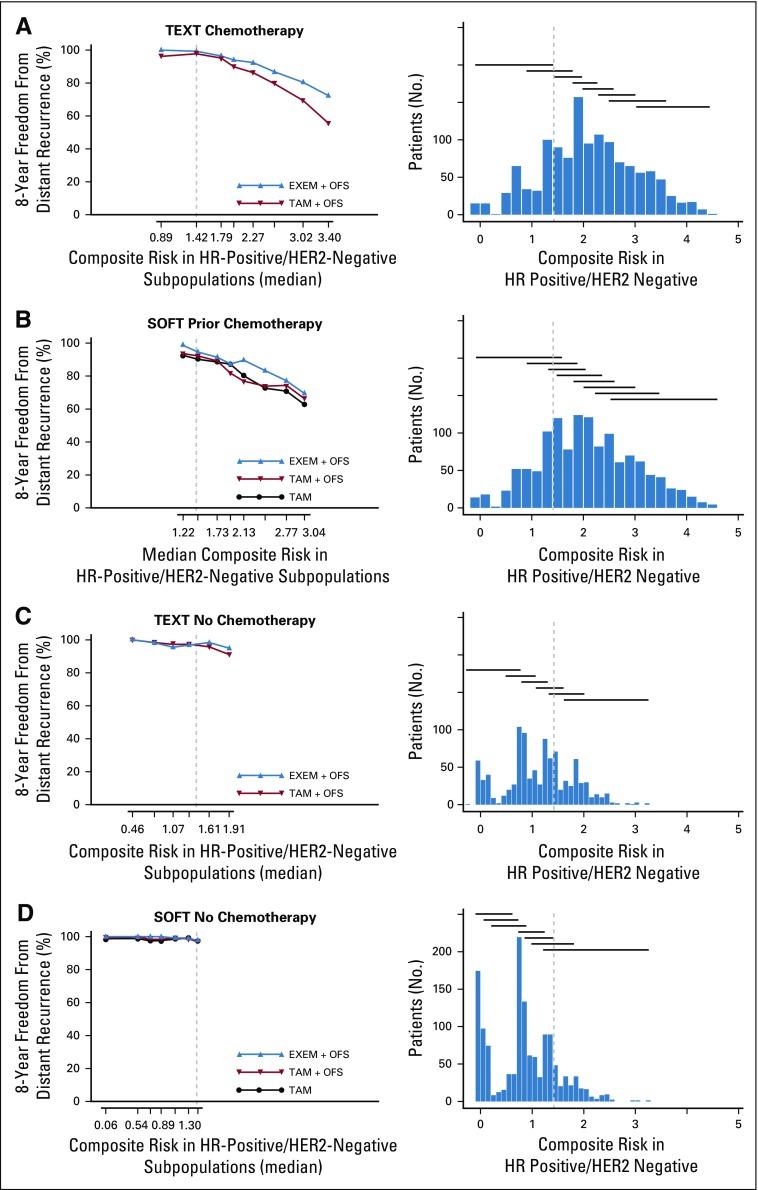
The overall rate of 8-year freedom from distant recurrence was 91.1% and ranged from approximately 100% to 63% across lowest to highest composite risks. TEXT patients who received chemotherapy had an average absolute improvement with exemestane plus OFS versus tamoxifen plus OFS of 5.1%, and STEPP analysis showed improvements from less than 1% to more than 15% from lowest to highest composite risks. SOFT patients who remained premenopausal after chemotherapy had an average 5.2% absolute improvement with exemestane plus OFS versus tamoxifen and reached 10% across composite risks; for tamoxifen plus OFS versus tamoxifen, the maximum improvement was approximately 3.5%. Women who did not receive chemotherapy had a more than 97% rate of 8-year freedom from distant recurrence, and improvements with exemestane plus OFS ranged from 1% to 4%.
CONCLUSION
Premenopausal women with HR-positive/HER2-negative breast cancer and high recurrence risk, as defined by clinicopathologic characteristics, may experience a 10% to 15% absolute improvement in 8-year freedom from distant recurrence with exemestane plus OFS versus tamoxifen plus OFS or tamoxifen alone. The potential benefit of escalating endocrine therapy versus tamoxifen alone is minimal for those at low recurrence risk.
目的
他莫昔芬和依西美坦试验(TEXT)/卵巢功能抑制试验(SOFT)显示,与单独使用他莫昔芬加卵巢功能抑制(OFS)相比,接受辅助依西美坦加 OFS 或他莫昔芬加 OFS 治疗的激素受体(HR)阳性乳腺癌的绝经前妇女有更好的结局。我们之前报告了通过连续、综合复发风险测量来调整决策的无任何复发的绝对改善幅度。随着随访时间的延长,我们现在关注远处复发。
方法
TEXT/SOFT HR 阳性/人表皮生长因子受体 2(HER2)阴性分析人群包括 4891 名按预先确定的化疗使用分层的女性。使用亚组治疗效果模式图(STEPP)方法,根据复发风险的连续综合测量定义的亚组,对 8 年无远处复发的 Kaplan-Meier 估计进行分析。对于每个患者,综合风险值是从一个 Cox 模型中获得的,该模型包含年龄;淋巴结状态;肿瘤大小;分级;以及雌激素受体、孕激素受体和 Ki-67 标记指数表达水平。
结果
8 年无远处复发的总体率为 91.1%,在最低到最高综合风险中从约 100%到 63%不等。接受化疗的 TEXT 患者,与他莫昔芬加 OFS 相比,依西美坦加 OFS 的绝对改善平均为 5.1%,STEPP 分析显示,从最低到最高综合风险,改善从不到 1%到超过 15%。化疗后仍处于绝经前的 SOFT 患者,与他莫昔芬相比,依西美坦加 OFS 的绝对改善平均为 5.2%,在综合风险中达到 10%;对于他莫昔芬加 OFS 与他莫昔芬相比,最大改善约为 3.5%。未接受化疗的女性 8 年无远处复发的比例超过 97%,依西美坦加 OFS 的改善幅度为 1%至 4%。
结论
根据临床病理特征定义的 HR 阳性/HER2 阴性乳腺癌且复发风险高的绝经前妇女,与他莫昔芬加 OFS 或他莫昔芬相比,依西美坦加 OFS 可能使 8 年无远处复发的绝对改善率提高 10%至 15%。对于复发风险较低的患者,升级内分泌治疗与单独使用他莫昔芬相比,潜在获益最小。



 Zotero 插件