
新辅助曲妥珠单抗治疗肿瘤的PD-1相关基因表达特征与HER2阳性乳腺癌患者的生存相关。
PD-1-Associated Gene Expression Signature of Neoadjuvant Trastuzumab-Treated Tumors Correlates with Patient Survival in HER2-Positive Breast Cancer.
作者信息
Hendricks William P D, Briones Natalia, Halperin Rebecca F, Facista Salvatore, Heaton Paul R, Mahadevan Daruka, Kim Suwon
机构信息
Integrated Cancer Genomics Division, Translational Genomics Research Institute, Phoenix, AZ 85004, USA.
Cancer and Cell Biology Division, Translational Genomics Research Institute, Phoenix, AZ 85004, USA.
出版信息
Cancers (Basel). 2019 Oct 15;11(10):1566. doi: 10.3390/cancers11101566.
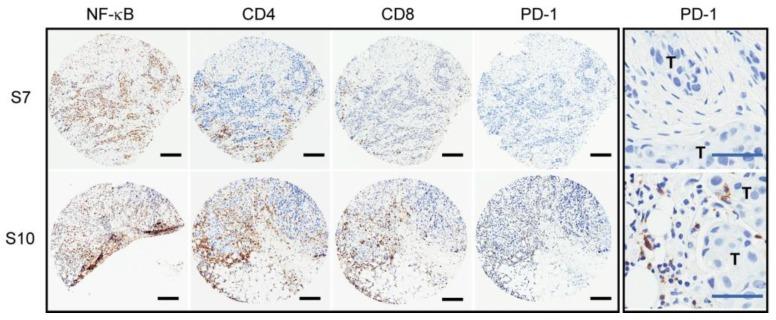
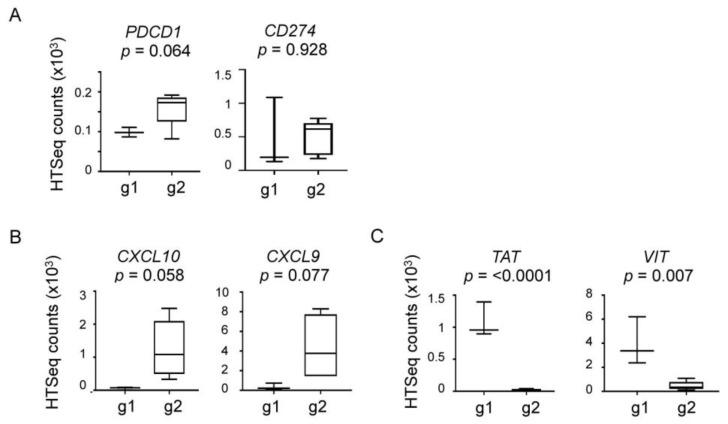
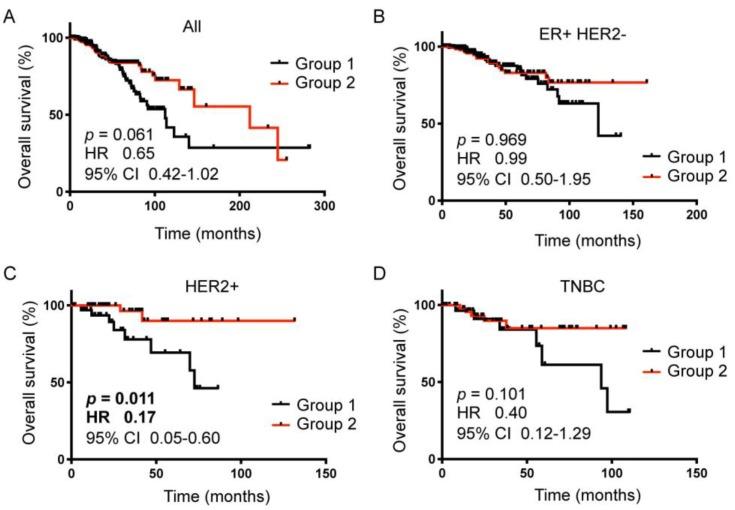
The therapeutic HER2-targeting antibody trastuzumab has been shown to elicit tumor immune response in a subset of HER2-positive (HER2+) breast cancer. We performed genomic and immunohistochemical profiling of tumors from eight patients who have completed multiple rounds of neoadjuvant trastuzumabb to identify predictive biomarkers for trastuzumab-elicited tumor immune responses. Immunohistochemistry showed that all tumors had an activated tumor immune microenvironment positive for nuclear NF-κB/p65RelA, CD4, and CD8 T cell markers, but only four out of eight tumors were positive for the PD-1 immune checkpoint molecule, which is indicative of an exhausted immune environment. Exome sequencing showed no specific driver mutations correlating with PD-1 positivity. Hierarchical clustering of the RNA sequencing data revealed two distinct groups, of which Group 2 represented the PD-1 positive tumors. A gene expression signature that was derived from this clustering composed of 89 genes stratified HER2+ breast cancer patients in the TCGA dataset and it was named PD-1-Associated Gene Expression Signature in HER2+ Breast Cancer (PAGES-HBC). Patients with the Group 2 PAGES-HBC composition had significantly more favorable survival outcomes with mortality reduced by 83% (hazard ratio 0.17; 95% CI, 0.05 to 0.60; = 0.011). Analysis of three longitudinal samples from a single patient showed that PAGES-HBC might be transiently induced by trastuzumab, independent of clonal tumor expansion over time. We conclude that PAGES-HBC could be further developed as a prognostic predictor of trastuzumab response in HER2+ breast cancer patients and be potentially used as an alternative biomarker for anti-PD-1 therapy trials.
治疗性HER2靶向抗体曲妥珠单抗已被证明可在一部分HER2阳性(HER2+)乳腺癌中引发肿瘤免疫反应。我们对8名完成多轮新辅助曲妥珠单抗治疗的患者的肿瘤进行了基因组和免疫组化分析,以确定曲妥珠单抗引发的肿瘤免疫反应的预测生物标志物。免疫组化显示,所有肿瘤均具有激活的肿瘤免疫微环境,核NF-κB/p65RelA、CD4和CD8 T细胞标志物呈阳性,但8个肿瘤中只有4个肿瘤的PD-1免疫检查点分子呈阳性,这表明免疫环境耗竭。外显子组测序未发现与PD-1阳性相关的特定驱动突变。RNA测序数据的层次聚类揭示了两个不同的组,其中第2组代表PD-1阳性肿瘤。从该聚类中得出的一个由89个基因组成的基因表达特征对TCGA数据集中的HER2+乳腺癌患者进行了分层,并将其命名为HER2+乳腺癌中的PD-1相关基因表达特征(PAGES-HBC)。具有第2组PAGES-HBC组成的患者具有明显更好的生存结果,死亡率降低了83%(风险比0.17;95%CI,0.05至0.60;P = 0.011)。对一名患者的三个纵向样本的分析表明,PAGES-HBC可能由曲妥珠单抗短暂诱导,与肿瘤随时间的克隆性扩增无关。我们得出结论,PAGES-HBC可进一步开发为HER2+乳腺癌患者曲妥珠单抗反应的预后预测指标,并有可能用作抗PD-1治疗试验的替代生物标志物。




 Zotero 插件