
伴 NPM1 基因突变的急性髓系白血病的 blast 表型和突变影响疾病生物学和结局。
Blast phenotype and comutations in acute myeloid leukemia with mutated NPM1 influence disease biology and outcome.
机构信息
Department of Pathology, Microbiology, and Immunology, Vanderbilt University Medical Center, Nashville, TN.
Department of Pathology, Massachusetts General Hospital, Harvard Medical School, Boston, MA.
出版信息
Blood Adv. 2019 Nov 12;3(21):3322-3332. doi: 10.1182/bloodadvances.2019000328.
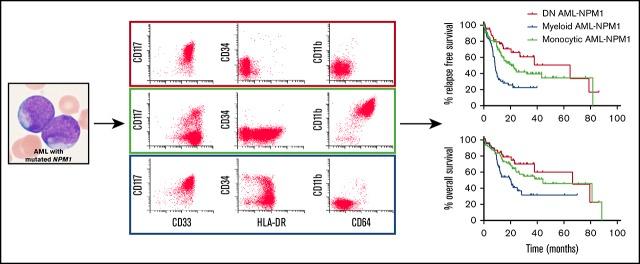
Recent work has identified distinct molecular subgroups of acute myeloid leukemia (AML) with implications for disease classification and prognosis. AML with mutated NPM1 (AML-NPM1) represents a distinct entity in the revised 2017 World Health Organization classification, but relatively little work has examined the clinical significance of phenotypic and genetic heterogeneity within this group. A multi-institutional cohort of 239 AML-NPM1 cases included 3 phenotypic groups: cases with blasts showing monocytic differentiation (n = 93; monocytic AML-NPM1), cases lacking monocytic differentiation (n = 72; myeloid AML-NPM1), and cases where blasts were negative for both CD34 and HLA-DR (n = 74; double-negative [DN] AML-NPM1). Genotypic diversity typical of AML-NPM1 was seen, with comutations occurring most commonly in DNA methylation genes (81% of cases), FLT3 (48%; including internal tandem duplication and tyrosine kinase domain mutations), and RAS pathway genes (30%). However, the comutation pattern differed by blast phenotype. TET2 and IDH1/2 mutations were significantly more common in DN AML-NPM1 (96% of cases) than in myeloid (39%) or monocytic AML-NPM1 (48%; P < .0001). Conversely, DNMT3A mutations were significantly less common in DN AML-NPM1 (27%) than in myeloid (44%) or monocytic cases (54%; P = .002). Furthermore, the 3 phenotypic groups showed significant differences in outcome, with DN AML-NPM1 showing significantly longer relapse-free (RFS) and overall survival (OS) (64.7 and 66.5 months, respectively) than monocytic AML-NPM1 (RFS, 20.6 months; OS, 44.3 months) or myeloid AML-NPM1 (RFS, 8.4 months; OS, 20.2 months; P < .0001 and P = .01 for RFS and OS, respectively). Our findings highlight biologic differences within immunophenotypically defined subgroups of NPM1-mutated AML that may impart prognostic significance.
最近的研究已经确定了急性髓系白血病(AML)的不同分子亚群,这对疾病分类和预后具有重要意义。在修订后的 2017 年世界卫生组织分类中,具有突变型 NPM1 的 AML(AML-NPM1)代表了一个独特的实体,但相对较少的工作研究了该组内表型和遗传异质性的临床意义。一个多机构的 239 例 AML-NPM1 病例队列包括 3 个表型组:具有单核细胞分化特征的原始细胞(n = 93;单核细胞 AML-NPM1)、缺乏单核细胞分化的病例(n = 72;髓系 AML-NPM1)和原始细胞既对 CD34 又对 HLA-DR 呈阴性的病例(n = 74;双阴性 [DN] AML-NPM1)。AML-NPM1 常见的基因型多样性,最常见的是共突变发生在 DNA 甲基化基因(81%的病例)、FLT3(48%;包括内部串联重复和酪氨酸激酶结构域突变)和 RAS 通路基因(30%)。然而,共突变模式因原始细胞表型而异。TET2 和 IDH1/2 突变在 DN AML-NPM1(96%的病例)中比在髓系(39%)或单核细胞 AML-NPM1(48%;P <.0001)中更为常见。相反,DNAML-NPM1 中 DNMT3A 突变明显较少(27%),而在髓系(44%)或单核细胞病例中(54%;P =.002)则更为常见。此外,这 3 个表型组在结局上有显著差异,DN AML-NPM1 的无复发生存(RFS)和总生存(OS)显著延长(分别为 64.7 和 66.5 个月),明显长于单核细胞 AML-NPM1(RFS,20.6 个月;OS,44.3 个月)或髓系 AML-NPM1(RFS,8.4 个月;OS,20.2 个月;P <.0001 和 P =.01 分别用于 RFS 和 OS)。我们的研究结果强调了在免疫表型定义的 NPM1 突变型 AML 亚组内存在生物学差异,这些差异可能具有预后意义。
 Zotero 插件