
通过氦离子束直接写入生长的三维超导纳米螺旋线。
Three-Dimensional Superconducting Nanohelices Grown by He-Focused-Ion-Beam Direct Writing.
作者信息
Córdoba Rosa, Mailly Dominique, Rezaev Roman O, Smirnova Ekaterina I, Schmidt Oliver G, Fomin Vladimir M, Zeitler Uli, Guillamón Isabel, Suderow Hermann, De Teresa José María
机构信息
Instituto de Ciencia de Materiales de Aragón (ICMA) , Universidad de Zaragoza-CSIC , E-50009 Zaragoza , Spain.
Departamento de Física de la Materia Condensada , Universidad de Zaragoza , E-50009 Zaragoza , Spain.
出版信息
Nano Lett. 2019 Dec 11;19(12):8597-8604. doi: 10.1021/acs.nanolett.9b03153. Epub 2019 Nov 25.
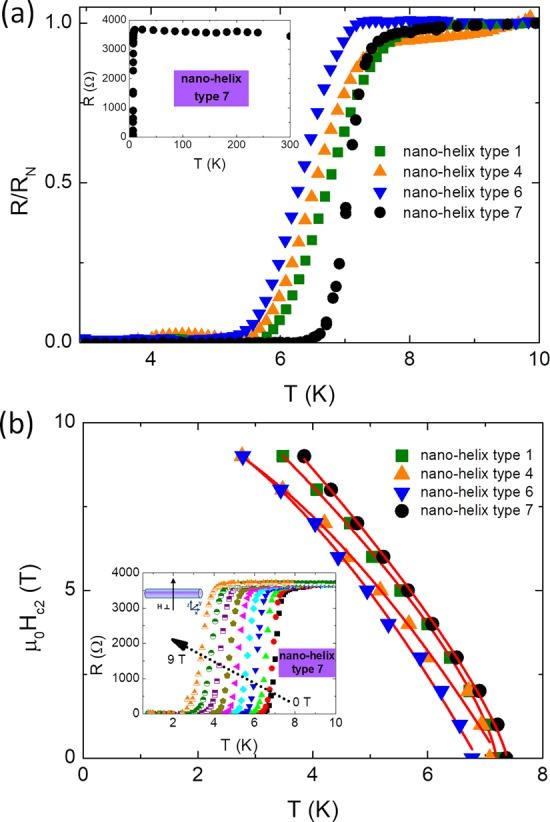
Novel schemes based on the design of complex three-dimensional (3D) nanoscale architectures are required for the development of the next generation of advanced electronic components. He focused-ion-beam (FIB) microscopy in combination with a precursor gas allows one to fabricate 3D nanostructures with an extreme resolution and a considerably higher aspect ratio than FIB-based methods, such as Ga FIB-induced deposition, or other additive manufacturing technologies. In this work, we report the fabrication of 3D tungsten carbide nanohelices with on-demand geometries via controlling key deposition parameters. Our results show the smallest and highest-densely packed nanohelix ever fabricated so far, with dimensions of 100 nm in diameter and aspect ratio up to 65. These nanohelices become superconducting at 7 K and show a large critical magnetic field and critical current density. In addition, given its helical 3D geometry, fingerprints of vortex and phase-slip patterns are experimentally identified and supported by numerical simulations based on the time-dependent Ginzburg-Landau equation. These results can be understood by the helical geometry that induces specific superconducting properties and paves the way for future electronic components, such as sensors, energy storage elements, and nanoantennas, based on 3D compact nanosuperconductors.
下一代先进电子元件的发展需要基于复杂三维(3D)纳米级架构设计的新型方案。聚焦离子束(FIB)显微镜与前驱体气体相结合,能够制造出具有极高分辨率且纵横比远高于基于FIB的方法(如Ga FIB诱导沉积)或其他增材制造技术的3D纳米结构。在这项工作中,我们报告了通过控制关键沉积参数制造具有按需几何形状的3D碳化钨纳米螺旋。我们的结果显示了迄今为止制造的最小且排列最密集的纳米螺旋,其直径为100 nm,纵横比高达65。这些纳米螺旋在7 K时变为超导,表现出大的临界磁场和临界电流密度。此外,鉴于其螺旋3D几何形状,通过基于含时金兹堡 - 朗道方程的数值模拟,在实验上识别并支持了涡旋和相位滑移模式的特征。这些结果可以通过诱导特定超导特性的螺旋几何形状来理解,并为基于3D紧凑纳米超导体的未来电子元件(如传感器、储能元件和纳米天线)铺平了道路。



 Zotero 插件