
基于 WGS 的肠炎沙门氏菌血清型婴儿亚种的群体结构研究。
WGS based study of the population structure of Salmonella enterica serovar Infantis.
机构信息
Department of Bacteria, Parasites and Fungi, Statens Serum Institut, Copenhagen, Artillerivej 5, Denmark.
Department of Veterinary and Animal Sciences, University of Copenhagen, Stigbøjlen 4, Frederiksberg C, Denmark.
出版信息
BMC Genomics. 2019 Nov 15;20(1):870. doi: 10.1186/s12864-019-6260-6.
BACKGROUND
Salmonella Infantis (S. Infantis) is one of the most frequent Salmonella serovars isolated from human cases of salmonellosis and the most detected serovar from animal and food sources in Europe. The serovar is commonly associated with poultry and there is increasing concern over multidrug resistant clones spreading worldwide, as the dominating clones are characterized by presence of large plasmids carrying multiple resistance genes. Increasing the knowledge of the S. Infantis population and evolution is important for understanding and preventing further spread. In this study, we analysed a collection of strains representing different decades, sources and geographic locations. We analysed the population structure and the accessory genome, in particular we identified prophages with a view to understand the role of prophages in relation to the evolution of this serovar.
RESULTS
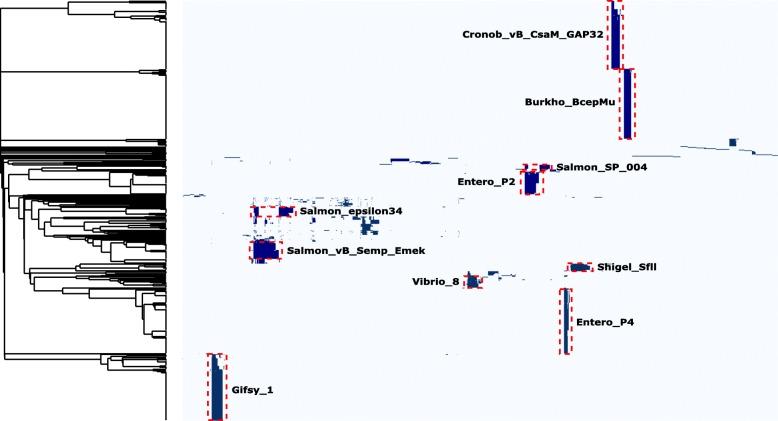
We sequenced a global collection of 100 S. Infantis strains. A core-genome SNP analysis separated five strains in e-Burst Group (eBG) 297 with a long branch. The remaining strains, all in eBG31, were divided into three lineages that were estimated to have separated approximately 150 years ago. One lineage contained the vast majority of strains. In five of six clusters, no obvious correlation with source or geographical locations was seen. However, one cluster contained mostly strains from human and avian sources, indicating a clone with preference for these sources. The majority of strains within this cluster harboured a pESI-like plasmid with multiple resistance genes. Another lineage contained three genetic clusters with more rarely isolated strains of mainly animal origin, possibly less sampled or less infectious clones. Conserved prophages were identified in all strains, likely representing bacteriophages which integrated into the chromosome of a common ancestor to S. Infantis. We also saw that some prophages were specific to clusters and were probably introduced when the clusters were formed.
CONCLUSIONS
This study analysed a global S. Infantis population and described its genetic structure. We hypothesize that the population has evolved in three separate lineages, with one more successfully emerging lineage. We furthermore detected conserved prophages present in the entire population and cluster specific prophages, which probably shaped the population structure.
背景
婴儿沙门氏菌(S. Infantis)是从人类沙门氏菌病病例中分离出的最常见的沙门氏菌血清型之一,也是欧洲动物和食品源中检测到的最常见的血清型。该血清型通常与家禽有关,人们越来越担心在全球范围内传播的多药耐药克隆,因为占主导地位的克隆的特点是存在携带多个耐药基因的大型质粒。增加对 S. Infantis 群体和进化的了解对于理解和防止进一步传播很重要。在这项研究中,我们分析了一组代表不同年代、来源和地理位置的菌株。我们分析了群体结构和附属基因组,特别是我们确定了噬菌体,以了解噬菌体在该血清型进化中的作用。
结果
我们对 100 株 S. Infantis 菌株进行了测序。全基因组 SNP 分析将 5 株分为 e-Burst Group(eBG)297 组,其分支较长。其余菌株均属于 eBG31,分为三个谱系,估计大约在 150 年前就已经分离。一个谱系包含了绝大多数菌株。在六个聚类中的五个聚类中,没有明显的来源或地理位置相关性。然而,一个聚类包含了大多数来自人类和禽类的菌株,表明该克隆对这些来源有偏好。该聚类中的大多数菌株携带一个带有多个耐药基因的 pESI 样质粒。另一个谱系包含三个遗传聚类,主要是动物来源的菌株,可能是采样较少或传染性较低的克隆。所有菌株均鉴定出保守的噬菌体,可能代表整合到 S. Infantis 共同祖先染色体中的噬菌体。我们还发现,一些噬菌体是特定于聚类的,可能是在聚类形成时引入的。
结论
本研究分析了全球 S. Infantis 种群并描述了其遗传结构。我们假设该种群是在三个独立的谱系中进化的,其中一个更成功的谱系出现了。我们还检测到了存在于整个种群中的保守噬菌体和聚类特异性噬菌体,这可能塑造了种群结构。

 Zotero 插件