
硒在骨肉瘤中的新兴抗癌潜力。
Emerging Anticancer Potentials of Selenium on Osteosarcoma.
机构信息
Department of Pharmacology, Faculty of Medicine, Universiti Kebangsaan Malaysia, Cheras, Kuala Lumpur 56000, Malaysia.
出版信息
Int J Mol Sci. 2019 Oct 25;20(21):5318. doi: 10.3390/ijms20215318.
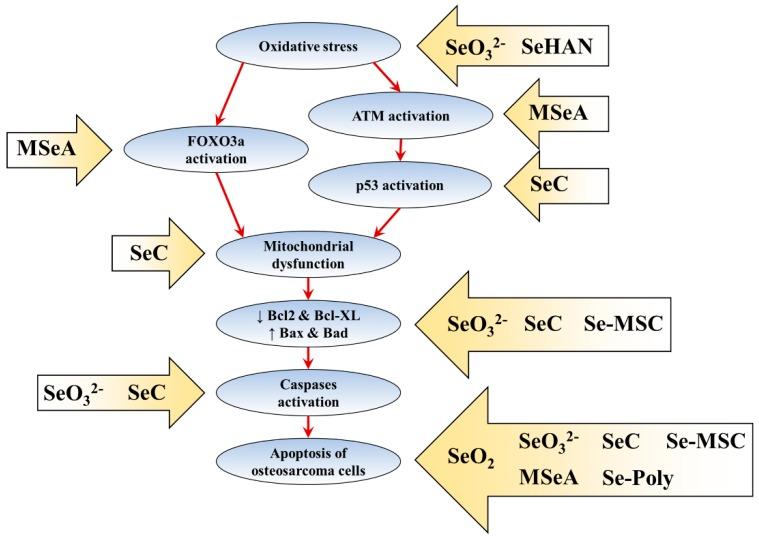
Selenium is a trace element essential to humans and forms complexes with proteins, which exert physiological functions in the body. In vitro studies suggested that selenium possesses anticancer effects and may be effective against osteosarcoma. This review aims to summarise current evidence on the anticancer activity of inorganic and organic selenium on osteosarcoma. Cellular studies revealed that inorganic and organic selenium shows cytotoxicity, anti-proliferative and pro-apoptotic effects on various osteosarcoma cell lines. These actions may be mediated by oxidative stress induced by selenium compounds, leading to the activation of p53, proapoptotic proteins and caspases. Inorganic selenium is selective towards cancer cells, but can cause non-selective cell death at a high dose. This condition challenges the controlled release of selenium from biomaterials. Selenium treatment in animals inoculated with osteosarcoma reduced the tumour size, but did not eliminate the incidence of osteosarcoma. Only one study investigated the relationship between selenium and osteosarcoma in humans, but the results were inconclusive. In summary, although selenium may exert anticancer properties on osteosarcoma in experimental model systems, its effects in humans require further investigation.
硒是人体必需的微量元素,与蛋白质形成复合物,在体内发挥生理功能。体外研究表明,硒具有抗癌作用,可能对骨肉瘤有效。本综述旨在总结无机硒和有机硒对骨肉瘤的抗癌活性的现有证据。细胞研究表明,无机硒和有机硒对各种骨肉瘤细胞系均表现出细胞毒性、抗增殖和促凋亡作用。这些作用可能是由硒化合物诱导的氧化应激介导的,导致 p53、促凋亡蛋白和半胱天冬酶的激活。无机硒对癌细胞具有选择性,但在高剂量下会引起非选择性细胞死亡。这种情况对硒从生物材料中的控制释放提出了挑战。用硒处理接种骨肉瘤的动物可减少肿瘤大小,但不能消除骨肉瘤的发生率。只有一项研究调查了硒与人类骨肉瘤之间的关系,但结果尚无定论。总之,尽管硒在实验模型系统中可能对骨肉瘤具有抗癌特性,但它在人类中的作用仍需要进一步研究。
 Zotero 插件