
生活方式干预对阿拉伯前驱糖尿病患者血糖、微量营养素和矿物质指标的改善作用。
Improvements in Glycemic, Micronutrient, and Mineral Indices in Arab Adults with Pre-Diabetes Post-Lifestyle Modification Program.
机构信息
Department of Food Science and Nutrition, College of Food Science and Agriculture King Saud University, Riyadh 12372, Saudi Arabia.
Biochemistry Department, College of Science, King Saud University, Riyadh 11451, Saudi Arabia.
出版信息
Nutrients. 2019 Nov 15;11(11):2775. doi: 10.3390/nu11112775.
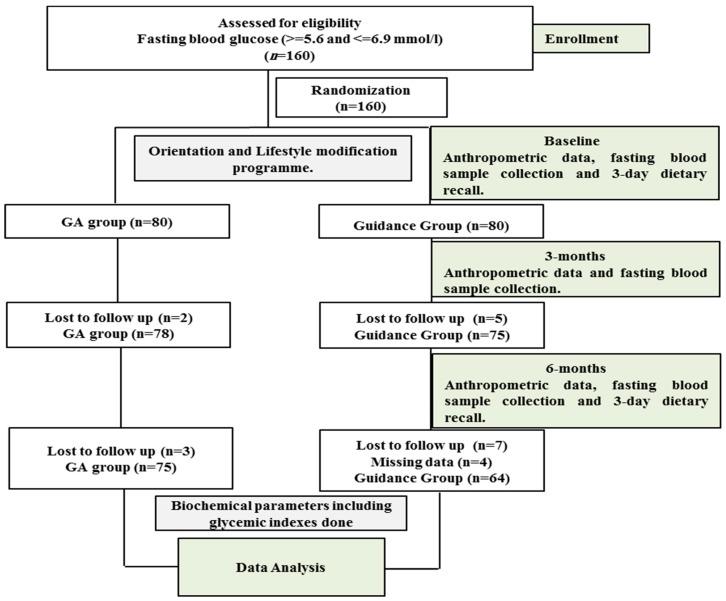
The present study aimed to investigate the changes in dietary patterns of adult Saudis with prediabetes who underwent a six-month lifestyle modification program. A total of 160 Saudis with prediabetes (baseline fasting glucose 5.6-6.9 mmol/L), aged 20-60 years, were enrolled in one of the two arms: A one-time general advice about lifestyle modification (GA group) at orientation or a well-structured and monitored nutrition and lifestyle counseling for six months (guidance group). Fasting blood samples and a dietary recall for daily intakes of macro/micronutrients using a validated computerized food database "ESHA-the Food Processor Nutrition Analysis program" were collected pre- and post-intervention. Compliance to reference daily intake (RDI) was also calculated at both time points. At baseline, overall, severe deficiencies in the majority of micronutrient intakes were observed. Post intervention, clinically significant improvements in the glycemic indices (fasting glucose and insulin resistance) were seen over time in the guidance group. Also, significant improvements in dietary habits and physical activity levels were more apparent in the guidance group than the GA group, particularly in the daily intakes of total carbohydrate (46.9% compliance post vs. 20.3% at baseline); dietary fiber (21.9% vs. 3.1%); and some micronutrients like vitamin B6 (21.3% vs. 6.7%), vitamin B12 (45.3% vs. 28%), vitamin C (21.9% vs. 7.8%), riboflavin (40% vs. 10.7%), niacin (41.3% vs. 14.7%), magnesium (18.8% vs. 4.7%), iron (54.7% vs. 34.4%), and copper (37.3% vs. 13.3%). The study highlights the effects of a six-month lifestyle modification program in improving dietary micronutrient intakes of Saudis with prediabetes. Since micronutrient intake was observed to be low, fortification of these micronutrients in the Saudi diet is recommended.
本研究旨在探讨经过六个月生活方式改变方案后,患有前驱糖尿病的沙特成年人饮食模式的变化。共有 160 名年龄在 20-60 岁之间、空腹血糖在 5.6-6.9mmol/L 的沙特前驱糖尿病患者被纳入以下两个方案中的一个:在定向阶段接受一次关于生活方式改变的一般性建议(GA 组),或接受为期六个月的结构化和监测的营养和生活方式咨询(指导组)。在干预前后,采集空腹血样并通过验证的计算机化食物数据库“ESHA-the Food Processor Nutrition Analysis program”进行每日宏量/微量营养素摄入量的饮食回忆。还在两个时间点计算了对参考日摄入量(RDI)的依从性。在基线时,观察到大多数微量营养素摄入严重不足。随着时间的推移,指导组的血糖指数(空腹血糖和胰岛素抵抗)得到了显著改善。此外,与 GA 组相比,指导组的饮食习惯和身体活动水平的显著改善更为明显,尤其是在总碳水化合物的每日摄入量(干预后为 46.9%,而基线时为 20.3%);膳食纤维(21.9%比 3.1%);以及一些微量营养素,如维生素 B6(21.3%比 6.7%)、维生素 B12(45.3%比 28%)、维生素 C(21.9%比 7.8%)、核黄素(40%比 10.7%)、烟酸(41.3%比 14.7%)、镁(18.8%比 4.7%)、铁(54.7%比 34.4%)和铜(37.3%比 13.3%)。本研究强调了六个月生活方式改变方案对改善前驱糖尿病沙特人的饮食微量营养素摄入的影响。由于观察到微量营养素摄入较低,建议在沙特饮食中强化这些微量营养素。
 Zotero 插件