
青少年时期认知控制中习得价值转移的神经发育转变。
Neurodevelopmental shifts in learned value transfer on cognitive control during adolescence.
机构信息
Department of Psychology and Center for Brain Science, Harvard University, Cambridge, MA, USA.
Department of Psychology and Center for Brain Science, Harvard University, Cambridge, MA, USA.
出版信息
Dev Cogn Neurosci. 2019 Dec;40:100730. doi: 10.1016/j.dcn.2019.100730. Epub 2019 Nov 6.
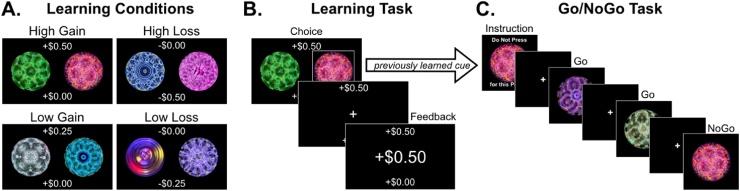
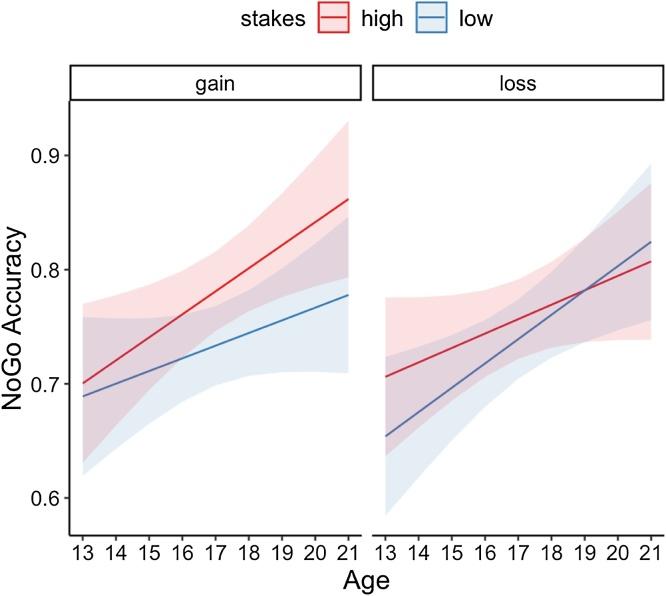
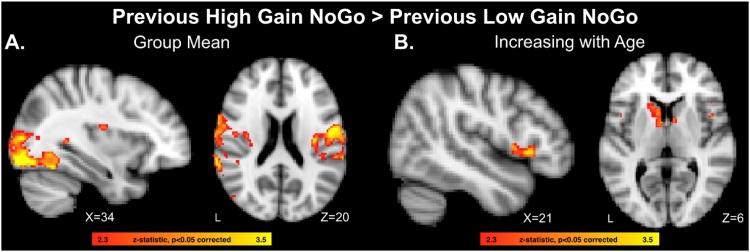
Value-associated cues in the environment often enhance subsequent goal-directed behaviors in adults, a phenomenon supported by the integration of motivational and cognitive neural systems. Given that the interactions among these systems change throughout adolescence, we tested when the beneficial effects of value associations on subsequent cognitive control performance emerge during adolescence. Participants (N = 81) aged 13-20 completed a reinforcement learning task with four cue-incentive pairings that could yield high gain, low gain, high loss, or low loss outcomes. Next, participants completed a Go/NoGo task during fMRI where the NoGo targets comprised the previously learned cues, which tested how prior value associations influence cognitive control performance. Improved accuracy for previously learned high gain relative to low gain cues emerged with age. Older adolescents exhibited enhanced recruitment of the dorsal striatum and ventrolateral prefrontal cortex during cognitive control execution to previously learned high gain relative to low gain cues. Older adolescents also expressed increased coupling between the dorsal striatum and dorsolateral prefrontal cortex for high gain cues, whereas younger adolescents expressed increased coupling between the striatum and ventromedial prefrontal cortex. These findings reveal that learned high value cue-incentive associations enhance cognitive control in late adolescence in parallel with value-selective recruitment of corticostriatal systems.
环境中的价值相关线索通常会增强成年人随后的目标导向行为,这一现象得到了动机和认知神经系统整合的支持。鉴于这些系统之间的相互作用在青少年时期发生变化,我们测试了价值关联对随后认知控制表现的有益影响在青少年时期何时出现。参与者(N=81)年龄在 13 到 20 岁之间,完成了一个强化学习任务,其中有四个线索-激励配对可以产生高收益、低收益、高损失或低损失的结果。接下来,参与者在 fMRI 期间完成了一个 Go/NoGo 任务,其中 NoGo 目标包括之前学习过的线索,这测试了先前的价值关联如何影响认知控制表现。与低收益线索相比,先前学习的高收益线索的准确性随着年龄的增长而提高。与低收益线索相比,年龄较大的青少年在执行认知控制时,背侧纹状体和腹外侧前额叶皮层的招募增强,表现出更高的认知控制能力。与低收益线索相比,年龄较大的青少年在高收益线索时还表现出背侧纹状体和背外侧前额叶皮层之间的耦合增加,而年龄较小的青少年则表现出纹状体和腹内侧前额叶皮层之间的耦合增加。这些发现表明,学习到的高价值线索激励关联在青少年晚期与价值选择性招募皮质纹状体系统一起增强了认知控制。

 Zotero 插件