
北欧国家的预期寿命和疾病负担:来自 2017 年全球疾病、伤害和危险因素研究的结果。
Life expectancy and disease burden in the Nordic countries: results from the Global Burden of Diseases, Injuries, and Risk Factors Study 2017.
出版信息
Lancet Public Health. 2019 Dec;4(12):e658-e669. doi: 10.1016/S2468-2667(19)30224-5. Epub 2019 Nov 20.
BACKGROUND
The Nordic countries have commonalities in gender equality, economy, welfare, and health care, but differ in culture and lifestyle, which might create country-wise health differences. This study compared life expectancy, disease burden, and risk factors in the Nordic region.
METHODS
Life expectancy in years and age-standardised rates of overall, cause-specific, and risk factor-specific estimates of disability-adjusted life-years (DALYs) were analysed in the Global Burden of Diseases, Injuries, and Risk Factors Study (GBD) 2017. Data were extracted for Denmark, Finland, Iceland, Norway, and Sweden (ie, the Nordic countries), and Greenland, an autonomous area of Denmark. Estimates were compared with global, high-income region, and Nordic regional estimates, including Greenland.
FINDINGS
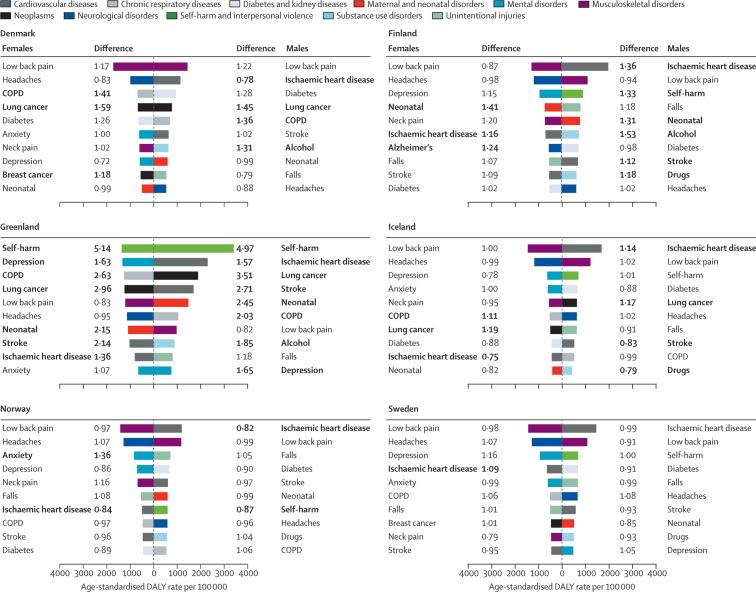
All Nordic countries exceeded the global life expectancy; in 2017, the highest life expectancy was in Iceland among females (85·9 years [95% uncertainty interval [UI] 85·5-86·4] vs 75·6 years [75·3-75·9] globally) and Sweden among males (80·8 years [80·2-81·4] vs 70·5 years [70·1-70·8] globally). Females (82·7 years [81·9-83·4]) and males (78·8 years [78·1-79·5]) in Denmark and males in Finland (78·6 years [77·8-79·2]) had lower life expectancy than in the other Nordic countries. The lowest life expectancy in the Nordic region was in Greenland (females 77·2 years [76·2-78·0], males 70·8 years [70·3-71·4]). Overall disease burden was lower in the Nordic countries than globally, with the lowest age-standardised DALY rates among Swedish males (18 555·7 DALYs [95% UI 15 968·6-21 426·8] per 100 000 population vs 35 834·3 DALYs [33 218·2-38 740·7] globally) and Icelandic females (16 074·1 DALYs [13 216·4-19 240·8] vs 29 934·6 DALYs [26 981·9-33 211·2] globally). Greenland had substantially higher DALY rates (26 666·6 DALYs [23 478·4-30 218·8] among females, 33 101·3 DALYs [30 182·3-36 218·6] among males) than the Nordic countries. Country variation was primarily due to differences in causes that largely contributed to DALYs through mortality, such as ischaemic heart disease. These causes dominated male disease burden, whereas non-fatal causes such as low back pain were important for female disease burden. Smoking and metabolic risk factors were high-ranking risk factors across all countries. DALYs attributable to alcohol use and smoking were particularly high among the Danes, as was alcohol use among Finnish males.
INTERPRETATION
Risk factor differences might drive differences in life expectancy and disease burden that merit attention also in high-income settings such as the Nordic countries. Special attention should be given to the high disease burden in Greenland.
FUNDING
Bill & Melinda Gates Foundation. The work on this paper was supported by the Research Council of Norway through FRIPRO (project number 262030) and by the Norwegian Institute of Public Health.
背景
北欧国家在性别平等、经济、福利和医疗保健方面具有共同性,但在文化和生活方式上存在差异,这可能导致各国的健康状况存在差异。本研究比较了北欧地区的预期寿命、疾病负担和风险因素。
方法
在全球疾病、伤害和风险因素研究(GBD)2017 中,分析了丹麦、芬兰、冰岛、挪威和瑞典(即北欧国家)以及丹麦的自治领土格陵兰的数据,以了解预期寿命和年龄标准化的全因、病因特异性和风险因素特异性残疾调整生命年(DALY)的发生率。将估计结果与全球、高收入地区和包括格陵兰在内的北欧地区的估计结果进行了比较。
结果
所有北欧国家的预期寿命均高于全球水平;2017 年,女性的最高预期寿命是冰岛(85.9 岁[95%置信区间(CI)85.5-86.4]比全球的 75.6 岁[75.3-75.9]高),男性的最高预期寿命是瑞典(80.8 岁[80.2-81.4]比全球的 70.5 岁[70.1-70.8]高)。丹麦的女性(82.7 岁[81.9-83.4])和男性(78.8 岁[78.1-79.5])以及芬兰的男性(78.6 岁[77.8-79.2])的预期寿命低于其他北欧国家。北欧地区的最低预期寿命是格陵兰(女性 77.2 岁[76.2-78.0],男性 70.8 岁[70.3-71.4])。北欧国家的疾病总负担低于全球水平,瑞典男性的年龄标准化 DALY 率最低(每 10 万人 18 555.7 DALY[95%CI 15 968.6-21 426.8],全球为 35 834.3 DALY[33 218.2-38 740.7]),冰岛女性的年龄标准化 DALY 率最低(每 10 万人 16 074.1 DALY[13 216.4-19 240.8],全球为 29 934.6 DALY[26 981.9-33 211.2])。格陵兰的 DALY 率明显高于北欧国家(女性 26 666.6 DALY[23 478.4-30 218.8],男性 33 101.3 DALY[30 182.3-36 218.6])。国家间的差异主要是由于通过死亡率对 DALY 产生主要影响的疾病原因造成的,例如缺血性心脏病。这些原因主导了男性的疾病负担,而非致命性原因,如腰痛,对女性的疾病负担很重要。吸烟和代谢风险因素是所有国家的高排名风险因素。在所有国家中,与酒精使用和吸烟有关的 DALY 归因风险都很高,丹麦人尤其如此,芬兰男性的酒精使用也很高。
解释
风险因素的差异可能导致预期寿命和疾病负担的差异,这些差异值得在高收入环境中,如北欧国家,引起关注。特别应该注意格陵兰的高疾病负担。
资金
比尔及梅琳达·盖茨基金会。本文的研究工作得到了挪威研究理事会的支持,通过 FRIPRO(项目编号 262030)和挪威公共卫生研究所资助。


 Zotero 插件